LRC Circuit¤
Introduction¤
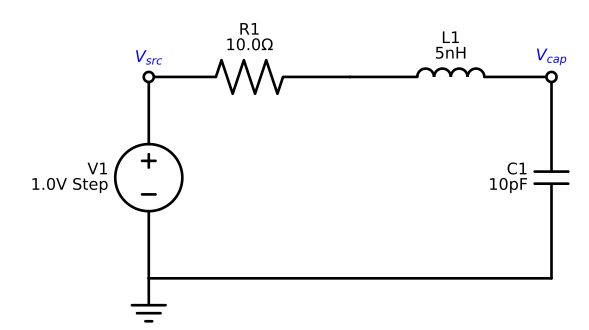
In this example, we simulate a classical Series RLC Circuit operating in the Gigahertz (RF) regime. The circuit consists of a voltage source, a resistor (\(10\Omega\)), an inductor (\(5\text{nH}\)), and a capacitor (\(10\text{pF}\)) connected in series.
The behavior of the circuit is determined by the relationship between the resistance (\(R\)) and the critical damping resistance, defined as $ R_{c} = 2\sqrt{L/C}$
For this specific configuration:
- Critical Resistance (\(R_c\)): \(2\sqrt{L/C} \approx 44.7\Omega\).
- Actual Resistance (\(R\)): \(10\Omega\).
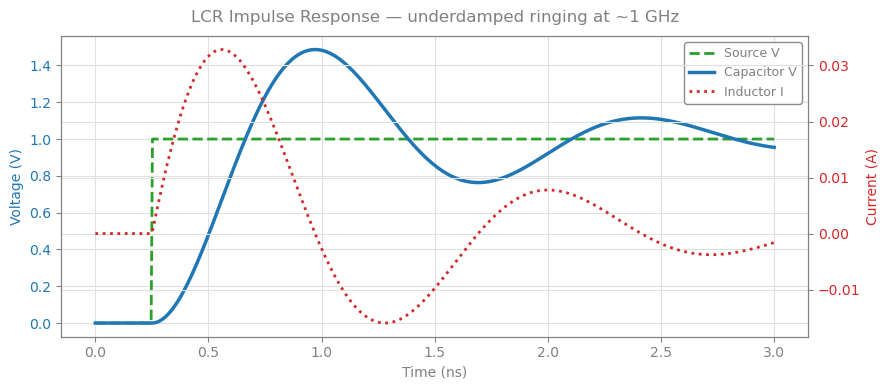
Since \(R < R_c\), the system is underdamped. When the voltage source is activated, energy oscillates—or "sloshes"—between the inductor’s magnetic field and the capacitor’s electric field. This creates a characteristic "ringing" effect (transient oscillation) that gradually decays as the resistor dissipates the energy as heat.
import diffrax
import jax
import jax.numpy as jnp
import matplotlib.pyplot as plt

from circulax import compile_circuit
from circulax.components.electronic import Capacitor, Inductor, Resistor, VoltageSource
net_dict = {
    "instances": {
        "GND": {"component": "ground"},
        "V1": {"component": "source_voltage", "settings": {"V": 1.0, "delay": 0.25e-9}},
        "R1": {"component": "resistor", "settings": {"R": 10.0}},
        "C1": {"component": "capacitor", "settings": {"C": 1e-11}},
        "L1": {"component": "inductor", "settings": {"L": 5e-9}},
    },
    "connections": {
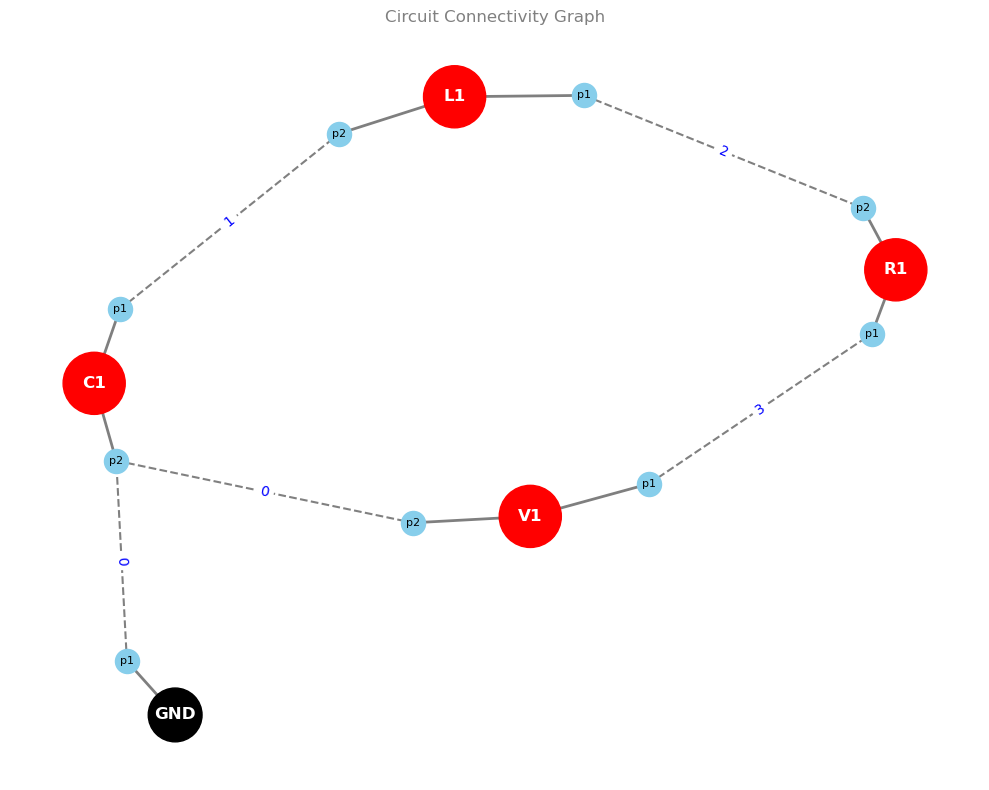
        "GND,p1": ("V1,p2", "C1,p2"),
        "V1,p1": "R1,p1",
        "R1,p2": "L1,p1",
        "L1,p2": "C1,p1",
    },
    "ports": {"source": "V1,p1", "cap": "C1,p1"},
}
Visualize the nodes¤
jax.config.update("jax_enable_x64", True)


models_map = {
    "resistor": Resistor,
    "capacitor": Capacitor,
    "inductor": Inductor,
    "source_voltage": VoltageSource,
    "ground": lambda: 0,
}

print("Compiling...")
circuit = compile_circuit(net_dict, models_map)

print(f"Total System Size: {circuit.sys_size}")
print("Internal component groups, useful for advanced state inspection:")
for g_name, g in circuit.groups.items():
    print(f"Group: {g_name}")
    print(f"  Count: {g.var_indices.shape[0]}")
    print(f"  Var Indices Shape: {g.var_indices.shape}")
    print(f"  Sample Var Indices:{g.var_indices}")
    print(f"  Jacobian Rows Length: {len(g.jac_rows)}")

print("2. Solving DC Operating Point...")
y_op = circuit.dc()

t_max = 3e-9
saveat = diffrax.SaveAt(ts=jnp.linspace(0, t_max, 500))
print("3. Running Simulation...")
sol = circuit.transient(
    t0=0.0,
    t1=t_max,
    dt0=1e-3 * t_max,
    y0=y_op,
    saveat=saveat,
    max_steps=100000,
    progress_meter=diffrax.TqdmProgressMeter(refresh_steps=100),
)

ts = sol.ts
v_src = circuit.port(sol.ys, "source")
v_cap = circuit.port(sol.ys, "cap")
# Advanced inspection: inductor current is an internal state, not a top-level port.
i_ind = sol.ys[:, 5]

plt.rcParams.update({
    "figure.figsize": (9, 4),
    "axes.grid": True,
    "text.color": "grey",
    "axes.facecolor": "white",
    "axes.edgecolor": "grey",
    "axes.labelcolor": "grey",
    "xtick.color": "grey",
    "ytick.color": "grey",
    "grid.color": "#e0e0e0",
    "figure.facecolor": "white",
    "font.family": "sans-serif",
})

ts_ns = ts * 1e9  # convert to nanoseconds

fig, ax1 = plt.subplots(figsize=(9, 4))
ax2 = ax1.twinx()
ln1 = ax1.plot(ts_ns, v_src, color="#2ca02c", linewidth=2, linestyle="--", label="Source V")
ln2 = ax1.plot(ts_ns, v_cap, color="#1f77b4", linewidth=2.5, label="Capacitor V")
ln3 = ax2.plot(ts_ns, i_ind, color="#d62728", linewidth=2, linestyle=":", label="Inductor I")
ax1.set_xlabel("Time (ns)")
ax1.set_ylabel("Voltage (V)", color="#1f77b4")
ax2.set_ylabel("Current (A)", color="#d62728")
ax1.tick_params(axis="y", labelcolor="#1f77b4")
ax2.tick_params(axis="y", labelcolor="#d62728")
lines = ln1 + ln2 + ln3
ax1.legend(lines, [l.get_label() for l in lines], loc="upper right", fontsize=9,
           framealpha=0.9, edgecolor="grey")
ax1.set_title("LCR Impulse Response — underdamped ringing at ~1 GHz", color="grey", pad=10)
fig.tight_layout()
plt.show()
Compiling...


Total System Size: 6
Internal component groups, useful for advanced state inspection:
Group: capacitor
  Count: 1
  Var Indices Shape: (1, 2)
  Sample Var Indices:[[1 0]]
  Jacobian Rows Length: 1
Group: inductor
  Count: 1
  Var Indices Shape: (1, 3)
  Sample Var Indices:[[3 1 4]]
  Jacobian Rows Length: 1
Group: resistor
  Count: 1
  Var Indices Shape: (1, 2)
  Sample Var Indices:[[2 3]]
  Jacobian Rows Length: 1
Group: source_voltage
  Count: 1
  Var Indices Shape: (1, 3)
  Sample Var Indices:[[2 0 5]]
  Jacobian Rows Length: 1
2. Solving DC Operating Point...


3. Running Simulation...