Resistor Ladder¤
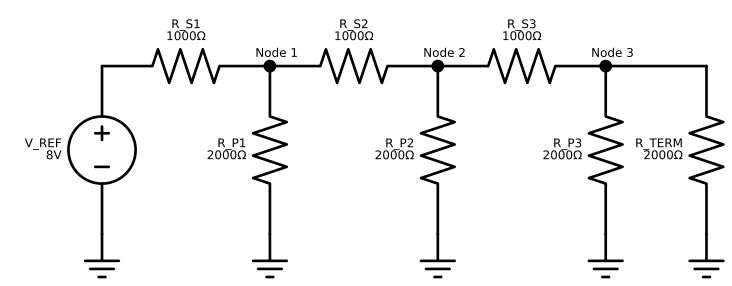
Before running complex transient analyses, it is standard practice to validate the solver against a known analytical solution. For this purpose, we use the R-2R Ladder Network.This circuit acts as a precise voltage divider. We have configured a "1-2-1" ladder where:
Series Resistors (\(R_S\)) = \(1000\Omega\) (\(R\)) Shunt/Termination Resistors (\(R_P\)) = \(2000\Omega\) (\(2R\))T
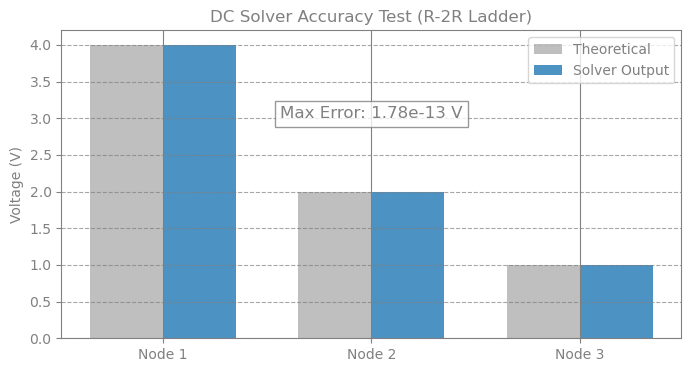
The Analytical Benchmark: Due to the recursive nature of the equivalent resistance in an R-2R ladder, the voltage at each successive node should be exactly half of the previous node.
- Node 1: \(4.0V\)
- Node 2: \(2.0V\)
- Node 3: \(1.0V\)
import time

import jax
import matplotlib.pyplot as plt
import numpy as np

from circulax import compile_circuit
from circulax.components.electronic import Resistor, VoltageSource
net_dict = {
    "instances": {
        "GND": {"component": "ground"},
        "V_REF": {"component": "source_voltage", "settings": {"V": 8.0}},
        "R_S1": {"component": "resistor", "settings": {"R": 1000.0}},
        "R_P1": {"component": "resistor", "settings": {"R": 2000.0}},
        "R_S2": {"component": "resistor", "settings": {"R": 1000.0}},
        "R_P2": {"component": "resistor", "settings": {"R": 2000.0}},
        "R_S3": {"component": "resistor", "settings": {"R": 1000.0}},
        "R_P3": {"component": "resistor", "settings": {"R": 2000.0}},
        "R_TERM": {"component": "resistor", "settings": {"R": 2000.0}},
    },
    "connections": {
        "GND,p1": ("V_REF,p2", "R_P1,p2", "R_P2,p2", "R_P3,p2", "R_TERM,p2"),
        "V_REF,p1": "R_S1,p1",
        "R_S1,p2": ("R_P1,p1", "R_S2,p1"),
        "R_S2,p2": ("R_P2,p1", "R_S3,p1"),
        "R_S3,p2": ("R_P3,p1", "R_TERM,p1"),
    },
    "ports": {
        "node1": "R_S1,p2",
        "node2": "R_S2,p2",
        "node3": "R_S3,p2",
        "gnd": "R_TERM,p2",
    },
}
jax.config.update("jax_enable_x64", True)

models_map = {
    "resistor": Resistor,
    "source_voltage": VoltageSource,
    "ground": lambda: 0,
}

print("1. Compiling Circuit...")
circuit = compile_circuit(net_dict, models_map)
print(f"   System Size: {circuit.sys_size} variables")

print("\n2. Solving DC Operating Point...")

start = time.time()
y_dc = circuit.dc()
print(f"Time take = {time.time() - start:.4f}s")

print("\n3. Verification:")


def get_v(name):
    return float(circuit.port(y_dc, name))


v_n1 = get_v("node1")
v_n2 = get_v("node2")
v_n3 = get_v("node3")

print("   V_REF:    8.0 V")
print(f"   Node 1:   {v_n1:.4f} V  (Expected: 4.0000 V)")
print(f"   Node 2:   {v_n2:.4f} V  (Expected: 2.0000 V)")
print(f"   Node 3:   {v_n3:.4f} V  (Expected: 1.0000 V)")

v_gnd = get_v("gnd")
print(f"   Ground:   {v_gnd:.1e} V  (Expected: 0.0)")

nodes = ["Node 1", "Node 2", "Node 3"]
voltages = [v_n1, v_n2, v_n3]
expected = [4.0, 2.0, 1.0]

plt.figure(figsize=(8, 4))
x = np.arange(len(nodes))
width = 0.35

plt.bar(x - width / 2, expected, width, label="Theoretical", color="gray", alpha=0.5)
plt.bar(x + width / 2, voltages, width, label="Solver Output", color="tab:blue", alpha=0.8)

plt.ylabel("Voltage (V)")
plt.title("DC Solver Accuracy Test (R-2R Ladder)")
plt.xticks(x, nodes)
plt.legend()
plt.grid(axis="y", linestyle="--", alpha=0.7)

max_err = np.max(np.abs(np.array(voltages) - np.array(expected)))
plt.text(
    1,
    3,
    f"Max Error: {max_err:.2e} V",
    ha="center",
    fontsize=12,
    bbox=dict(facecolor="white", alpha=0.8),
)

plt.show()

if max_err < 1e-6:
    print("\n✅ DC Solver PASSED")
else:
    print("\n❌ DC Solver FAILED")
1. Compiling Circuit...


   System Size: 6 variables

2. Solving DC Operating Point...


Time take = 0.2316s

3. Verification:
   V_REF:    8.0 V
   Node 1:   4.0000 V  (Expected: 4.0000 V)
   Node 2:   2.0000 V  (Expected: 2.0000 V)
   Node 3:   1.0000 V  (Expected: 1.0000 V)
   Ground:   -3.5e-25 V  (Expected: 0.0)
✅ DC Solver PASSED