
Resonator frequency estimation models#
Required extras
This notebook needs the models extra:
uv add "qpdk[models]"
# or, from a checkout of this repository:
uv sync --extra models
# or with pip:
pip install "qpdk[models]"
See the extras reference for what each extra installs.
This example demonstrates estimating resonance frequencies of superconducting microwave resonators using Jax.
Probelines weakly coupled to \(\lambda/4\) resonator#
Creates a probelines weakly coupled to a quarter-wave resonator.
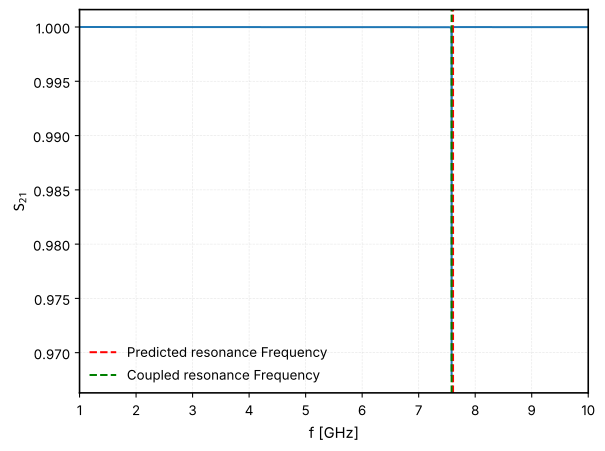
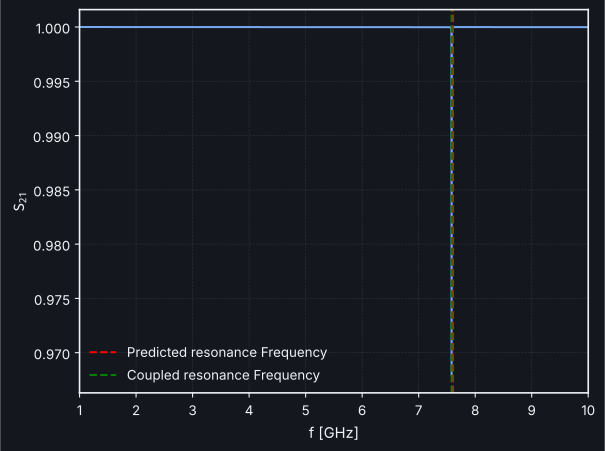
The resonance frequency is first estimated using the resonator_frequency function and then compared to the frequency in the coupled case.
ep_eff, z0 = cpw_parameters(width=10, gap=6)
logger.info(f"{ep_eff=!r}")
logger.info(f"{z0=!r}")  # Characteristic impedance

res_freq = resonator_frequency(
    length=4000,
    epsilon_eff=float(jnp.real(ep_eff)),
    is_quarter_wave=True,
)
logger.info(f"Resonance frequency (quarter-wave): {res_freq / 1e9} GHz")

circuit, info = sax.circuit(
    netlist={
        "instances": {
            "R1": "quarter_wave_resonator",
        },
        "connections": {},
        "ports": {
            "in": "R1,coupling_o1",
            "out": "R1,coupling_o2",
        },
    },
    models={
        "quarter_wave_resonator": partial(
            quarter_wave_resonator_coupled,
            cross_section=coplanar_waveguide(width=10, gap=6),
        )
    },
)

frequencies = jnp.linspace(1e9, 10e9, 5001)
S = circuit(f=frequencies, length=4000.0)
logger.info(info)
plt.plot(frequencies / 1e9, abs(S["in", "out"]) ** 2)
plt.xlabel("f [GHz]")
plt.ylabel("$S_{21}$")


def _mark_resonance_frequency(x_value: float | jax.Array, color: str, label: str):
    """Draws a vertical dashed line on the current matplotlib plot to mark a resonance frequency.

    Args:
        x_value: Resonance frequency in Hz. This value is converted to GHz for plotting.
        color: Matplotlib-compatible color specification for the vertical line.
        label: Text label to use in the plot legend for this resonance marker.
    """
    plt.axvline(
        float(x_value) / 1e9,  # Convert frequency from Hz to GHz for plotting
        color=color,
        linestyle="--",
        label=label,
    )


_mark_resonance_frequency(res_freq, "red", "Predicted resonance Frequency")
actual_freq = frequencies[jnp.argmin(abs(S["in", "out"]))]
logger.info(f"Coupled resonance frequency: {float(actual_freq) / 1e9} GHz")
_mark_resonance_frequency(actual_freq, "green", "Coupled resonance Frequency")

plt.legend()
2026-10-22 13:35:01.536 | INFO | __main__:<module>:2 - ep_eff=Array(6.06519124-1.49847261e-05j, dtype=complex128)
2026-10-22 13:35:01.537 | INFO | __main__:<module>:3 - z0=Array(49.31279884, dtype=float64)
2026-10-22 13:35:01.616 | INFO | __main__:<module>:10 - Resonance frequency (quarter-wave): 7.6081395616176914 GHz
2026-10-22 13:35:07.497 | INFO | __main__:<module>:33 - CircuitInfo(dag=<networkx.classes.digraph.DiGraph object at 0x7fa0ac9bef00>, models={'quarter_wave_resonator': functools.partial(<function quarter_wave_resonator_coupled at 0x7fa0d0de2700>, cross_section=CrossSection(sections=(Section(width=10.0, offset=0.0, insets=None, layer=<LayerMapQPDK.M1_DRAW: 1>, port_names=('o1', 'o2'), port_types=('optical', 'optical'), name='_default', hidden=False, simplify=None, skip_transition=False, width_function=None, offset_function=None), Section(width=6.0, offset=8.0, insets=None, layer=<LayerMapQPDK.M1_ETCH: 47>, port_names=(None, None), port_types=('optical', 'optical'), name='etch_offset_pos', hidden=False, simplify=None, skip_transition=False, width_function=None, offset_function=None), Section(width=6.0, offset=-8.0, insets=None, layer=<LayerMapQPDK.M1_ETCH: 47>, port_names=(None, None), port_types=('optical', 'optical'), name='etch_offset_neg', hidden=False, simplify=None, skip_transition=False, width_function=None, offset_function=None), Section(width=10.0, offset=0, insets=None, layer=<LayerMapQPDK.WG: 59>, port_names=(None, None), port_types=('optical', 'optical'), name='waveguide', hidden=False, simplify=None, skip_transition=False, width_function=None, offset_function=None)), components_along_path=(), radius=100.0, radius_min=11.0, bbox_layers=None, bbox_offsets=None)), 'top_level': <function _flat_circuit.<locals>._circuit at 0x7fa07c1cbf60>}, backend='klu')
2026-10-22 13:35:07.731 | INFO | __main__:<module>:57 - Coupled resonance frequency: 7.5826 GHz
<matplotlib.legend.Legend at 0x7fa05e917500>
Optimizer for given resonance frequency#
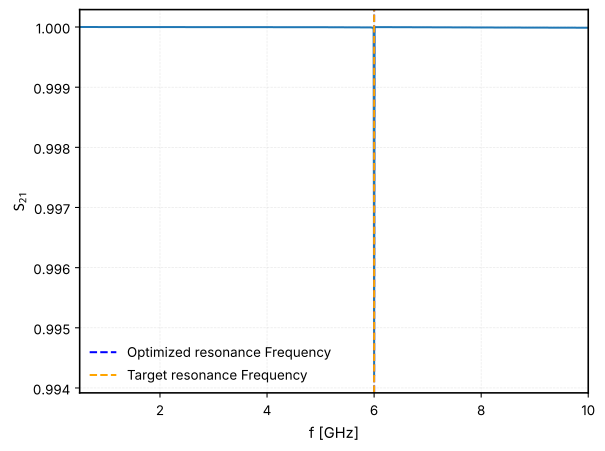
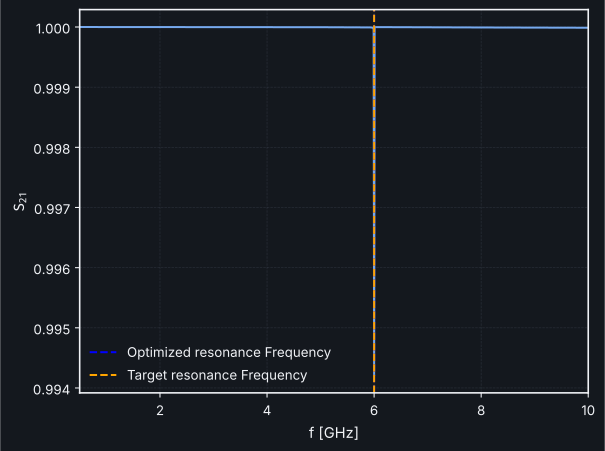
Find the resonator length that gives a desired resonance frequency using an optimizer. Here we use Optax and JAX’s automatic differentiation. Instead of evaluating the entire frequency band in every iteration, we can simply minimize the transmission \(|S_{21}|^2\) exactly at the target frequency. JAX automatically computes the analytical gradient of the transmission with respect to the resonator length, making the optimization remarkably fast and precise.
TARGET_FREQUENCY = 6e9  # Target resonance frequency in Hz


@jax.jit
def loss_fn(params: dict[str, jnp.ndarray]) -> jnp.ndarray:
    """Loss function to minimize the S21 transmission at the target frequency.

    Args:
        params: Dictionary containing the resonator length in micrometers.

    Returns:
        The loss value as a JAX array.
    """
    length = params["length"]
    # Setup model using the Jittable `circuit` function
    S = circuit(f=jnp.array([TARGET_FREQUENCY]), length=length)
    # S is evaluated at TARGET_FREQUENCY
    # Minimize S21 magnitude at the target frequency
    s21 = S["in", "out"][0]
    return jnp.real(s21 * jnp.conj(s21))


# Test loss function
logger.info(f"Loss at 4000 um: {float(loss_fn({'length': jnp.array(4000.0)}))}")
logger.info(f"Loss at 5900 um: {float(loss_fn({'length': jnp.array(5900.0)}))}")

# To ensure we start within the narrow resonance dip, we first evaluate a coarse array of lengths
expected_length = 4000.0 * (res_freq / TARGET_FREQUENCY)
coarse_lengths = jnp.linspace(expected_length - 1000, expected_length + 1000, 2001)


@jax.jit
@jax.vmap
def sweep_loss(length_val: jnp.ndarray) -> jnp.ndarray:
    """Evaluate loss over a single length value during the initial vmap sweep.

    Args:
        length_val: The length of the resonator in micrometers.

    Returns:
        The loss value for the given length.
    """
    return loss_fn({"length": length_val})


coarse_losses = sweep_loss(coarse_lengths)
best_initial_length = float(coarse_lengths[jnp.argmin(coarse_losses)])
logger.info(f"Best initial guess from sweep: {best_initial_length:.2f} µm")

# Initialize optimizer
params = {"length": jnp.array(best_initial_length)}
optimizer = optax.adam(learning_rate=0.1)
opt_state = optimizer.init(params)


@jax.jit
def step(params, opt_state):
    """Perform a single Optax optimization step to update parameters.

    Args:
        params: Dictionary containing current parameters (e.g., 'length').
        opt_state: Current state of the optimizer.

    Returns:
        A tuple containing (updated parameters, updated opt_state).
    """
    loss_value, grads = jax.value_and_grad(loss_fn)(params)
    updates, opt_state = optimizer.update(grads, opt_state, params)
    params = optax.apply_updates(params, updates)
    return params, opt_state, loss_value


for _ in trange(100, desc="Optimizing"):
    params, opt_state, loss_value = step(params, opt_state)

length_val = float(jax.device_get(params["length"]))
logger.info(f"Optimized Length: {length_val:.2f} µm")

# Evaluate over a range of frequencies to verify
verification_frequencies = jnp.linspace(0.5e9, 10e9, 1001)
optimal_S = circuit(f=verification_frequencies, length=params["length"])
optimal_freq = verification_frequencies[jnp.argmin(abs(optimal_S["in", "out"]))]
optimal_freq_val = float(jax.device_get(optimal_freq))
logger.info(f"Achieved Resonance Frequency: {optimal_freq_val / 1e9:.2f} GHz")

# Plot
plt.close()
plt.plot(verification_frequencies / 1e9, abs(optimal_S["in", "out"]) ** 2)
plt.xlabel("f [GHz]")
plt.ylabel("$S_{21}$")
_mark_resonance_frequency(optimal_freq_val, "blue", "Optimized resonance Frequency")
_mark_resonance_frequency(TARGET_FREQUENCY, "orange", "Target resonance Frequency")
plt.legend()
plt.show()
2026-10-22 13:35:10.364 | INFO | __main__:<module>:24 - Loss at 4000 um: 0.9999955174879595
2026-10-22 13:35:10.365 | INFO | __main__:<module>:25 - Loss at 5900 um: 0.9999957491109099
2026-10-22 13:35:12.587 | INFO | __main__:<module>:48 - Best initial guess from sweep: 5059.09 µm
2026-10-22 13:35:19.718 | INFO | __main__:<module>:77 - Optimized Length: 5058.83 µm
2026-10-22 13:35:21.665 | INFO | __main__:<module>:84 - Achieved Resonance Frequency: 6.00 GHz