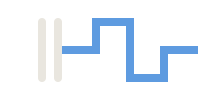
r"""Suspended vacuum-gap (drum) capacitor and drum LC resonator cells.

The drum is a parallel-plate capacitor whose top electrode is an aluminium
membrane suspended a vacuum gap above a circular bottom electrode in ``M1``
:cite:`cicakLowlossSuperconductingResonant2010,mercierdelepinayRealizationDirectionalAmplification2019`.
The default 15 µm drum and the resonator layout follow the Aalto University
device of :cite:`pirkkalainenSqueezingQuantumNoise2015`.
The membrane is drawn on ``VG_TOP`` and the sacrificial layer that holds it up
during fabrication on ``VG_SAC``. Wherever ``VG_TOP`` lies outside ``VG_SAC``
the membrane lands on ``M1`` and is clamped there.

The gap is not a cell parameter. It is set by the layer stack, see
:func:`qpdk.tech.get_vacuum_gap`.
"""

from __future__ import annotations

import math
from typing import Literal

import gdsfactory as gf
from gdsfactory.component import Component
from gdsfactory.typings import CrossSectionSpec, LayerSpec
from kfactory import kdb
from klayout.db import Region

from qpdk.cells._schematic import (
    drum_lc_resonator_schematic,
    vacuum_gap_capacitor_schematic,
)
from qpdk.cells.inductor import meander_inductor
from qpdk.cells.waveguides import straight
from qpdk.tech import (
    LAYER,
    get_etch_section,
    get_vacuum_gap,
    meander_inductor_cross_section,
)

_CIRCLE_POINTS = 128


def _disc(radius: float, center: tuple[float, float] = (0.0, 0.0)) -> Region:
    """Return a polygonal disc of ``radius`` centred on ``center``."""
    x, y = center
    box = kdb.DBox(x - radius, y - radius, x + radius, y + radius)
    return Region(kdb.DPolygon.ellipse(box, _CIRCLE_POINTS).to_itype(0.001))


def _box(x0: float, y0: float, x1: float, y1: float) -> Region:
    """Return the axis-aligned box spanned by two corners."""
    return Region(kdb.DBox(x0, y0, x1, y1).to_itype(0.001))


def _layer_region(component: Component, layer: LayerSpec) -> Region:
    """Return the merged, flattened shapes of ``component`` on ``layer``."""
    layer_tuple = gf.get_layer_tuple(layer)
    return Region(
        kdb.RecursiveShapeIterator(
            component.kcl.layout,
            component._base.kdb_cell,  # pyright: ignore[reportPrivateUsage]
            component.kcl.layout.layer(layer_tuple[0], layer_tuple[1]),
        )
    ).merged()


[docs]
@gf.cell(tags=["capacitors"], schematic_function=vacuum_gap_capacitor_schematic)
def vacuum_gap_capacitor(
    radius: float = 7.5,
    support: Literal["rim", "legs"] = "rim",
    etch_gap: float = 2.0,
    rim_width: float = 3.0,
    n_legs: int = 4,
    leg_width: float = 2.0,
    cross_section: CrossSectionSpec = meander_inductor_cross_section,
) -> Component:
    r"""Creates a suspended vacuum-gap parallel-plate (drum) capacitor.

    A circular bottom electrode of radius :math:`a` in ``M1`` sits under an
    aluminium membrane on ``VG_TOP``, separated by the vacuum gap :math:`d` of
    the layer stack, after
    :cite:`cicakLowlossSuperconductingResonant2010,pirkkalainenSqueezingQuantumNoise2015`.
    The membrane is clamped onto an ``M1`` ring around the electrode, either
    along its whole edge (``support="rim"``) or through ``n_legs`` radial legs
    (``support="legs"``). ``VG_SAC`` marks the sacrificial layer under the
    suspended part.

    In the Aalto process the membrane is evaporated on a sacrificial
    amorphous-silicon layer that is etched away to release it
    :cite:`mercierdelepinayRealizationDirectionalAmplification2019`. Here the
    membrane lands on ``M1``, since the layer stack measures the gap from the
    top of ``M1``.

    The suspended part spans the electrode plus the etched gap to the ring,
    a diameter of :math:`2(a + \text{etch\_gap})`. With the defaults that is
    19 µm over a 15 µm electrode, so the mechanics of the drawn membrane are
    not those of the 15 µm drum of
    :cite:`pirkkalainenSqueezingQuantumNoise2015`.

    .. svgbob::

              .-----------.  ring + membrane (o2)
             /  .-------.  \
        o1 ---=|  bottom |   |--- o2
             \  '-------'  /
              '-----------'

    Port ``o1`` connects to the bottom electrode through a lead that passes
    under the membrane in a slot of the ring. Port ``o2`` connects to the ring
    and through it to the membrane. The plate overlap is set by the bottom
    electrode, so the parallel-plate capacitance is
    :math:`C = \varepsilon_0 \pi a^2 / d`, see
    :func:`qpdk.models.drum.vacuum_gap_capacitance_analytical`.

    Args:
        radius: Bottom-electrode radius :math:`a` in µm.
        support: How the membrane is held, ``"rim"`` or ``"legs"``.
        etch_gap: Etched gap in µm between electrode and ring, and between ring
            and ground.
        rim_width: Width of the ``M1`` ring the membrane lands on, in µm.
        n_legs: Number of radial legs for ``support="legs"``.
        leg_width: Width of each leg in µm for ``support="legs"``.
        cross_section: Cross-section of the two leads and ports.

    Returns:
        Component: The drum capacitor with ports ``o1`` (bottom electrode) and
            ``o2`` (membrane).

    Raises:
        ValueError: If a dimension is not positive, ``support`` is unknown,
            ``n_legs`` < 1, or a leg would land on the lead slot.
    """
    for name, value in (
        ("radius", radius),
        ("etch_gap", etch_gap),
        ("rim_width", rim_width),
        ("leg_width", leg_width),
    ):
        if value <= 0:
            raise ValueError(f"{name} must be positive, got {value}")
    if support not in {"rim", "legs"}:
        raise ValueError(f"support must be 'rim' or 'legs', got {support!r}")
    if support == "legs" and n_legs < 1:
        raise ValueError(f"n_legs must be at least 1, got {n_legs}")

    xs = gf.get_cross_section(cross_section)
    wire_width = xs.width
    etch_section = get_etch_section(xs)
    slot_half_width = wire_width / 2 + etch_section.width

    r_ring_in = radius + etch_gap
    r_ring_out = r_ring_in + rim_width
    r_land = (r_ring_in + r_ring_out) / 2
    r_etch = r_ring_out + etch_gap

    # The o1 lead runs west under the membrane through a slot in the ring
    slot = _box(-r_etch, -slot_half_width, 0, slot_half_width)
    ring = _disc(r_ring_out) - _disc(r_ring_in) - slot
    metal = (
        _disc(radius)
        + _box(-r_etch, -wire_width / 2, 0, wire_width / 2)
        + ring
        + _box(r_land, -wire_width / 2, r_etch, wire_width / 2)
    ).merged()
    etch = (
        _disc(r_etch) + _box(-r_etch, -slot_half_width, r_etch, slot_half_width)
    ) - metal

    sacrificial = (
        _disc(r_ring_in) + (_box(-r_land, -slot_half_width, 0, slot_half_width))
    ).merged()

    if support == "rim":
        membrane = _disc(r_land)
    else:
        membrane = _disc(radius + etch_gap / 2)
        offset = 0.5 if n_legs % 2 == 0 else 0.0
        for k in range(n_legs):
            angle = 360 * (k + offset) / n_legs
            leg = _box(0, -leg_width / 2, r_land, leg_width / 2).transformed(
                kdb.DCplxTrans(1, angle, False, 0, 0).to_itrans(0.001)
            )
            if not (leg - _disc(r_ring_in) & slot).is_empty():
                raise ValueError(
                    f"Leg at {angle:.1f}° lands on the o1 lead slot; "
                    "change n_legs or leg_width"
                )
            membrane += leg
        membrane.merge()

    c = Component()
    c.add_polygon(metal, layer=xs.layer)
    c.add_polygon(etch, layer=etch_section.layer)
    c.add_polygon(membrane, layer=LAYER.VG_TOP)
    c.add_polygon(sacrificial, layer=LAYER.VG_SAC)

    for name, x, orientation in (("o1", -r_etch, 180), ("o2", r_etch, 0)):
        c.add_port(
            name=name,
            center=(x, 0),
            width=wire_width,
            orientation=orientation,
            layer=xs.layer,
            port_type="optical",
            cross_section=xs,
        )

    c.info["vacuum_gap"] = get_vacuum_gap()
    c.info["overlap_area"] = math.pi * radius**2
    return c


[docs]
@gf.cell(
    tags=["resonators", "capacitors", "inductors", "couplers"],
    schematic_function=drum_lc_resonator_schematic,
)
def drum_lc_resonator(
    radius: float = 7.5,
    support: Literal["rim", "legs"] = "rim",
    n_turns: int = 75,
    turn_length: float = 300.0,
    inductor_cross_section: CrossSectionSpec = "meander_inductor_cross_section",
    coupling_gap: float = 6.0,
    coupling_pad_size: float = 20.0,
    margin: float = 10.0,
    cross_section: CrossSectionSpec = "cpw",
) -> Component:
    r"""Creates a drum LC resonator side-coupled to a CPW feedline.

    A meander inductor is shunted to ground by a
    :func:`vacuum_gap_capacitor` at its open end, forming the mechanically
    compliant LC circuit of :cite:`pirkkalainenSqueezingQuantumNoise2015`. The
    resonator couples capacitively to the feedline through a pad at
    ``coupling_gap`` from the centre conductor, after the capacitively coupled
    drum cavities of :cite:`ockeloenkorppiLowNoiseAmplificationFrequency2016`.
    The bottom electrode is the hot node and the membrane is grounded through
    the drum ring.

    .. svgbob::

        o1 =================================== o2  feedline
                           [pad]
                 +------------+--+
                 |  meander   L  +--(drum)--GND
                 +------------+
                 GND

    The etched window sits below the feedline's lower ground plane, which is
    kept intact except for a notch around the pad. The notch leaves
    ``coupling_gap`` of clearance to the ground on the sides of the pad.

    The resonance is :math:`\omega_\text{r} = 1/\sqrt{L (C_\text{d} + C_\text{p} + C_\text{c})}`
    in the lumped model, see :func:`qpdk.models.drum.drum_lc_resonator`, which
    also lists what that model leaves out. The default meander is about 23 mm
    of wire, a substantial fraction of a guided wavelength near 7 GHz on
    silicon, so this layout is not a lumped inductor there and its real
    resonances differ from that model. Simulate the layout before relying on
    its frequency.

    Args:
        radius: Drum bottom-electrode radius in µm.
        support: How the drum membrane is held, ``"rim"`` or ``"legs"``.
        n_turns: Number of meander inductor runs. Must be odd. The default
            gives about 14 nH, the inductance of
            :cite:`pirkkalainenSqueezingQuantumNoise2015`.
        turn_length: Length of each meander run in µm.
        inductor_cross_section: Cross-section of the meander wire, the drum
            leads and the internal wiring.
        coupling_gap: Gap between the coupling pad and the feedline centre
            conductor in µm.
        coupling_pad_size: Side length of the square coupling pad in µm.
        margin: Spacing in µm between the pad, inductor, drum and the edge of
            the etched window.
        cross_section: Cross-section of the feedline.

    Returns:
        Component: The resonator with feedline ports ``o1`` and ``o2``.

    Raises:
        ValueError: If ``n_turns`` is even or a spacing is not positive.
    """
    if n_turns % 2 == 0:
        raise ValueError(
            "n_turns must be odd so that the inductor ends on the drum side"
        )
    for name, value in (
        ("coupling_gap", coupling_gap),
        ("coupling_pad_size", coupling_pad_size),
        ("margin", margin),
    ):
        if value <= 0:
            raise ValueError(f"{name} must be positive, got {value}")

    feed_xs = gf.get_cross_section(cross_section)
    feed_etch = get_etch_section(feed_xs)
    wire_xs = gf.get_cross_section(inductor_cross_section)
    wire_width = wire_xs.width

    tmp = Component()
    ind = tmp << meander_inductor(
        n_turns=n_turns,
        turn_length=turn_length,
        cross_section=inductor_cross_section,
        add_etch=False,
    )
    drum = tmp << vacuum_gap_capacitor(
        radius=radius, support=support, cross_section=inductor_cross_section
    )

    # Coupling pad below the feedline, its right edge flush with the inductor end
    pad_top = -feed_xs.width / 2 - coupling_gap
    pad_bottom = pad_top - coupling_pad_size
    ind.dmove((
        0,
        pad_bottom - margin - wire_width / 2 - ind.ports["o2"].dcenter[1],
    ))
    node_x, node_y = ind.ports["o2"].dcenter
    drum.dmove((node_x + margin - drum.ports["o1"].dcenter[0], node_y))

    x_left = ind.ports["o1"].dcenter[0] - margin
    x_right = drum.ports["o2"].dcenter[0]
    y_bottom = ind.dbbox().bottom - margin
    # The window stops at the pad bottom so the feedline keeps its lower ground
    # plane. Only a notch around the pad opens onto the feedline gap.
    feed_gap_edge = -feed_xs.width / 2 - feed_etch.width
    window_top = pad_bottom
    notch = _box(
        node_x - coupling_pad_size - coupling_gap,
        pad_bottom,
        node_x + coupling_gap,
        max(feed_gap_edge, pad_top),
    )

    feed = tmp << straight(
        length=x_right - x_left + 2 * margin, cross_section=cross_section
    )
    feed.dmove((x_left - margin, 0))

    metal = (
        _layer_region(tmp, wire_xs.layer)
        + _box(node_x - coupling_pad_size, pad_bottom, node_x, pad_top)
        # Pad to inductor end, inductor end to drum, inductor start to ground
        + _box(node_x - wire_width, node_y, node_x, pad_bottom)
        + _box(
            node_x, node_y - wire_width / 2, node_x + margin, node_y + wire_width / 2
        )
        + _box(
            x_left,
            ind.ports["o1"].dcenter[1] - wire_width / 2,
            ind.ports["o1"].dcenter[0],
            ind.ports["o1"].dcenter[1] + wire_width / 2,
        )
    ).merged()
    etch = (
        _layer_region(tmp, LAYER.M1_ETCH)
        + _box(x_left, y_bottom, x_right, window_top)
        + notch
    ) - metal

    c = Component()
    c.add_polygon(metal, layer=wire_xs.layer)
    c.add_polygon(etch, layer=LAYER.M1_ETCH)
    c.add_polygon(_layer_region(tmp, LAYER.VG_TOP), layer=LAYER.VG_TOP)
    c.add_polygon(_layer_region(tmp, LAYER.VG_SAC), layer=LAYER.VG_SAC)
    # Keep the feedline routing-collision layer
    c.add_polygon(_layer_region(tmp, LAYER.WG), layer=LAYER.WG)
    c.add_ports(feed.ports)

    c.info["vacuum_gap"] = get_vacuum_gap()
    c.info["total_wire_length"] = ind.cell.info["total_wire_length"]
    c.info["n_squares"] = ind.cell.info["n_squares"]
    return c