SAX Simulation of a Resonator Test Chip#
This notebook demonstrates how to run a circuit-level SAX simulation of the
resonator_test_chip_yaml component, which is defined via a .pic.yml netlist
file and a corresponding gdsfactory+ schematic.
The workflow is:
Load the component from the YAML netlist with gdsfactory.
Extract the netlist for circuit simulation.
Build a SAX circuit using the QPDK model library.
Evaluate the S-parameters over a frequency range.
Plot the transmission to observe resonator dips.
Load the component#
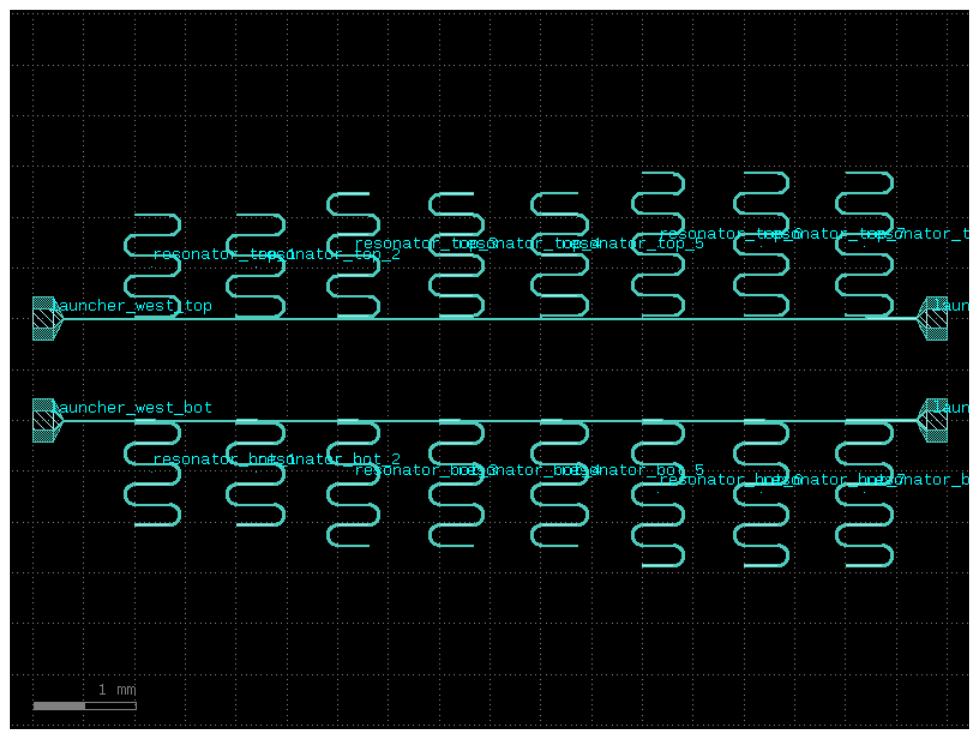
The resonator test chip is defined in a .pic.yml file that lives alongside
the QPDK sample scripts. It contains 16 quarter-wave coupled resonators
(8 per probeline), four launchers, and CPW routing between all elements.
yaml_path = PATH.samples / "resonator_test_chip_yaml.pic.yml"
chip = gf.read.from_yaml(yaml_path)
chip.plot()
Extract the netlist#
Component.get_netlist() returns a dictionary with instances,
nets, ports, and placements. SAX understands this format directly.
with warnings.catch_warnings():
    warnings.simplefilter("ignore")
    netlist = chip.get_netlist()

print("Instances:")
for name, inst in netlist["instances"].items():
    print(f"  {name}: {inst['component']}")
Instances:
  bend_s: bend_s
  bend_s2: bend_s
  bend_s3: bend_s
  bend_s4: bend_s
  launcher: launcher
  launcher2: launcher
  launcher3: launcher
  launcher4: launcher
  resonator_bot_1: quarter_wave_resonator_coupled
  resonator_bot_2: quarter_wave_resonator_coupled
  resonator_bot_3: quarter_wave_resonator_coupled
  resonator_bot_4: quarter_wave_resonator_coupled
  resonator_bot_5: quarter_wave_resonator_coupled
  resonator_bot_6: quarter_wave_resonator_coupled
  resonator_bot_7: quarter_wave_resonator_coupled
  resonator_bot_8: quarter_wave_resonator_coupled
  resonator_top_1: quarter_wave_resonator_coupled
  resonator_top_2: quarter_wave_resonator_coupled
  resonator_top_3: quarter_wave_resonator_coupled
  resonator_top_4: quarter_wave_resonator_coupled
  resonator_top_5: quarter_wave_resonator_coupled
  resonator_top_6: quarter_wave_resonator_coupled
  resonator_top_7: quarter_wave_resonator_coupled
  resonator_top_8: quarter_wave_resonator_coupled
  straight: straight
  straight2: straight
  straight3: straight
  straight4: straight
  straight5: straight
  straight6: straight
  straight7: straight
  straight8: straight
  straight9: straight
  straight10: straight
  straight11: straight
  straight12: straight
  straight13: straight
  straight14: straight
Build the SAX circuit#
QPDK ships a models dictionary that maps every component name to a SAX
model function. We pass the netlist and models to sax.circuit.
circuit_fn, circuit_info = sax.circuit(
    netlist=netlist,
    models=models,
    on_internal_port="ignore",
)
Simulate#
Evaluate the circuit over the 5–9 GHz band. The four external ports correspond to the four launchers:
Port |
Launcher |
Probeline |
|---|---|---|
o1 |
West top |
Top |
o2 |
East top |
Top |
o3 |
West bot |
Bottom |
o4 |
East bot |
Bottom |
The top probeline has eight resonators with varying coupling gaps (12–26 µm) and the bottom probeline has eight resonators with a fixed coupling gap of 16 µm.
freq = jnp.linspace(5e9, 9e9, 5001)
s_params = circuit_fn(f=freq)

freq_ghz = freq / 1e9
Results#
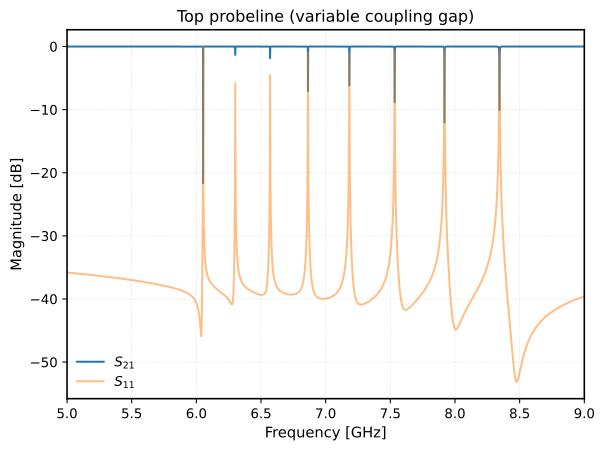
Top probeline – variable coupling gap#
:math:S_{21} (port o1 → o2) shows eight notches, one per resonator.
s21 = s_params[("o1", "o2")]
s11 = s_params[("o1", "o1")]

fig, ax = plt.subplots()
ax.plot(freq_ghz, 20 * jnp.log10(jnp.abs(s21)), label="$S_{21}$")
ax.plot(freq_ghz, 20 * jnp.log10(jnp.abs(s11)), label="$S_{11}$", alpha=0.5)
ax.set_xlabel("Frequency [GHz]")
ax.set_ylabel("Magnitude [dB]")
ax.set_title("Top probeline (variable coupling gap)")
ax.legend()
ax.grid(True)
plt.tight_layout()
plt.show()
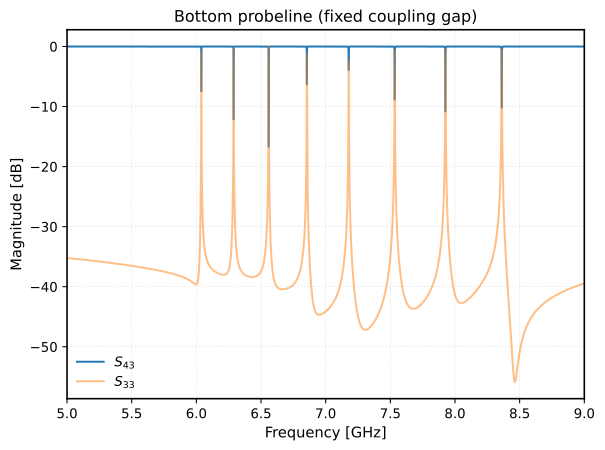
Bottom probeline – fixed coupling gap#
:math:S_{43} (port o3 → o4) shows eight notches with uniform coupling
depth because all resonators share the same 16 µm coupling gap.
s43 = s_params[("o3", "o4")]
s33 = s_params[("o3", "o3")]

fig, ax = plt.subplots()
ax.plot(freq_ghz, 20 * jnp.log10(jnp.abs(s43)), label="$S_{43}$")
ax.plot(freq_ghz, 20 * jnp.log10(jnp.abs(s33)), label="$S_{33}$", alpha=0.5)
ax.set_xlabel("Frequency [GHz]")
ax.set_ylabel("Magnitude [dB]")
ax.set_title("Bottom probeline (fixed coupling gap)")
ax.legend()
ax.grid(True)
plt.tight_layout()
plt.show()
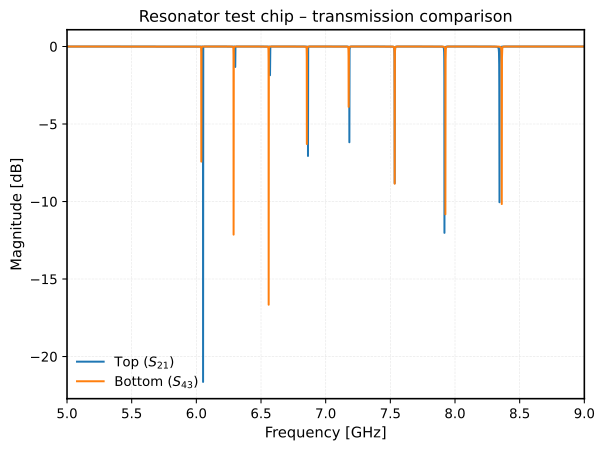
Both probelines#
Overlay both transmission traces to compare the two probelines.
fig, ax = plt.subplots()
ax.plot(freq_ghz, 20 * jnp.log10(jnp.abs(s21)), label="Top ($S_{21}$)")
ax.plot(freq_ghz, 20 * jnp.log10(jnp.abs(s43)), label="Bottom ($S_{43}$)")
ax.set_xlabel("Frequency [GHz]")
ax.set_ylabel("Magnitude [dB]")
ax.set_title("Resonator test chip – transmission comparison")
ax.legend()
ax.grid(True)
plt.tight_layout()
plt.show()