

Transmon Qubit Design with NetKet#
Required extras
This notebook needs the models and netket extras:
uv add "qpdk[models,netket]"
# or, from a checkout of this repository:
uv sync --extra models --extra netket
# or with pip:
pip install "qpdk[models,netket]"
See the extras reference for what each extra installs.
This notebook demonstrates how to use NetKet [CCH+19, VHS+22] to numerically analyse the transmon qubit Hamiltonian for superconducting qubit design, and how to translate the resulting quantum parameters into physical layout parameters using qpdk.
NetKet is a JAX-based library for many-body quantum physics that provides exact diagonalisation and variational solvers for custom Hamiltonians. For superconducting qubit design, it serves as a flexible numerical tool for computing energy spectra, charge dispersion, and coupling parameters directly from the microscopic circuit Hamiltonian.
Background#
The transmon qubit [KYG+07] is an anharmonic oscillator formed by shunting a Josephson junction with a large capacitance. Its Hamiltonian in the charge basis reads:
The shunt capacitance sets \(E_\text{C}\), while the junction critical current sets \(E_\text{J}\).
where \(E_\text{C}\) is the charging energy, \(E_\text{J}\) the Josephson energy, \(\hat{n}\) the Cooper-pair number operator, \(n_\text{g}\) the offset charge, and \(\hat{\varphi}\) the superconducting phase.
In the truncated charge basis \(\{|n\rangle\}\) with \(n \in \{-n_\text{cut}, \ldots, +n_\text{cut}\}\):
Diagonal elements: \(\langle n | \hat{H} | n \rangle = 4 E_\text{C} (n - n_\text{g})^2\)
Off-diagonal elements: \(\langle n \pm 1 | \hat{H} | n \rangle = -E_\text{J} / 2\)
In the transmon regime (\(E_\text{J} / E_\text{C} \gg 1\)), the qubit frequency and anharmonicity are approximately [KYG+07]:
Building the Transmon Hamiltonian#
We construct the transmon Hamiltonian as a matrix in the truncated charge
basis and wrap it in a NetKet
LocalOperator,
which can then be passed to NetKet’s exact-diagonalisation routines.
EJ = 20.0  # Josephson energy in GHz
EC = 0.2  # Charging energy in GHz
ng = 0.0  # Offset charge (gate charge)

ncut = 15  # Charge basis truncation: n ∈ {-ncut, ..., +ncut}
n_states = 2 * ncut + 1

# Build the Hamiltonian matrix in the charge basis
charges = jnp.arange(n_states) - ncut  # physical charge quantum numbers
H_mat = jnp.diag(4 * EC * (charges - ng) ** 2)
for n in range(n_states - 1):
    H_mat = H_mat.at[n, n + 1].set(-EJ / 2)  # Josephson tunnelling
    H_mat = H_mat.at[n + 1, n].set(-EJ / 2)

# Wrap as a NetKet operator on a Fock Hilbert space
hi = nk.hilbert.Fock(n_max=n_states - 1, N=1)
H_transmon = nk.operator.LocalOperator(hi, np.asarray(H_mat), acting_on=[0])
Transmon Spectrum via Exact Diagonalisation#
NetKet provides
lanczos_ed
for efficient sparse-matrix diagonalisation. We extract the lowest five
eigenvalues and compute the qubit frequency \(\omega_\text{q} = E_1 - E_0\) and
the anharmonicity \(\alpha = (E_2 - E_1) - (E_1 - E_0)\).
evals_exact = nk.exact.lanczos_ed(H_transmon, k=5, compute_eigenvectors=False)
e0_exact = evals_exact[0]
evals = evals_exact - e0_exact  # shift ground state to zero

f01 = evals[1] - evals[0]
f12 = evals[2] - evals[1]
alpha_nk = f12 - f01  # negative for transmon

# Analytical transmon approximation from qpdk
omega_t_approx, _ = ej_ec_to_frequency_and_anharmonicity(EJ, EC)

display(
    Math(rf"""
\textbf{{Transmon Spectrum (NetKet):}} \\
E_\text{{J}}/E_\text{{C}} = {EJ / EC:.0f} \\
f_{{01}} = {f01:.4f}\,\text{{GHz}} \quad
(\text{{approx.}}\;\sqrt{{8 E_\text{{J}} E_\text{{C}}}} - E_\text{{C}} = {omega_t_approx:.4f}\,\text{{GHz}}) \\
f_{{12}} = {f12:.4f}\,\text{{GHz}} \\
\alpha = f_{{12}} - f_{{01}} = {alpha_nk:.4f}\,\text{{GHz}} \quad
(\text{{approx.}}\;-E_\text{{C}} = -{EC:.4f}\,\text{{GHz}})
""")
)
Variational Energy via VMC (Full Summation)#
While exact diagonalisation works for this small Hilbert space, larger systems require variational methods. Here we demonstrate a simple Variational Monte Carlo (VMC) approach using JAX and Flax, computing the energy by summing over all basis states.
This case is trivial to diagonalize exactly, but looking at something more complex cannot always be done exactly due to the exponential growth of the Hilbert space.
We define a simple feedforward neural network using Flax to serve as our variational ansatz for the ground state wavefunction. The network takes the charge configuration as input and outputs the logarithm of the wavefunction amplitude (log-psi). We then compute the energy expectation value by summing over all charge states, and use JAX’s automatic differentiation to compute gradients for optimization.
For the network architecture, we use a compact multilayer perceptron
[Ros58] preceded by a
sinusoidal input encoding at geometrically spaced frequencies. This
encoding lifts the one-dimensional Fock-state index into a
higher-dimensional feature space of sines and cosines, enabling the
subsequent :math:\tanh-activated hidden layers to approximate the
smooth, Gaussian-like ground-state wavefunction much more efficiently
than piecewise-linear activations such as Leaky ReLU.
For details on VMC with NetKet, see the documentation: https://netket.readthedocs.io/en/latest/vmc-from-scratch/index.html
class VariationalTransmon(nn.Module):
    r"""A compact MLP with sinusoidal input encoding for the transmon wavefunction.

    Sinusoidal (Fourier) features at geometrically spaced frequencies lift
    the one-dimensional Fock-state index into a richer feature space, allowing
    the two :math:`\tanh`-activated hidden layers to approximate the smooth,
    Gaussian-like ground state much more efficiently than a plain MLP with
    piecewise-linear activations.
    """

    n_max: int = 30
    n_freqs: int = 4

    @nn.compact
    def __call__(self, x):
        """Evaluate the model on a set of input configurations.

        Returns:
            The model evaluation result as a squeezed array.
        """
        # x has shape (..., 1)
        x = x.astype(jnp.float32)
        # Sinusoidal feature encoding at geometrically spaced frequencies;
        # maps the scalar input to a 2*n_freqs-dimensional feature vector.
        freqs = 2.0 ** jnp.arange(self.n_freqs) * (jnp.pi / self.n_max)
        x = jnp.concatenate([jnp.sin(x * freqs), jnp.cos(x * freqs)], axis=-1)
        x = nn.Dense(features=32)(x)
        x = jnp.tanh(x)
        x = nn.Dense(features=32)(x)
        x = jnp.tanh(x)
        x = nn.Dense(features=1)(x)
        return jnp.squeeze(x, axis=-1)


model = VariationalTransmon(n_max=n_states - 1)
parameters = model.init(jax.random.key(0), jnp.ones((1, 1)))


def to_array(model, parameters):
    """Compute the normalized wavefunction as an array.

    Returns:
        The normalized wavefunction as a JAX array.
    """
    all_configs = hi.all_states()
    logpsi = model.apply(parameters, all_configs)
    psi = jnp.exp(logpsi)
    return psi / jnp.linalg.norm(psi)


def compute_energy(model, parameters, H_sparse):
    """Compute the variational energy of the state.

    Returns:
        The expected value of the energy (real part).
    """
    psi = to_array(model, parameters)
    psi = psi.astype(H_sparse.dtype)
    return jnp.real(jnp.vdot(psi, H_sparse @ psi))


@partial(jax.jit, static_argnames="model")
def train_step(model, parameters, opt_state, H_sparse):
    """Perform a single variational optimization step.

    Returns:
        A tuple containing (updated parameters, updated opt_state, energy).
    """
    energy, grad = jax.value_and_grad(compute_energy, argnums=1)(
        model, parameters, H_sparse
    )
    updates, opt_state = tx.update(grad, opt_state, parameters)
    parameters = optax.apply_updates(parameters, updates)
    return parameters, opt_state, energy


H_sparse = H_transmon.to_sparse(jax_=True)
tx = optax.adam(0.01)
opt_state = tx.init(parameters)

energies = []
for _ in tqdm(range(200), desc="Variational Optimization"):
    parameters, opt_state, e_val = train_step(model, parameters, opt_state, H_sparse)
    energies.append(e_val)

e_gs_variational = float(energies[-1])

display(
    Math(rf"""
\textbf{{Ground State Energy Comparison:}} \\
E_{{0, \text{{exact}}}} = {e0_exact:.6f}\,\text{{GHz}} \\
E_{{0, \text{{variational}}}} = {e_gs_variational:.6f}\,\text{{GHz}} \\
\text{{Error:}} \quad |E_\text{{exact}} - E_\text{{var}}| = {abs(e0_exact - e_gs_variational):.2e}\,\text{{GHz}}
""")
)
Charge Dispersion#
A key design criterion for the transmon is its exponential insensitivity to charge noise. As \(E_\text{J}/E_\text{C}\) increases, the energy levels flatten as a function of the offset charge \(n_\text{g}\), suppressing dephasing from charge fluctuations [KYG+07].
We sweep \(n_\text{g}\) across one period and compute the first three transition energies for several values of \(E_\text{J}/E_\text{C}\).
ng_sweep = jnp.linspace(-0.5, 0.5, 101)
ej_ec_ratios = [1, 5, 20, 50]

fig, axes = plt.subplots(1, len(ej_ec_ratios), figsize=(14, 3.5), sharey=True)

for ax, ratio in zip(axes, ej_ec_ratios):
    EJ_sweep = ratio * EC
    levels = jnp.zeros((len(ng_sweep), 4))

    for i, ng_val in enumerate(ng_sweep):
        H_sweep = jnp.diag(4 * EC * (charges - ng_val) ** 2)
        for n in range(n_states - 1):
            H_sweep = H_sweep.at[n, n + 1].set(-EJ_sweep / 2)
            H_sweep = H_sweep.at[n + 1, n].set(-EJ_sweep / 2)
        ev = jnp.linalg.eigvalsh(H_sweep)
        levels = levels.at[i].set(ev[:4] - ev[0])

    for j in range(1, 4):
        ax.plot(ng_sweep, levels[:, j], label=rf"$E_{j} - E_0$")
    ax.set_xlabel(r"$n_\text{g}$")
    ax.set_title(rf"$E_J/E_C = {ratio}$")
    ax.grid(True, alpha=0.3)

axes[0].set_ylabel("Energy (GHz)")
axes[-1].legend(fontsize=8)
fig.suptitle("Charge Dispersion: Transmon Regime", y=1.02)
fig.tight_layout()
plt.show()
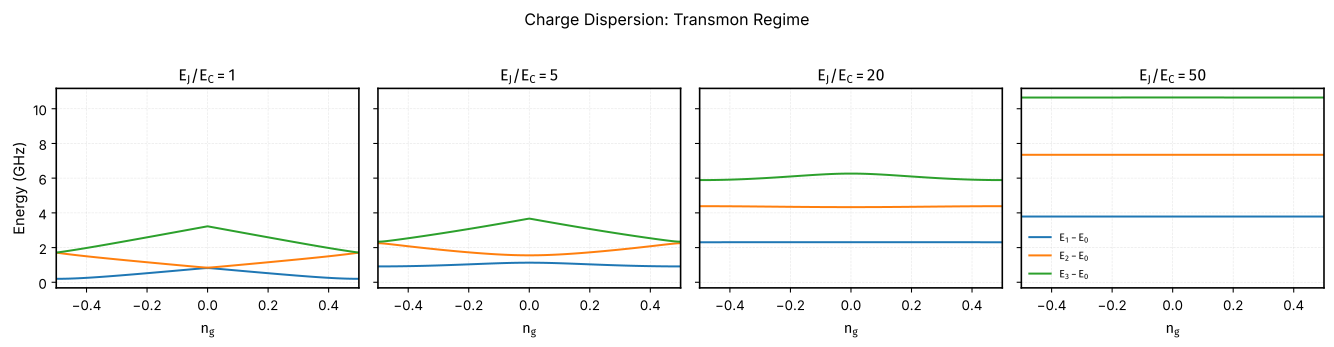
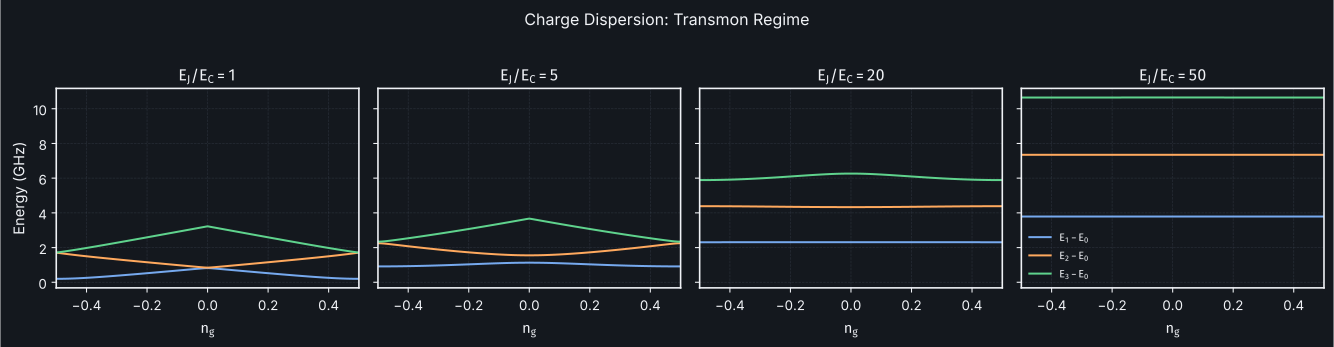
The plots demonstrate how the energy levels become increasingly flat with respect to the offset charge \(n_\text{g}\) as the ratio \(E_\text{J}/E_\text{C}\) grows. In the transmon regime (\(E_\text{J}/E_\text{C} \gtrsim 50\)), the charge dispersion is exponentially suppressed, making the qubit insensitive to charge noise—a key design advantage [KYG+07].
Transmon–Resonator Coupling#
In circuit QED, the transmon is coupled to a readout resonator via the electric-field interaction [BGGW21]:
where \(\hat{a}\) and \(\hat{b}\) are the transmon and resonator ladder operators respectively, and \(g\) is the coupling strength.
We build the full transmon–resonator Hamiltonian in the energy eigenbasis of the transmon (Duffing oscillator approximation) and diagonalise it using NetKet to extract the dispersive shift \(\chi\):
where \(E_{ij}\) is the dressed eigenenergy with \(i\) transmon excitations and \(j\) resonator photons.
omega_r_val = 7.0  # Resonator frequency in GHz
g_val = 0.1  # Coupling strength in GHz
n_levels = 8  # Truncation level for each mode

# Combined Hilbert space: site 0 = transmon, site 1 = resonator
hi_combined = nk.hilbert.Fock(n_max=n_levels - 1, N=2)

# Transmon as Duffing oscillator: f01 * n + (α/2) * n(n-1)
H_qubit = jnp.diag(
    jnp.array([f01 * n + (alpha_nk / 2) * n * (n - 1) for n in range(n_levels)])
)

# Resonator: ω_r * n
H_res = jnp.diag(jnp.array([omega_r_val * n for n in range(n_levels)]))

# (a + a†) ladder operator
a_plus_adag = jnp.zeros((n_levels, n_levels))
for n in range(n_levels - 1):
    a_plus_adag = a_plus_adag.at[n, n + 1].set(jnp.sqrt(n + 1))
    a_plus_adag = a_plus_adag.at[n + 1, n].set(jnp.sqrt(n + 1))

# Coupling operator: g * (a + a†) ⊗ (b + b†)
coupling = g_val * jnp.kron(a_plus_adag, a_plus_adag)

# Build full Hamiltonian as sum of NetKet operators
H_full = (
    nk.operator.LocalOperator(hi_combined, np.asarray(H_qubit), acting_on=[0])
    + nk.operator.LocalOperator(hi_combined, np.asarray(H_res), acting_on=[1])
    + nk.operator.LocalOperator(hi_combined, np.asarray(coupling), acting_on=[0, 1])
)

# Full exact diagonalisation
evals_full, evecs_full = nk.exact.full_ed(H_full, compute_eigenvectors=True)
sort_idx = jnp.argsort(evals_full)
evals_full = evals_full[sort_idx]
evecs_full = evecs_full[:, sort_idx]


# Identify dressed states by maximum overlap with bare states
def _find_dressed(qubit_idx: int, res_idx: int) -> int:
    """Return the index of the dressed state closest to |qubit_idx, res_idx⟩."""
    bare = jnp.zeros(n_levels**2)
    bare = bare.at[qubit_idx * n_levels + res_idx].set(1.0)
    return int(jnp.argmax(jnp.abs(evecs_full.T @ bare) ** 2))


idx_00 = _find_dressed(0, 0)
idx_10 = _find_dressed(1, 0)
idx_01 = _find_dressed(0, 1)
idx_11 = _find_dressed(1, 1)

chi_netket = (evals_full[idx_11] - evals_full[idx_10]) - (
    evals_full[idx_01] - evals_full[idx_00]
)

display(
    Math(rf"""
\textbf{{Dispersive Shift (NetKet):}} \\
g = {g_val * 1e3:.0f}\,\text{{MHz}}, \quad
\omega_\text{{r}} = {omega_r_val:.1f}\,\text{{GHz}} \\
\Delta = \omega_\text{{q}} - \omega_\text{{r}} = {f01 - omega_r_val:.3f}\,\text{{GHz}} \\
\chi = {chi_netket * 1e3:.3f}\,\text{{MHz}}
""")
)
Dispersive Shift vs. Coupling Strength#
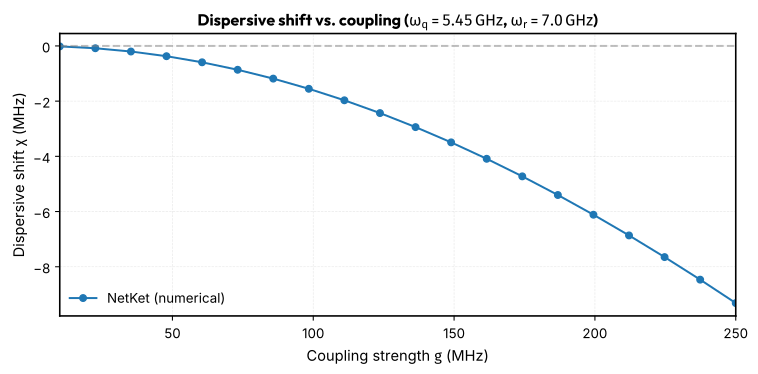
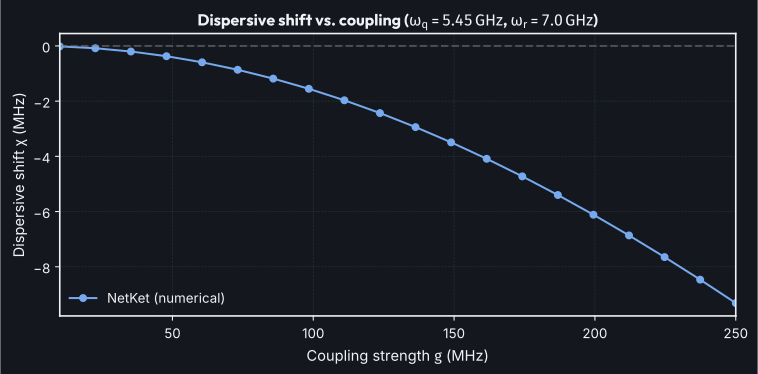
We sweep the coupling strength \(g\) to observe the quadratic scaling of the dispersive shift in the dispersive regime (\(g \ll |\Delta|\)).
g_sweep = jnp.linspace(0.01, 0.25, 20)
chi_sweep = jnp.zeros_like(g_sweep)

for i, g_i in enumerate(g_sweep):
    H_i = (
        nk.operator.LocalOperator(hi_combined, np.asarray(H_qubit), acting_on=[0])
        + nk.operator.LocalOperator(hi_combined, np.asarray(H_res), acting_on=[1])
        + nk.operator.LocalOperator(
            hi_combined,
            np.asarray(g_i * jnp.kron(a_plus_adag, a_plus_adag)),
            acting_on=[0, 1],
        )
    )
    ev_i, evc_i = nk.exact.full_ed(H_i, compute_eigenvectors=True)
    si = jnp.argsort(ev_i)
    ev_i, evc_i = ev_i[si], evc_i[:, si]

    def _fd(qi: int, ri: int, _evc: np.ndarray = evc_i) -> int:
        bv = jnp.zeros(n_levels**2)
        bv = bv.at[qi * n_levels + ri].set(1.0)
        return int(jnp.argmax(jnp.abs(_evc.T @ bv) ** 2))

    j00, j10, j01, j11 = _fd(0, 0), _fd(1, 0), _fd(0, 1), _fd(1, 1)
    chi_sweep = chi_sweep.at[i].set((ev_i[j11] - ev_i[j10]) - (ev_i[j01] - ev_i[j00]))

fig, ax = plt.subplots(figsize=(8, 4))
ax.plot(g_sweep * 1e3, chi_sweep * 1e3, "o-", markersize=5, label="NetKet (numerical)")
ax.axhline(0, color="gray", linestyle="--", alpha=0.5)
ax.set_xlabel("Coupling strength $g$ (MHz)")
ax.set_ylabel(r"Dispersive shift $\chi$ (MHz)")
ax.set_title(
    rf"Dispersive shift vs. coupling ($\omega_\text{{q}} = {f01:.2f}\,\text{{GHz}}$, "
    rf"$\omega_\text{{r}} = {omega_r_val:.1f}\,\text{{GHz}}$)"
)
ax.legend()
ax.grid(True, alpha=0.3)
fig.tight_layout()
plt.show()
Design Workflow: From Target \(\chi\) to Layout Parameters#
The purpose of computing \(\chi\) is to design a qubit–resonator system with a target dispersive shift. The workflow is:
Choose target \(\chi\) based on readout speed requirements
Select \(\omega_\text{q}\), \(\omega_\text{r}\), \(\alpha\) from qubit design goals
Determine \(g\) from target \(\chi\) using qpdk helpers
Convert to circuit parameters (\(C_\Sigma\), \(L_\text{J}\), \(C_\text{c}\))
Convert to layout parameters (resonator length, capacitor geometry)
Step 1–3: From target \(\chi\) to coupling \(g\)#
# Design targets
chi_target_mhz = -1.0  # Target dispersive shift in MHz
chi_target = chi_target_mhz * 1e-3  # Convert to GHz

# Qubit and resonator parameters (from NetKet calculation above)
EJ_design = EJ
EC_design = EC
omega_r_design = omega_r_val

# Use the analytical transmon approximation for design
omega_t_design, alpha_design = ej_ec_to_frequency_and_anharmonicity(
    EJ_design, EC_design
)

# Find g using the qpdk analytical inversion
g_design = dispersive_shift_to_coupling(
    chi_target, omega_t_design, omega_r_design, alpha_design
)

display(
    Math(rf"""
\textbf{{Step 1–3: Hamiltonian Design}} \\
\text{{Target:}}\quad \chi = {chi_target_mhz:.1f}\,\text{{MHz}} \\
E_\text{{J}} = {EJ_design:.1f}\,\text{{GHz}}, \quad
E_\text{{C}} = {EC_design:.1f}\,\text{{GHz}} \\
\omega_\text{{q}} = {omega_t_design:.3f}\,\text{{GHz}}, \quad
\alpha \approx -E_\text{{C}} = -{EC_design:.1f}\,\text{{GHz}} \\
\omega_\text{{r}} = {omega_r_design:.1f}\,\text{{GHz}} \\
\text{{Required coupling:}}\quad g = {float(g_design) * 1e3:.1f}\,\text{{MHz}}
""")
)
Step 4: Convert to circuit parameters#
Using the qpdk helper functions, we convert the Hamiltonian parameters to circuit parameters:
Total qubit capacitance \(C_\Sigma\) from \(E_\text{C}\) via
ec_to_capacitanceJosephson inductance \(L_\text{J}\) from \(E_\text{J}\) via
ej_to_inductanceCoupling capacitance \(C_\text{c}\) from \(g\) via
coupling_strength_to_capacitance
# Total qubit capacitance
C_sigma = float(ec_to_capacitance(EC_design))

# Josephson inductance
L_J = float(ej_to_inductance(EJ_design))

# Determine resonator length for the target frequency
ep_eff, z0 = cpw_parameters(width=10, gap=6)


def _resonator_objective(x: np.ndarray) -> float:
    """Minimise the squared frequency error.

    Returns:
        The squared error between the calculated and design frequency.
    """
    freq = resonator_frequency(
        length=float(x[0]),
        epsilon_eff=float(jnp.real(ep_eff)),
        is_quarter_wave=True,
    )
    return (freq - omega_r_design * 1e9) ** 2


result = scipy.optimize.minimize(_resonator_objective, 4000.0, bounds=[(1000, 20000)])
resonator_length = result.x[0]

# Total resonator capacitance from CPW impedance and phase velocity
# {cite:p}`gopplCoplanarWaveguideResonators2008a`:
# C_r = l / Re(Z_0 * v_p)
C_r = float(1 / jnp.real(z0 * (c_0 / jnp.sqrt(ep_eff))) * resonator_length * 1e-6)  # F

# Coupling capacitance
C_c = float(
    coupling_strength_to_capacitance(
        g_ghz=float(g_design),
        c_sigma=C_sigma,
        c_r=C_r,
        f_q_ghz=omega_t_design,
        f_r_ghz=omega_r_design,
    )
)

display(
    Math(rf"""
\textbf{{Step 4: Circuit Parameters}} \\
C_\Sigma = {C_sigma * 1e15:.1f}\,\text{{fF}} \\
L_\text{{J}} = {L_J * 1e9:.2f}\,\text{{nH}} \\
C_\text{{r}} = {C_r * 1e15:.1f}\,\text{{fF}} \\
C_\text{{c}} = {C_c * 1e15:.2f}\,\text{{fF}}
""")
)
Step 5: Layout parameters#
The circuit parameters map directly to layout dimensions:
f_resonator_achieved = resonator_frequency(
    length=resonator_length,
    epsilon_eff=float(jnp.real(ep_eff)),
    is_quarter_wave=True,
)

display(
    Math(rf"""
\textbf{{Step 5: Layout Parameters}} \\
\text{{Resonator length:}}\quad l = {resonator_length:.0f}\,\text{{µm}} \\
\text{{Resonator CPW width:}}\quad w = 10\,\text{{µm}}, \quad
\text{{gap}} = 6\,\text{{µm}} \\
\text{{Resonator frequency achieved:}}\quad
f_\text{{r}} = {f_resonator_achieved / 1e9:.3f}\,\text{{GHz}}
""")
)
Readout System Design Considerations#
A complete readout design also requires considering the resonator linewidth \(\kappa\), the Purcell decay rate, and the measurement-induced dephasing.
# Resonator quality factor and linewidth
Q_ext = 10_000  # External quality factor
kappa = resonator_linewidth_from_q(omega_r_design, Q_ext)

# Purcell decay rate
gamma_purcell = purcell_decay_rate(
    float(g_design), omega_t_design, omega_r_design, kappa
)
T_purcell = 1 / (gamma_purcell * 1e9) if gamma_purcell > 0 else float("inf")

# Measurement-induced dephasing
n_bar = 5.0  # Mean photon number during readout
gamma_phi = measurement_induced_dephasing(chi_target, kappa, n_bar)

# SNR estimate: the signal-to-noise ratio scales as χ/κ
chi_over_kappa = abs(chi_target) / kappa

display(
    Math(rf"""
\textbf{{Readout System Parameters:}} \\
Q_\text{{ext}} = {Q_ext:,} \\
\kappa = \omega_\text{{r}} / Q_\text{{ext}} = {kappa * 1e6:.1f}\,\text{{kHz}} \\
\gamma_\text{{Purcell}} = \kappa (g/\Delta)^2
  = {gamma_purcell * 1e6:.2f}\,\text{{kHz}}
  \quad \Rightarrow \quad T_\text{{Purcell}}
  = {T_purcell * 1e6:.0f}\,\text{{µs}} \\
\Gamma_\phi(\bar{{n}}={n_bar:.0f})
  = 8\chi^2 \bar{{n}} / \kappa
  = {gamma_phi * 1e6:.2f}\,\text{{kHz}} \\
|\chi| / \kappa = {chi_over_kappa:.1f}
  \quad (\text{{want}} \gtrsim 1 \text{{ for high-fidelity readout}})
""")
)
QPDK Layout Components#
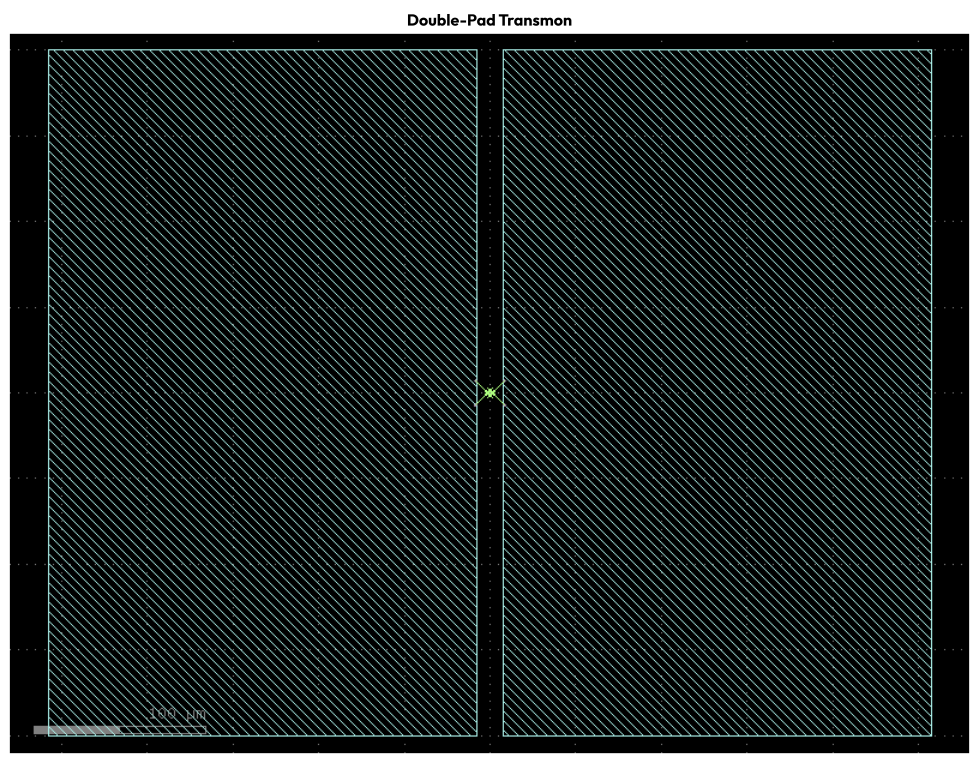
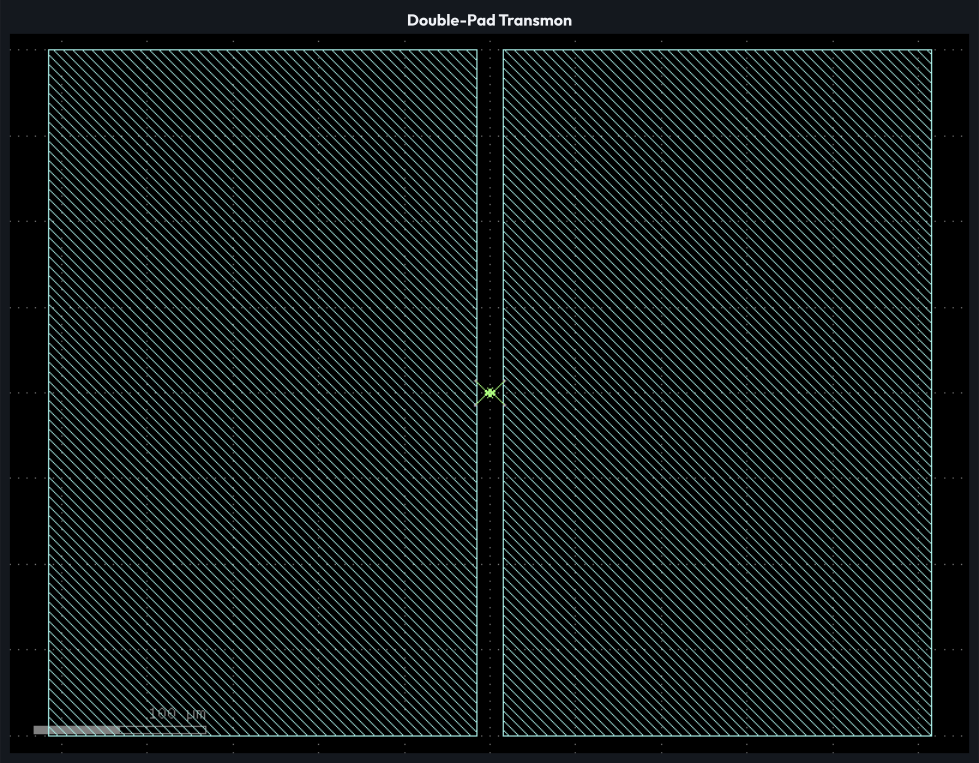
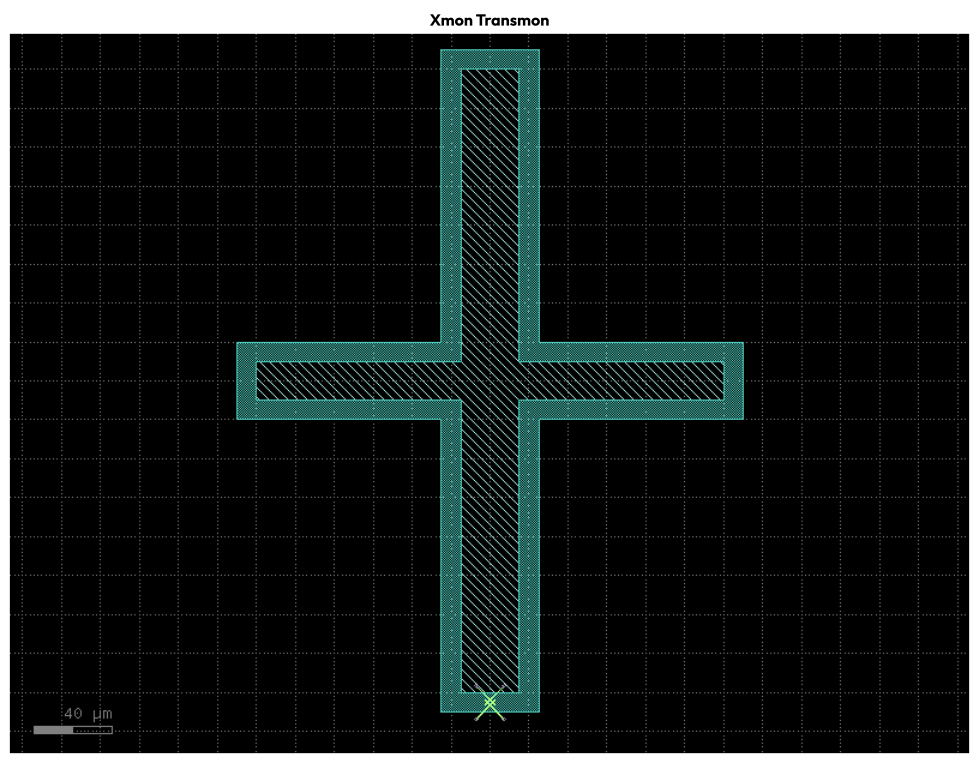
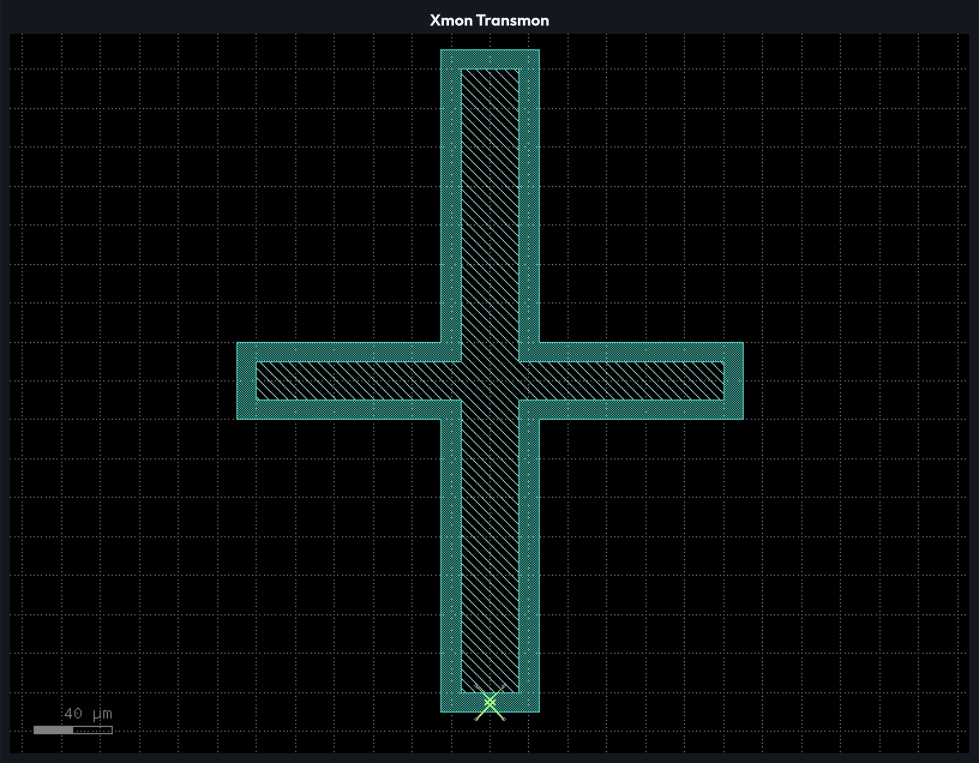
The design parameters computed above map directly to physical layout cells in qpdk. Below we show two transmon geometries that can be used for fabrication: the double-pad transmon and the Xmon transmon.
Each cell exposes design parameters (pad dimensions, gap widths, junction dimensions) that determine the Hamiltonian parameters \(E_\text{J}\), \(E_\text{C}\), and \(g\) through their effect on the capacitance and Josephson energy of the circuit.
c_dpt = double_pad_transmon()
c_dpt.plot()
plt.title("Double-Pad Transmon")
plt.show()
c_xmon = xmon_transmon()
c_xmon.plot()
plt.title("Xmon Transmon")
plt.show()
Design parameter mapping:
Layout parameter |
Circuit parameter |
Hamiltonian parameter |
|---|---|---|
Pad dimensions, gap width |
\(C_\Sigma\) (total capacitance) |
\(E_\text{C} = e^2 / (2 C_\Sigma)\) |
Junction area, critical current |
\(L_\text{J}\) (Josephson inductance) |
\(E_\text{J} = \Phi_0^2 / (4\pi^2 L_\text{J})\) |
Coupling finger length / gap |
\(C_\text{c}\) (coupling capacitance) |
\(g \propto C_\text{c} / \sqrt{C_\Sigma C_\text{r}}\) |
CPW length, width, gap |
\(Z_0\), \(\varepsilon_\text{eff}\) |
\(\omega_\text{r}\) (resonator frequency) |
Summary: Complete Design Table#
The table below summarises the full design flow from Hamiltonian parameters to layout parameters, with the dispersive shift as the central design target.
data = [
    ("Target", "Target dispersive shift $\\chi$", f"{chi_target_mhz:.1f}", "MHz"),
    ("Hamiltonian", "$E_\\text{J}$", f"{EJ_design:.1f}", "GHz"),
    ("Hamiltonian", "$E_\\text{C}$", f"{EC_design:.1f}", "GHz"),
    ("Hamiltonian", "$\\omega_\\text{q}$ (NetKet)", f"{f01:.4f}", "GHz"),
    ("Hamiltonian", "$\\omega_\\text{q}$ (approx.)", f"{omega_t_design:.4f}", "GHz"),
    ("Hamiltonian", "$\\alpha$ (NetKet)", f"{alpha_nk:.4f}", "GHz"),
    ("Hamiltonian", "$\\omega_\\text{r}$", f"{omega_r_design:.1f}", "GHz"),
    ("Hamiltonian", "$g$", f"{float(g_design) * 1e3:.1f}", "MHz"),
    ("Circuit", "$C_\\Sigma$", f"{C_sigma * 1e15:.1f}", "fF"),
    ("Circuit", "$L_\\text{J}$", f"{L_J * 1e9:.2f}", "nH"),
    ("Circuit", "$C_\\text{r}$", f"{C_r * 1e15:.1f}", "fF"),
    ("Circuit", "$C_\\text{c}$", f"{C_c * 1e15:.2f}", "fF"),
    ("Layout", "Resonator length", f"{resonator_length:.0f}", "µm"),
    ("Layout", "Resonator CPW width", "10", "µm"),
    ("Layout", "Resonator CPW gap", "6", "µm"),
    ("Layout", "Resonator freq", f"{f_resonator_achieved / 1e9:.3f}", "GHz"),
    ("Readout", "$Q_{\\text{ext}}$", f"{Q_ext:,}", ""),
    ("Readout", "$\\kappa$", f"{kappa * 1e6:.1f}", "kHz"),
    ("Readout", "$T_{\\text{Purcell}}$", f"{T_purcell * 1e6:.0f}", "µs"),
    ("Readout", "$|\\chi|/\\kappa$", f"{chi_over_kappa:.1f}", ""),
]

df = pl.DataFrame(data, schema=["Category", "Parameter", "Value", "Unit"], orient="row")

display_dataframe(df)
| Category | Parameter | Value | Unit |
|---|---|---|---|
| Target | Target dispersive shift χ | -1.0 | MHz |
| Hamiltonian | EJ | 20.0 | GHz |
| Hamiltonian | EC | 0.2 | GHz |
| Hamiltonian | ωq (NetKet) | 5.4490 | GHz |
| Hamiltonian | ωq (approx.) | 5.4569 | GHz |
| Hamiltonian | α (NetKet) | -0.2191 | GHz |
| Hamiltonian | ωr | 7.0 | GHz |
| Hamiltonian | g | 82.0 | MHz |
| Circuit | CΣ | 96.9 | fF |
| Circuit | LJ | 8.17 | nH |
| Circuit | Cr | 724.2 | fF |
| Circuit | Cc | 7.03 | fF |
| Layout | Resonator length | 4348 | µm |
| Layout | Resonator CPW width | 10 | µm |
| Layout | Resonator CPW gap | 6 | µm |
| Layout | Resonator freq | 7.000 | GHz |
| Readout | Qext | 10,000 | |
| Readout | κ | 700.0 | kHz |
| Readout | TPurcell | 506 | µs |
| Readout | |χ|/κ | 1.4 |
References#
Alexandre Blais, Arne L. Grimsmo, S. M. Girvin, and Andreas Wallraff. Circuit quantum electrodynamics. Reviews of Modern Physics, 93(2):025005, May 2021. doi:10.1103/RevModPhys.93.025005.
Giuseppe Carleo, Kenny Choo, Damian Hofmann, James ET Smith, Tom Westerhout, Fabien Alet, Emily J Davis, Stavros Efthymiou, Ivan Glasser, Sheng-Hsuan Lin, Marta Mauri, Guglielmo Mazzola, Christian B Pereira, and Filippo Vicentini. Netket: a machine learning toolkit for many-body quantum systems. SoftwareX, 10:100311, 2019. doi:10.1016/j.softx.2019.100311.
Jens Koch, Terri M. Yu, Jay Gambetta, A. A. Houck, D. I. Schuster, J. Majer, Alexandre Blais, M. H. Devoret, S. M. Girvin, and R. J. Schoelkopf. Charge-insensitive qubit design derived from the Cooper pair box. Physical Review A, 76(4):042319, October 2007. doi:10.1103/PhysRevA.76.042319.
F. Rosenblatt. The perceptron: A probabilistic model for information storage and organization in the brain. Psychological Review, 65(6):386–408, 1958. doi:10.1037/h0042519.
Filippo Vicentini, Damian Hofmann, Attila Szabó, Dian Wu, Christopher Roth, Clemens Giuliani, Gabriel Pescia, Jannes Nys, Vladimir Vargas-Calderón, Nikita Astrakhantsev, and Giuseppe Carleo. Netket 3: machine learning toolbox for many-body quantum systems. SciPost Phys. Codebases, pages 7, 2022. doi:10.21468/SciPostPhysCodeb.7.