

JAX Backend Comparison for Quantum Circuit Simulation#
This notebook loads recorded CPU, CUDA, and Apple Silicon (MPS) measurements
from Parquet files in notebooks/data/jax_backend_comparison/. Documentation CI
executes the analysis and renders the plots; no GPU or live benchmark is needed.
The sweeps cover 100 to 30 million frequency points.
Each curve identifies its hardware and precision. These are different machines,
so the plot compares complete systems, with a CPU baseline for each machine.
Recording measurements#
Install the models extra and fetch the data with Git LFS from a checkout:
uv sync --extra models
git lfs pull --include="notebooks/data/jax_backend_comparison/*.parquet"
The recorder builds a capacitively coupled quarter-wave resonator with 500 µm
feedlines, a 20 fF coupling capacitor, and a 4000 µm shorted CPW stub (width
10 µm, gap 6 µm). SAX’s pure-JAX filipsson_gunnar solver runs on every device;
the default KLU solver’s FFI kernels are CPU-only. For each sweep size it warms
up jax.jit, checks output precision and device, then times ten evaluations,
synchronizing the entire output with jax.block_until_ready on each call.
QPDK_REQUIRE_GPU=1 uv run --extra models --with "jax[cuda12]" \
  python -m qpdk.samples.benchmark_jax_backends \
  notebooks/data/jax_backend_comparison/cuda.parquet
Apple Silicon uses experimental jax-mps,
which requires JAX 0.11.x. Installing a new environment with normal dependency
resolution requires SAX to allow that version.
The saved MPS measurements use an existing experimental JAX 0.11 environment.
Once compatible SAX is available, install jax-mps alongside qpdk[models]
and use QPDK_REQUIRE_MPS=1 with the same recorder, saving apple-m5.parquet.
MPS supports float32/complex64 only; compare it with CPU and CUDA float32.
The saved runs retain their original package versions and model source hash.
Parquet stores typed nested records: one machine run per file, with all raw repetitions, workload settings, software versions, errors, and real/imaginary CPU reference arrays. Commit these files through Git LFS. Notebook outputs are stripped; changing plot styling only requires rerendering this analysis. See the extras reference for the model dependencies.
Recorded Runs#
Runs must share the same workload and CPU float64 reference before their timings can be compared. The reference uses 1001 points from 2 to 8 GHz. All errors below are absolute linear transmission errors, not dB errors or relative errors near the resonance dip.
result_paths = sorted(
    (PATH.repo / "notebooks/data/jax_backend_comparison").glob("*.parquet")
)
if not result_paths:
    raise FileNotFoundError(
        "No benchmark records found. Fetch the Parquet files with Git LFS."
    )
runs = [pq.read_table(path).to_pylist()[0] for path in result_paths]
workload = runs[0]["workload"]
_BENCHMARK_SIZES = workload["sizes"]
_N_REPEATS = workload["n_repeats"]
reference = np.asarray(runs[0]["reference_s21"]["real"]) + 1j * np.asarray(
    runs[0]["reference_s21"]["imag"]
)
for result_path, run in zip(result_paths, runs, strict=True):
    if run["workload"] != workload:
        raise ValueError(f"Recorded workload differs in {result_path.name}.")
    trace = run["reference_s21"]
    np.testing.assert_allclose(
        np.asarray(trace["real"]) + 1j * np.asarray(trace["imag"]),
        reference,
        rtol=1e-10,
        atol=1e-12,
        err_msg=f"CPU reference differs in {result_path.name}",
    )

combined_results = {}
for run in runs:
    for result in run["results"]:
        name = f"{result['hardware']} / {result['backend']}"
        combined_results.setdefault(name, (run, result))

print(
    f"{'Hardware / backend':<60} {'JAX':<8} {'Max |S21| error':>17} {'Max complex error':>19}"
)
for name, (run, result) in combined_results.items():
    samples = np.asarray(result["samples_s"])
    if samples.shape != (len(_BENCHMARK_SIZES), _N_REPEATS) or not np.all(
        np.isfinite(samples) & (samples > 0)
    ):
        raise ValueError(f"Invalid timing samples for {name}.")
    print(
        f"{name:<60} {run['versions']['jax']:<8} {result['magnitude_error']:17.6g} {result['complex_error']:19.6g}"
    )
    print(
        f"  {run['system']}; Python {run['python']}; packages {run['versions']}; recorded {run['recorded_at']}"
    )
Hardware / backend                                           JAX        Max |S21| error   Max complex error
Apple M5 / CPU float64                                       0.11.1         1.11022e-15          1.2654e-15
  Darwin; Python 3.13.16; packages {'jax': '0.11.1', 'jaxlib': '0.11.1', 'sax': '0.18.2', 'jaxellip': '0.0.1', 'jax-mps': '0.11.0'}; recorded 2026-10-15T16:25:45.698756+00:00
Apple M5 / CPU float32                                       0.11.1         0.000207334         0.000213879
  Darwin; Python 3.13.16; packages {'jax': '0.11.1', 'jaxlib': '0.11.1', 'sax': '0.18.2', 'jaxellip': '0.0.1', 'jax-mps': '0.11.0'}; recorded 2026-10-15T16:25:45.698756+00:00
Apple M5 GPU / MPS float32                                   0.11.1          0.00026673         0.000289203
  Darwin; Python 3.13.16; packages {'jax': '0.11.1', 'jaxlib': '0.11.1', 'sax': '0.18.2', 'jaxellip': '0.0.1', 'jax-mps': '0.11.0'}; recorded 2026-10-15T16:25:45.698756+00:00
Intel(R) Xeon(R) CPU E5-2698 v4 @ 2.20GHz / CPU float64      0.11.1         1.05471e-15         1.27381e-15
  Linux; Python 3.13.15; packages {'jax': '0.11.1', 'jaxlib': '0.11.1', 'sax': '0.18.2', 'jaxellip': '0.0.1'}; recorded 2026-10-15T16:32:16.476474+00:00
Intel(R) Xeon(R) CPU E5-2698 v4 @ 2.20GHz / CPU float32      0.11.1         0.000202238         0.000216401
  Linux; Python 3.13.15; packages {'jax': '0.11.1', 'jaxlib': '0.11.1', 'sax': '0.18.2', 'jaxellip': '0.0.1'}; recorded 2026-10-15T16:32:16.476474+00:00
Tesla V100-SXM2-32GB / CUDA float64                          0.11.1         7.43849e-15         7.61859e-15
  Linux; Python 3.13.15; packages {'jax': '0.11.1', 'jaxlib': '0.11.1', 'sax': '0.18.2', 'jaxellip': '0.0.1'}; recorded 2026-10-15T16:32:16.476474+00:00
Tesla V100-SXM2-32GB / CUDA float32                          0.11.1         0.000203788         0.000210198
  Linux; Python 3.13.15; packages {'jax': '0.11.1', 'jaxlib': '0.11.1', 'sax': '0.18.2', 'jaxellip': '0.0.1'}; recorded 2026-10-15T16:32:16.476474+00:00
Reference Transmission#
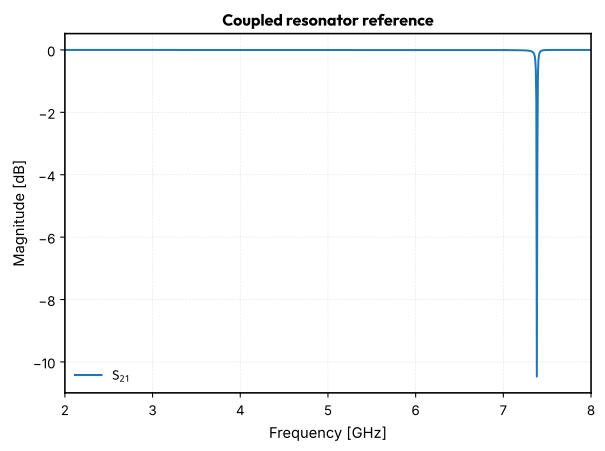
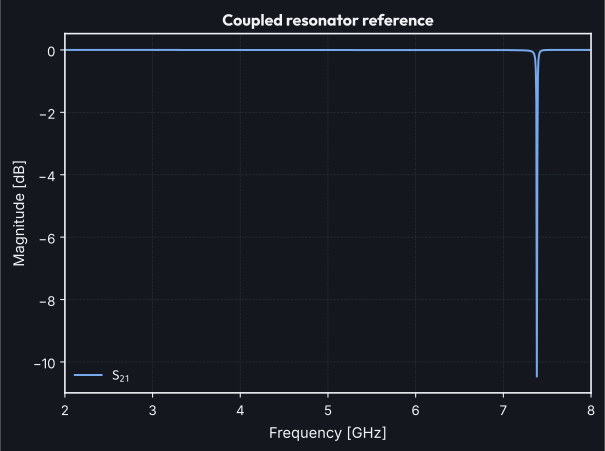
The saved CPU float64 trace shows the resonance of the coupled resonator.
f_start, f_stop = workload["frequency_hz"]
freq_ghz = np.linspace(f_start, f_stop, len(reference)) / 1e9
fig, ax = plt.subplots()
ax.plot(freq_ghz, 20 * np.log10(np.abs(reference)), label="$S_{21}$")
ax.set_xlabel("Frequency [GHz]")
ax.set_ylabel("Magnitude [dB]")
ax.set_title("Coupled resonator reference")
ax.legend()
plt.show()
Scaling Analysis#
The cost of one evaluation has two parts: a fixed overhead per call (dispatch and kernel launches) and a cost per frequency point. We therefore model the median time as
where \(t_0\) is the overhead and \(c\) the cost per point. A single power law \(t = a N^b\) cannot describe this: the overhead dominates at small \(N\), so the curve is flat there and only becomes linear once \(c N \gg t_0\), near the crossover size \(N^\ast = t_0 / c\).
The timings span several decades, so an ordinary least-squares fit would only follow the largest sizes. We minimise the relative residuals instead, which is still a linear problem: dividing \(t_0 + c N_i \approx t_i\) by \(t_i\) gives \(t_0 / t_i + c \, N_i / t_i \approx 1\). Both parameters are physically non-negative; if the unconstrained solution makes one of them negative, we drop that term and refit.
def fit_overhead_model(sizes: list[int], times: list[float]) -> tuple[float, float]:
    """Fit ``t = t0 + c * N`` to timings, minimising the relative residuals.

    Args:
        sizes: Number of frequency points per measurement.
        times: Median evaluation time [s] per measurement.

    Returns:
        Fixed overhead ``t0`` [s] and cost per frequency point ``c`` [s].
    """
    n = np.asarray(sizes, dtype=float)
    t = np.asarray(times, dtype=float)
    design = np.column_stack([1 / t, n / t])
    (t0, c), *_ = np.linalg.lstsq(design, np.ones_like(t), rcond=None)
    if t0 < 0:  # pure per-point cost: minimise sum((c * N / t - 1) ** 2)
        x = n / t
        t0, c = 0.0, x.sum() / (x**2).sum()
    elif c < 0:  # pure overhead
        x = 1 / t
        t0, c = x.sum() / (x**2).sum(), 0.0
    return float(t0), float(c)


backend_times = {
    name: np.median(result["samples_s"], axis=1).tolist()
    for name, (_, result) in combined_results.items()
}

fits = {
    name: fit_overhead_model(_BENCHMARK_SIZES, times)
    for name, times in backend_times.items()
}

for name, (t0, c) in fits.items():
    t_model = t0 + c * np.asarray(_BENCHMARK_SIZES)
    max_error = np.max(np.abs(t_model / np.asarray(backend_times[name]) - 1))
    print(
        f"{name}: t0 = {t0 * 1e6:8.1f} µs, c = {c * 1e9:8.2f} ns/point, "
        f"N* = t0/c ≈ {t0 / c if c > 0 else float('inf'):,.0f} points, "
        f"max relative error {max_error:.0%}"
    )
Apple M5 / CPU float64: t0 =     67.0 µs, c =    41.11 ns/point, N* = t0/c ≈ 1,631 points, max relative error 62%
Apple M5 / CPU float32: t0 =     64.0 µs, c =    16.93 ns/point, N* = t0/c ≈ 3,779 points, max relative error 48%
Apple M5 GPU / MPS float32: t0 =  11936.0 µs, c =    12.39 ns/point, N* = t0/c ≈ 963,254 points, max relative error 6%
Intel(R) Xeon(R) CPU E5-2698 v4 @ 2.20GHz / CPU float64: t0 =    159.0 µs, c =   161.95 ns/point, N* = t0/c ≈ 982 points, max relative error 58%
Intel(R) Xeon(R) CPU E5-2698 v4 @ 2.20GHz / CPU float32: t0 =    134.8 µs, c =    53.74 ns/point, N* = t0/c ≈ 2,508 points, max relative error 47%
Tesla V100-SXM2-32GB / CUDA float64: t0 =    904.3 µs, c =     1.58 ns/point, N* = t0/c ≈ 570,945 points, max relative error 28%
Tesla V100-SXM2-32GB / CUDA float32: t0 =    619.1 µs, c =     0.31 ns/point, N* = t0/c ≈ 2,000,325 points, max relative error 51%
Performance Comparison#
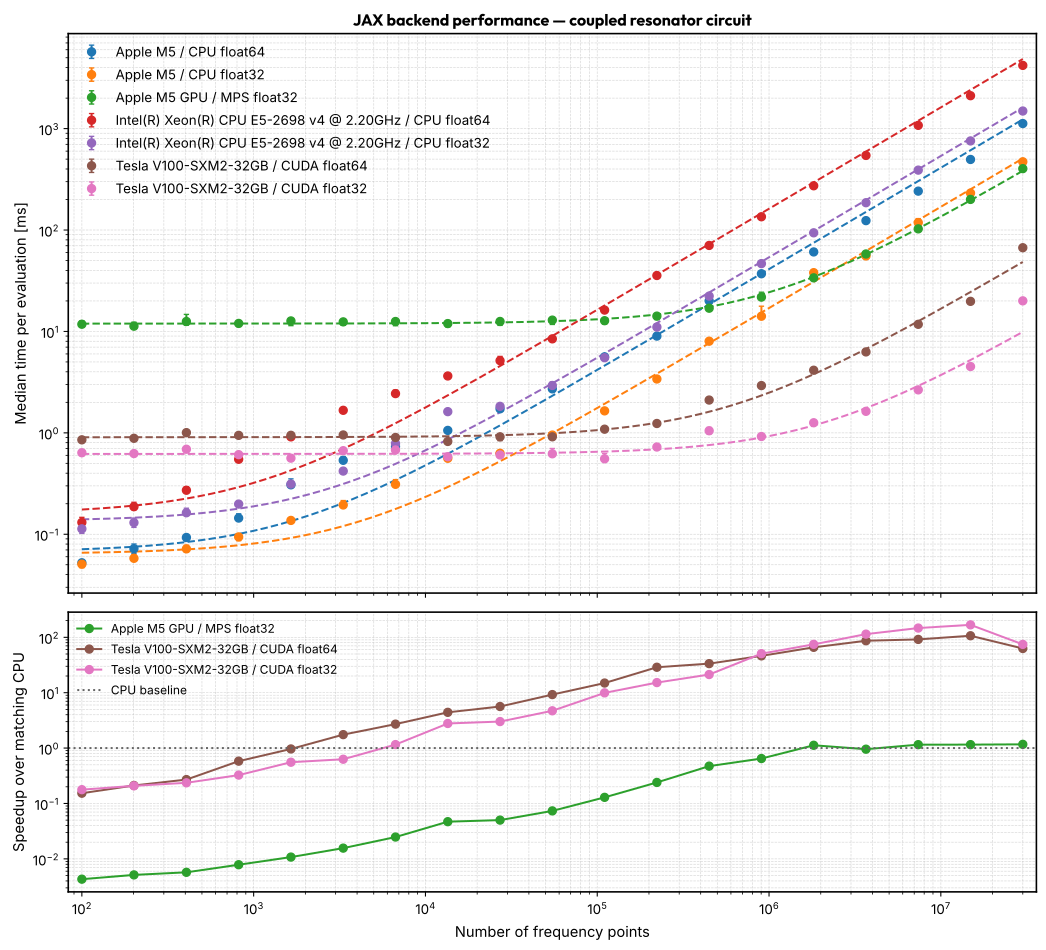
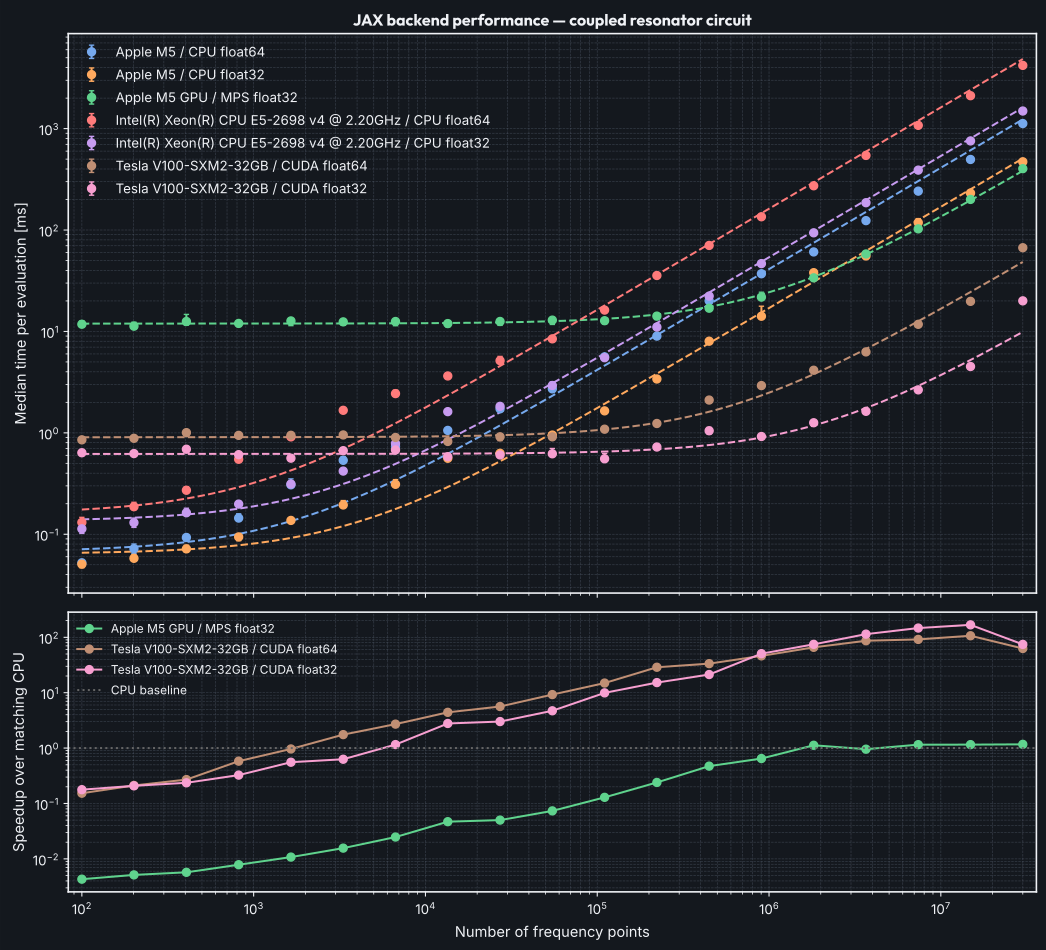
The plot below shows the median evaluation time against the number of frequency points, with the fitted model as a dashed line for each backend. On log–log axes the model is flat below \(N^\ast\) and has slope 1 above it. Hardware and precision are shown for every curve; the CPU rows are the baselines for their own machines. Points show measured medians. Error bars span the 25th to 75th percentiles of the repetitions, while dashed lines show the overhead fit.
The lower panel compares each accelerator with the CPU on its own machine at matching precision. Values above 1 mean the GPU is faster. These ratios use measured medians; the fitted lines do not establish a crossover on their own.
_n_fit = np.geomspace(_BENCHMARK_SIZES[0], _BENCHMARK_SIZES[-1], 200)

fig, (ax, speedup_ax) = plt.subplots(
    2, 1, sharex=True, figsize=(11, 10), gridspec_kw={"height_ratios": [2, 1]}
)
for name, times in backend_times.items():
    t0, c = fits[name]
    samples = np.asarray(combined_results[name][1]["samples_s"])
    medians = np.asarray(times)
    lower, upper = np.percentile(samples, [25, 75], axis=1)
    line = ax.errorbar(
        _BENCHMARK_SIZES,
        medians * 1_000,
        yerr=np.asarray([medians - lower, upper - medians]) * 1_000,
        fmt="o",
        capsize=2,
        label=name,
    )[0]
    ax.plot(
        _n_fit,
        (t0 + c * _n_fit) * 1_000,
        "--",
        color=line.get_color(),
    )

    run, result = combined_results[name]
    backend, precision = result["backend"].split()
    if backend != "CPU":
        cpu = next(
            row for row in run["results"] if row["backend"] == f"CPU {precision}"
        )
        speedup = np.median(cpu["samples_s"], axis=1) / medians
        speedup_ax.plot(
            _BENCHMARK_SIZES, speedup, "o-", color=line.get_color(), label=name
        )

ax.set_xscale("log")
ax.set_yscale("log")
speedup_ax.set_xlabel("Number of frequency points")
ax.set_ylabel("Median time per evaluation [ms]")
ax.set_title("JAX backend performance — coupled resonator circuit")
ax.legend()
ax.grid(True, which="both", ls="--", alpha=0.5)
speedup_ax.set_yscale("log")
speedup_ax.set_ylabel("Speedup over matching CPU")
speedup_ax.axhline(1, color="0.4", ls=":", label="CPU baseline")
speedup_ax.legend(fontsize=9)
speedup_ax.grid(True, which="both", ls="--", alpha=0.5)
speedup_ax.set_xlim(_BENCHMARK_SIZES[0] / 1.2, _BENCHMARK_SIZES[-1] * 1.2)
plt.tight_layout()
plt.show()
Summary#
Backend |
Notes |
|---|---|
CPU |
Float64 reference and float32 baseline for comparisons at matching precision. |
GPU |
CUDA runs at both float64/complex128 and float32/complex64. Compare float32 against MPS and float64 against the CPU reference; consumer GPUs often have much lower float64 throughput. |
MPS |
Apple Silicon via experimental jax-mps; float32/complex64 only. New environments await SAX support for JAX 0.11. |
SAX / JAX integration notes#
Jit the circuit:
sax.circuitreturns an un-jitted function. Wrap it injax.jitbefore calling it repeatedly, or Python dispatch overhead dominates the runtime of small and medium sweeps.Output type:
sax.circuitreturns anSDict(a plaindictmapping port-pair tuples to JAX arrays), whichjax.jitandjax.block_until_readyaccept as a pytree.Fixed input shape:
jax.jitcompiles for a concrete input shape. Each distinct frequency-array length triggers a new compilation, so reuse one size where you can.