

Pulse-Level Simulation of Superconducting Qubits with QuTiP-QIP#
Required extras
This notebook needs the models and qutip extras:
uv add "qpdk[models,qutip]"
# or, from a checkout of this repository:
uv sync --extra models --extra qutip
# or with pip:
pip install "qpdk[models,qutip]"
See the extras reference for what each extra installs.
This notebook demonstrates how to use qutip-qip [LCM22] to perform pulse-level simulations of superconducting transmon qubits. It bridges the gap between the Hamiltonian-level design covered in the companion notebooks (scQubits parameter calculation and pymablock dispersive shift) and the actual control pulses that drive quantum gates on hardware.
We use qutip-jax as the JAX backend for QuTiP, leveraging the existing JAX integration in qpdk.
Why Pulse-Level Simulation?#
Ideal quantum gate models assume instantaneous, perfect operations. In practice, gates on superconducting qubits are realised by shaped microwave pulses applied over tens to hundreds of nanoseconds. Pulse-level simulation captures the actual time dynamics of the system, including:
Leakage to non-computational states (the third level of the transmon)
Gate errors from finite pulse duration and bandwidth
Decoherence from \(T_1\) relaxation and \(T_2\) dephasing
These effects are critical for designing high-fidelity quantum processors [KSB+20, KKY+19].
For some recent examples of qutip pulse-level simulation in the context of superconducting
qubits, see [And24, Sal23].
From Layout to Simulation: Design Mapping#
In a real quantum PDK (qpdk), the physical layout parameters directly determine the Hamiltonian parameters used in the pulse-level simulation.
Step 1: Layout Component#
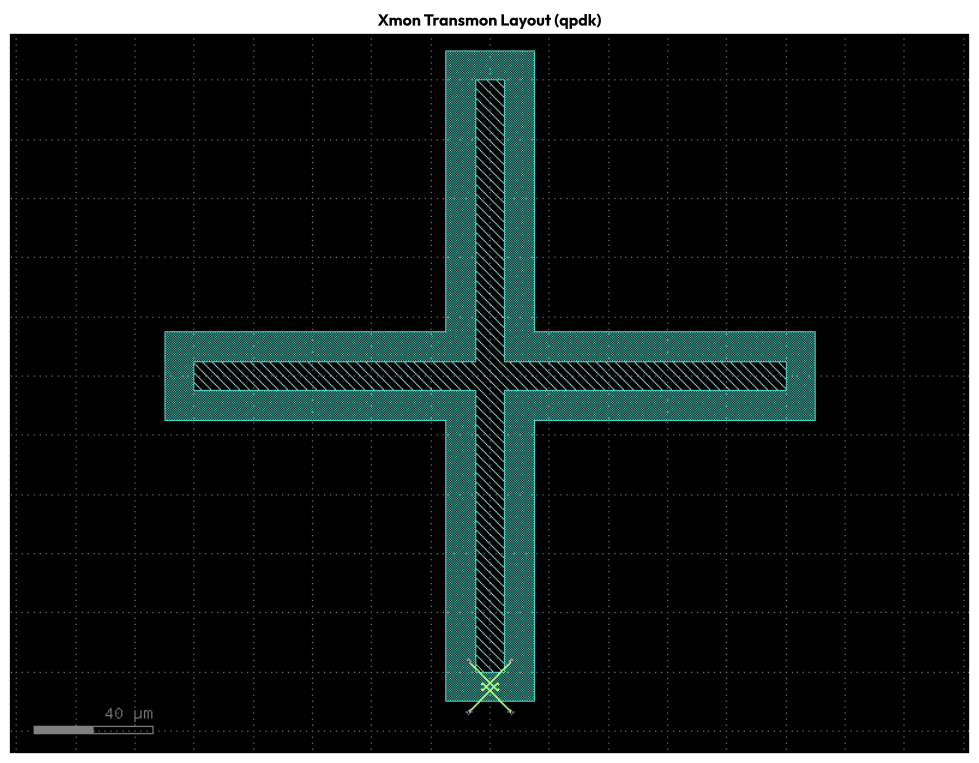
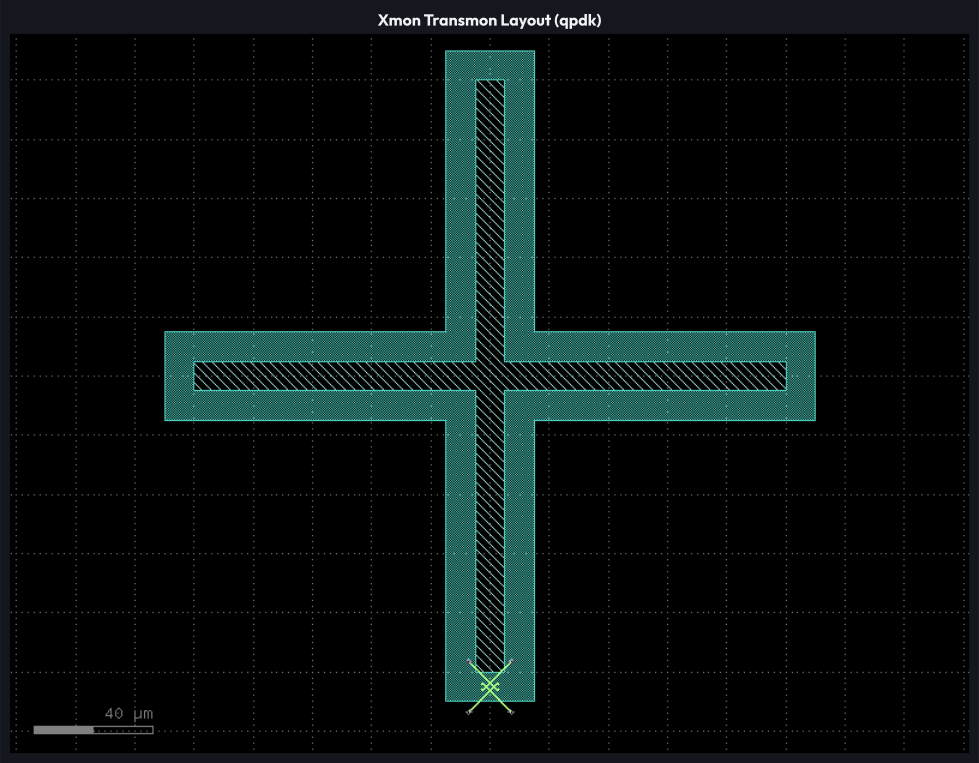
We start with an Xmon transmon design. The sizes of arms and the gap between them determine the total shunt capacitance \(C_\Sigma\), which sets the charging energy \(E_\text{C} = e^2 / (2 C_\Sigma)\).
c_transmon = xmon_transmon(arm_width=(10.0,) * 4, arm_lengths=(100.0,) * 4)
c_transmon.plot()
plt.title("Xmon Transmon Layout (qpdk)")
plt.show()
Step 2: Parameter Extraction#
Changing the arm_width and arm_length in the layout modifies \(E_\text{C}\).
For a transmon, the Josephson energy \(E_\text{J}\) is determined by the critical
current of the junction.
Below we see how a change in \(E_\text{C}\) (e.g., from making the pads larger) affects the qubit frequency \(\omega_\text{q}\) and anharmonicity \(\alpha\).
# Fixed EJ = 15 GHz
EJ_val = 15.0

# EC = 0.3 GHz (standard pads) vs EC = 0.2 GHz (larger pads)
ec_values = [0.3, 0.2]

for ec in ec_values:
    wq_calc, alpha_calc = ej_ec_to_frequency_and_anharmonicity(EJ_val, ec)
    display(
        Math(rf"""
\text{{For }} E_\text{{C}} = {ec:.1f}\,\text{{GHz}} \implies
\omega_\text{{q}} \approx {wq_calc:.3f}\,\text{{GHz}}, \quad
\alpha \approx {alpha_calc:.3f}\,\text{{GHz}}
""")
    )
Design Trade-off:
Larger pads (Lower \(E_\text{C}\)): Reduces \(\alpha\), which requires longer pulses to avoid leakage to \(|2\rangle\) (slower gates).
Smaller pads (Higher \(E_\text{C}\)): Increases \(\alpha\), allowing faster gates, but makes the qubit more sensitive to charge noise.
Pulse-Level Simulation: Single-Qubit X Gate#
We now simulate an \(X\) gate on a qubit with the extracted parameters.
The SCQubits processor captures the time-domain pulse envelopes and
the population dynamics.
# Using parameters extracted from layout (EC = 0.3 GHz, EJ = 15 GHz)
# QuTiP-QIP SCQubits expects negative anharmonicity for transmons,
# while the qpdk perturbation model returns positive values by convention.
wq0, a0 = ej_ec_to_frequency_and_anharmonicity(EJ_val, 0.3)
wq = [float(wq0), float(wq0) - 0.1]
alpha = [-float(a0), -float(a0)]

g_coupling = 0.1
wr = 6.5

qc_x = QubitCircuit(2)
qc_x.add_gate("X", targets=0)

processor_x = SCQubits(2, wq=wq, alpha=alpha, g=g_coupling, wr=wr)
processor_x.load_circuit(qc_x)

init_state = qutip.basis([3, 3], [0, 0])
result_x = cast(qutip.Result, processor_x.run_state(init_state))
Population Dynamics and Leakage#
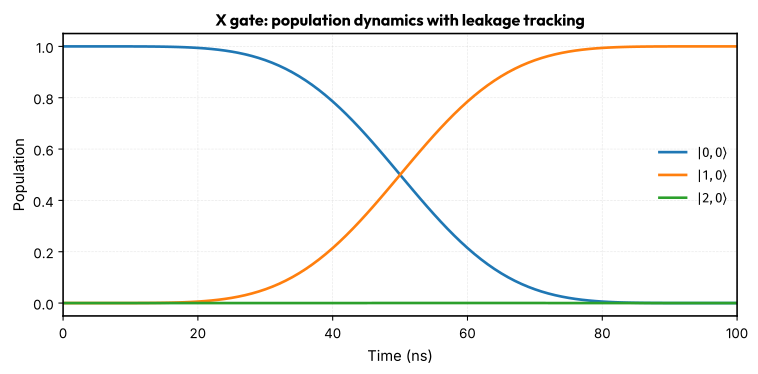
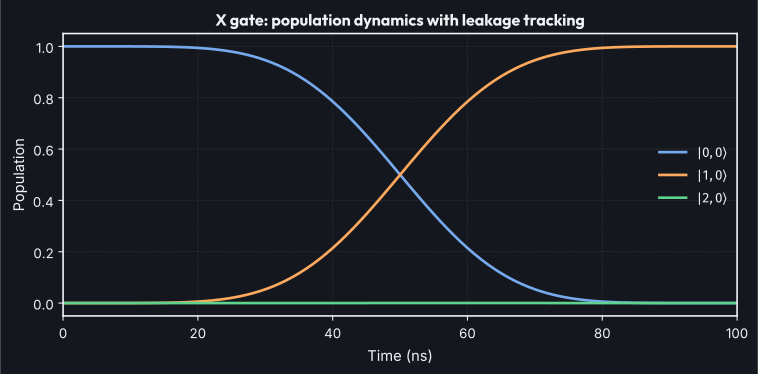
We track the population in each basis state. The 3-level transmon model reveals any leakage to the \(|2\rangle\) state, which is heavily influenced by the anharmonicity \(\alpha\) set in the layout.
# Define projection operators for population tracking
proj_ops = {
    r"$|0,0\rangle$": qutip.tensor(qutip.fock_dm(3, 0), qutip.fock_dm(3, 0)),
    r"$|1,0\rangle$": qutip.tensor(qutip.fock_dm(3, 1), qutip.fock_dm(3, 0)),
    r"$|2,0\rangle$": qutip.tensor(qutip.fock_dm(3, 2), qutip.fock_dm(3, 0)),
}

tlist_x = jnp.asarray(result_x.times)

fig, ax = plt.subplots(figsize=(8, 4))
for label, proj in proj_ops.items():
    pops = [qutip.expect(proj, s) for s in result_x.states]
    ax.plot(tlist_x, pops, linewidth=2, label=label)

ax.set_xlabel("Time (ns)")
ax.set_ylabel("Population")
ax.set_title("X gate: population dynamics with leakage tracking")
ax.legend(loc="center right")
ax.grid(True, alpha=0.3)
plt.show()
Bell State Preparation#
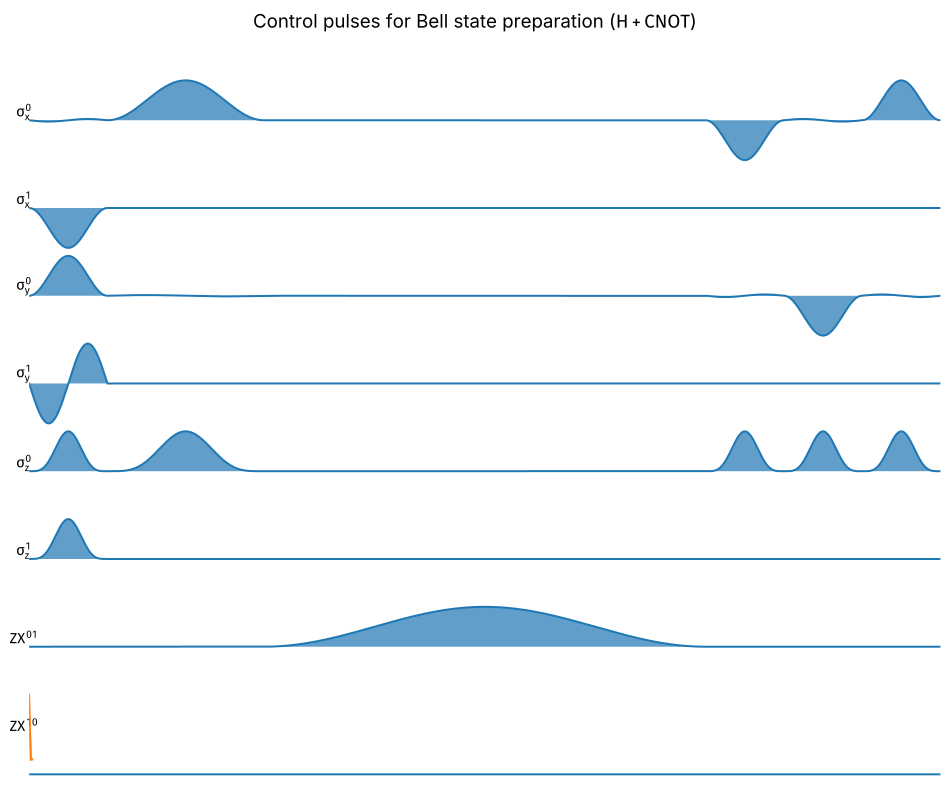
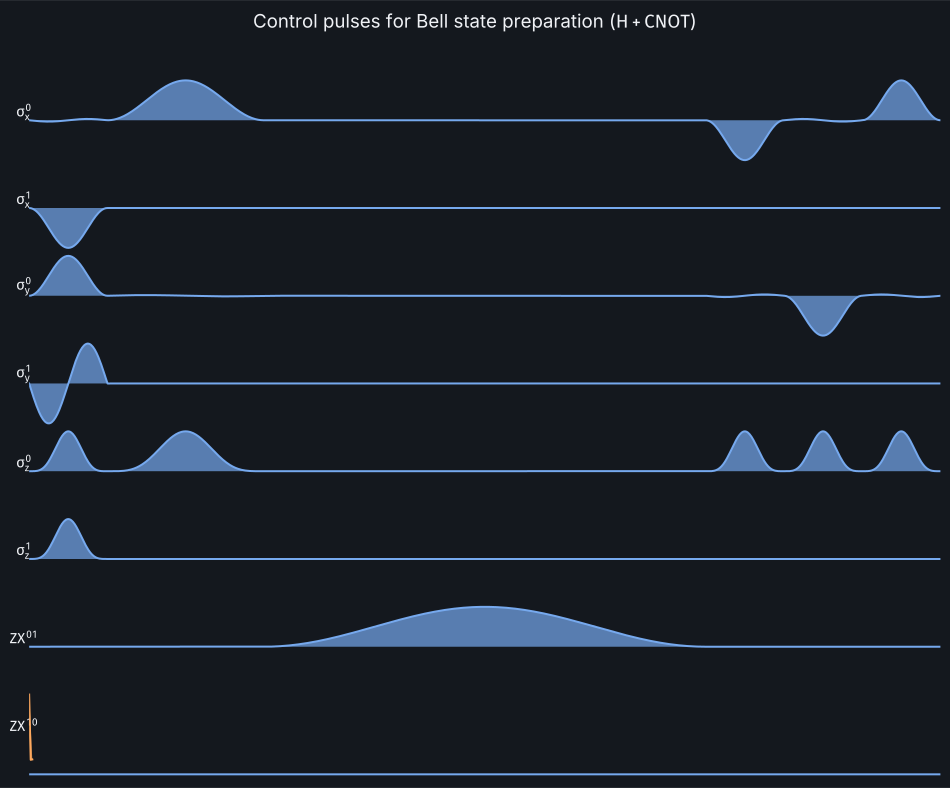
Entanglement between two qubits is realized via a CNOT gate. In this processor, the CNOT is implemented using Cross-Resonance (CR) pulses. The efficiency of the CR interaction depends on the frequency detuning \(\Delta = \omega_{\text{q},1} - \omega_{\text{q},2}\), which is set by the junction sizing in the layout.
qc_bell = QubitCircuit(2)
qc_bell.add_gate("SNOT", targets=0)  # Hadamard
qc_bell.add_gate("CNOT", controls=0, targets=1)

processor_bell = SCQubits(2, wq=wq, alpha=alpha, g=g_coupling, wr=wr)
processor_bell.load_circuit(qc_bell)

result_bell = cast(qutip.Result, processor_bell.run_state(init_state))
fig, axes = processor_bell.plot_pulses(figsize=(10, 8))
fig.suptitle(
    r"Control pulses for Bell state preparation ($H + \text{CNOT}$)",
    fontsize=14,
    y=1.02,
)
fig.tight_layout()
plt.show()
Fidelity Analysis#
We compute the state fidelity with the ideal Bell state.
# Ideal Bell state |Φ+⟩ = (|00⟩ + |11⟩)/√2
bell_ideal = (
    qutip.tensor(qutip.basis(3, 0), qutip.basis(3, 0))
    + qutip.tensor(qutip.basis(3, 1), qutip.basis(3, 1))
).unit()

final_state = result_bell.states[-1]
fidelity_bell = qutip.fidelity(final_state, bell_ideal)

display(
    Math(rf"""
\textbf{{Bell State Fidelity:}} \\
F(|\Phi^+\rangle) = {fidelity_bell:.6f}
""")
)
Decoherence Effects: \(T_2\) Sweep#
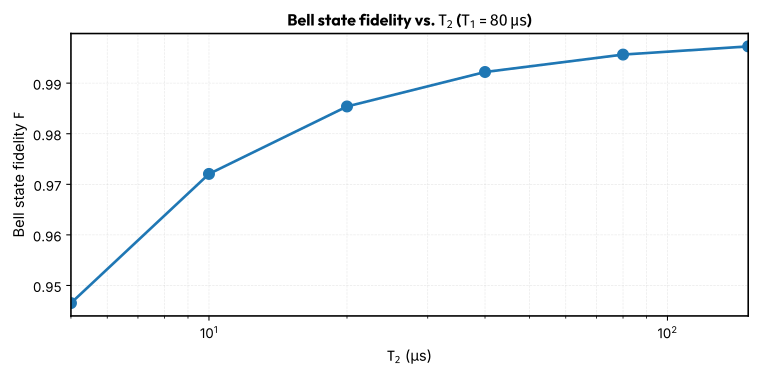
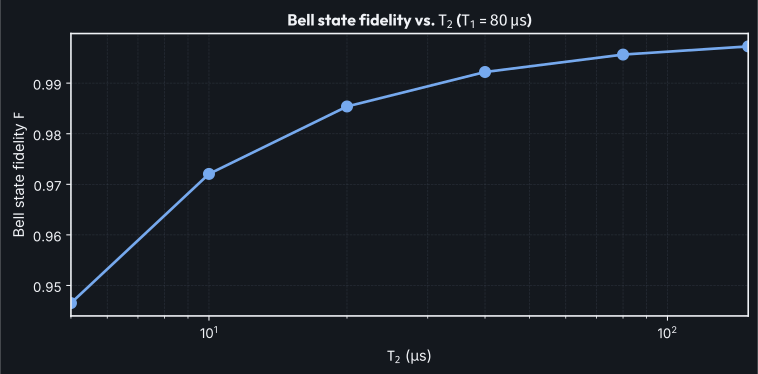
Real qubits are limited by decoherence. If our layout has higher loss (e.g., from narrow gaps), the \(T_1\) and \(T_2\) times decrease, directly reducing the gate fidelity.
# Sweep T2 values (in ns) with fixed T1 = 80 μs
t1_fixed = 80_000.0  # 80 μs in ns
t2_values_us = jnp.array([5, 10, 20, 40, 80, 150])
t2_values_ns = t2_values_us * 1e3

fidelities_t2 = []
for t2 in t2_values_ns:
    proc = SCQubits(
        2, wq=wq, alpha=alpha, g=g_coupling, wr=wr, t1=t1_fixed, t2=float(t2)
    )
    proc.load_circuit(qc_bell)
    res = cast(qutip.Result, proc.run_state(init_state))
    f = qutip.fidelity(res.states[-1], bell_ideal)
    fidelities_t2.append(f)

fig, ax = plt.subplots(figsize=(8, 4))
ax.semilogx(t2_values_us, fidelities_t2, "o-", linewidth=2, markersize=8)
ax.set_xlabel(r"$T_2$ (µs)")
ax.set_ylabel(r"Bell state fidelity $F$")
ax.set_title(
    rf"Bell state fidelity vs. $T_2$ ($T_1 = {t1_fixed / 1e3:.0f}\,\text{{µs}}$)"
)
ax.grid(True, alpha=0.3, which="both")
plt.show()
Summary: The Design Cycle#
This notebook demonstrated the connection between physical layout and pulse-level performance:
Layout (qpdk): Geometric parameters (pad size, gap) determine \(C_\Sigma\) and \(L_\text{J}\).
Hamiltonian (qpdk.models): Parameters \(E_\text{C}, E_\text{J}\) set \(\omega_\text{q}\) and \(\alpha\).
Simulation (QuTiP): Pulse-level dynamics reveal gate fidelity and leakage.
Iterate: If leakage is too high (\(|2\rangle\) population), we go back to step 1 and increase \(E_\text{C}\) in the layout.
For more details on parameter extraction, see the companion notebooks on scQubits parameter calculation.
References#
Joona Andersson. Pulse-level simulations of the fermionic-simulation gate on a superconducting quantum processor. Master's thesis, Aalto University, March 2024. URN:NBN:fi:aalto-202403172710.
Morten Kjaergaard, Mollie E. Schwartz, Jochen Braumüller, Philip Krantz, Joel I.-J. Wang, Simon Gustavsson, and William D. Oliver. Superconducting Qubits: Current State of Play. Annual Review of Condensed Matter Physics, 11(1):369–395, March 2020. doi:10.1146/annurev-conmatphys-031119-050605.
P. Krantz, M. Kjaergaard, F. Yan, T. P. Orlando, S. Gustavsson, and W. D. Oliver. A quantum engineer's guide to superconducting qubits. Applied Physics Reviews, 6(2):021318, June 2019. doi:10.1063/1.5089550.
Boxi Li, Tommaso Calarco, and Felix Motzoi. Pulse-level noisy quantum circuits with QuTiP. Quantum, 6:630, January 2022. doi:10.22331/q-2022-01-24-630.
Otto Salmenkivi. Mitigation of coherent errors in the control of superconducting qubits with composite pulse sequences. Master's thesis, University of Jyväskylä, 2023. URN:NBN:fi:jyu-202304132446.