

Monte Carlo Fabrication Tolerance Analysis#
Required extras
This notebook needs the models and ray extras:
uv add "qpdk[models,ray]"
# or, from a checkout of this repository:
uv sync --extra models --extra ray
# or with pip:
pip install "qpdk[models,ray]"
See the extras reference for what each extra installs.
This notebook demonstrates how to run a circuit-level SAX simulation of the
resonator_test_chip_yaml component, which is defined via a .pic.yml netlist
file and a corresponding gdsfactory+ schematic.
The workflow is:
Load the component from the YAML netlist with gdsfactory.
Extract the netlist for circuit simulation.
Build a SAX circuit using the QPDK model library.
Evaluate the S-parameters over a frequency range.
Plot the transmission to observe resonator dips.
Perform a Monte Carlo fabrication tolerance analysis to quantify how CPW width and gap variations affect resonance frequencies and transmission.
Load the component#
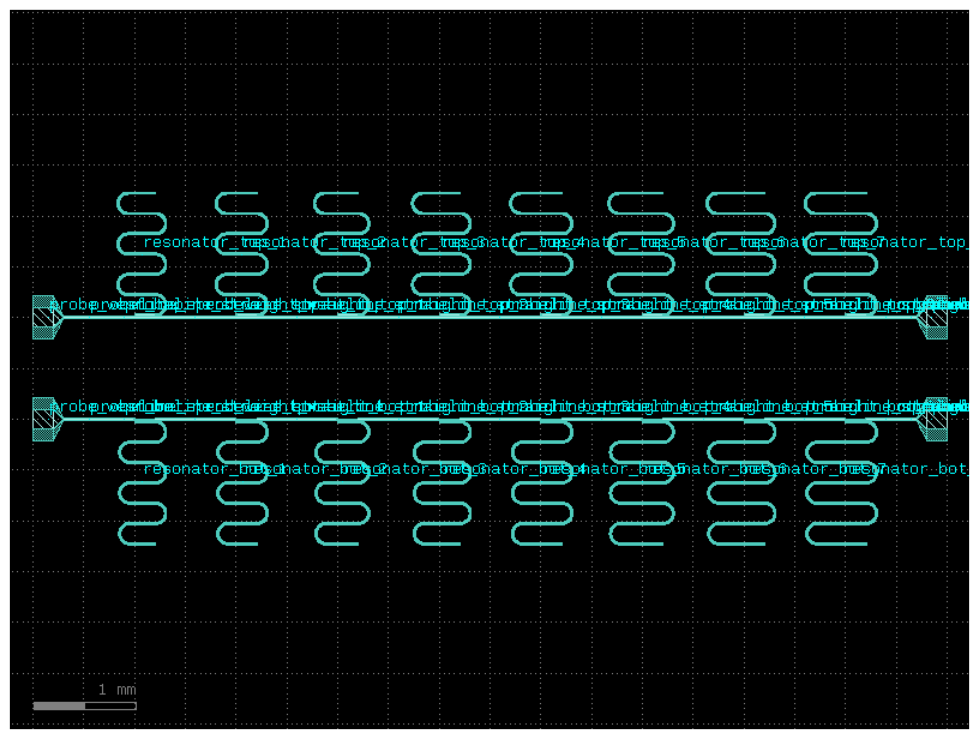
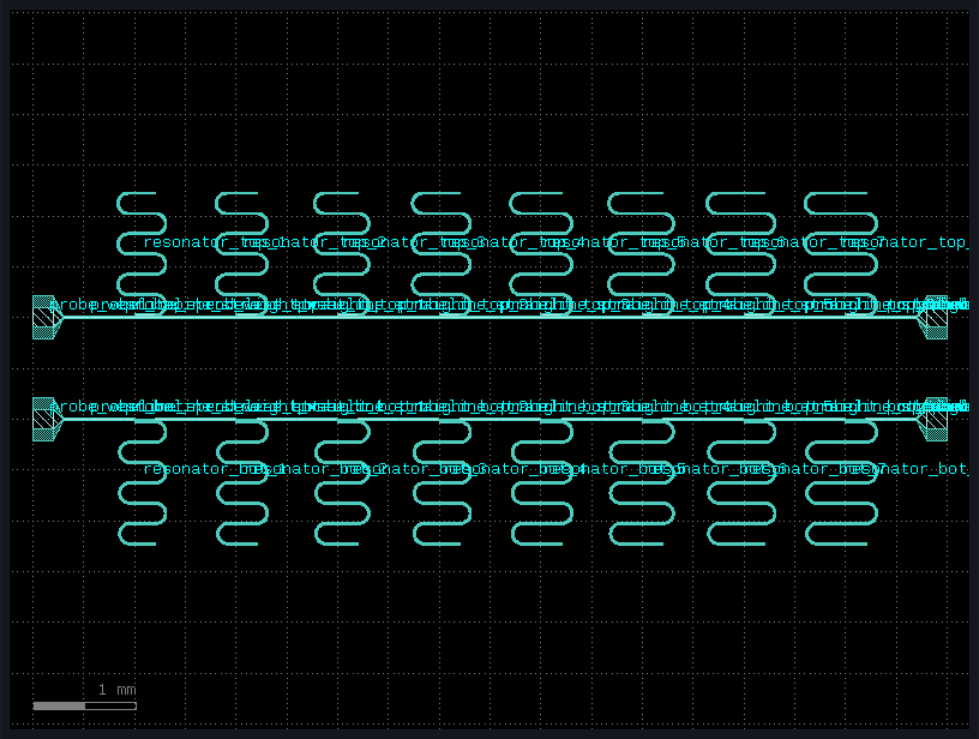
The resonator test chip is defined in a .pic.yml file that lives alongside
the QPDK sample scripts. It contains 16 quarter-wave coupled resonators
(8 per probeline), four launchers, and CPW routing between all elements.
yaml_path = PATH.samples / "resonator_test_chip_yaml.pic.yml"
chip = gf.read.from_yaml(yaml_path)
chip.plot()
Extract the netlist#
Component.get_netlist() returns a dictionary with instances,
nets, ports, and placements. SAX understands this format directly.
with warnings.catch_warnings():
    warnings.simplefilter("ignore")
    netlist = chip.get_netlist()

print("Instances:")
for name, inst in netlist["instances"].items():
    print(f"  {name}: {inst['component']}")
Instances:
  probe_east_bot: launcher
  probe_east_top: launcher
  probe_west_bot: launcher
  probe_west_top: launcher
  probeline_sbend_east_bot: bend_s
  probeline_sbend_east_top: bend_s
  probeline_sbend_west_bot: bend_s
  probeline_sbend_west_top: bend_s
  probeline_straight_bot_1: straight
  probeline_straight_bot_2: straight
  probeline_straight_bot_3: straight
  probeline_straight_bot_4: straight
  probeline_straight_bot_5: straight
  probeline_straight_bot_6: straight
  probeline_straight_bot_7: straight
  probeline_straight_east_bot: straight
  probeline_straight_east_top: straight
  probeline_straight_top_1: straight
  probeline_straight_top_2: straight
  probeline_straight_top_3: straight
  probeline_straight_top_4: straight
  probeline_straight_top_5: straight
  probeline_straight_top_6: straight
  probeline_straight_top_7: straight
  probeline_straight_west_bot: straight
  probeline_straight_west_top: straight
  resonator_bot_1: quarter_wave_resonator_coupled
  resonator_bot_2: quarter_wave_resonator_coupled
  resonator_bot_3: quarter_wave_resonator_coupled
  resonator_bot_4: quarter_wave_resonator_coupled
  resonator_bot_5: quarter_wave_resonator_coupled
  resonator_bot_6: quarter_wave_resonator_coupled
  resonator_bot_7: quarter_wave_resonator_coupled
  resonator_bot_8: quarter_wave_resonator_coupled
  resonator_top_1: quarter_wave_resonator_coupled
  resonator_top_2: quarter_wave_resonator_coupled
  resonator_top_3: quarter_wave_resonator_coupled
  resonator_top_4: quarter_wave_resonator_coupled
  resonator_top_5: quarter_wave_resonator_coupled
  resonator_top_6: quarter_wave_resonator_coupled
  resonator_top_7: quarter_wave_resonator_coupled
  resonator_top_8: quarter_wave_resonator_coupled
Build the SAX circuit#
QPDK ships a models dictionary that maps every component name to a SAX
model function. We pass the netlist and models to sax.circuit.
circuit_fn, circuit_info = sax.circuit(
    netlist=netlist,
    models=models,
    on_internal_port="ignore",
)
Simulate#
Evaluate the circuit over the 5–9 GHz band. The four external ports correspond to the four launchers:
Port |
Launcher |
Probeline |
|---|---|---|
o1 |
West top |
Top |
o2 |
East top |
Top |
o3 |
West bot |
Bottom |
o4 |
East bot |
Bottom |
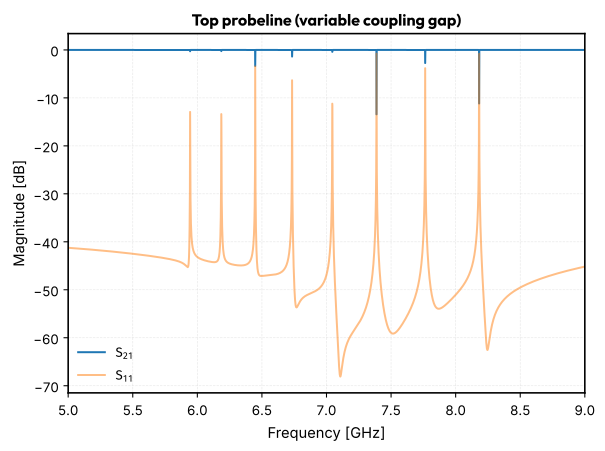
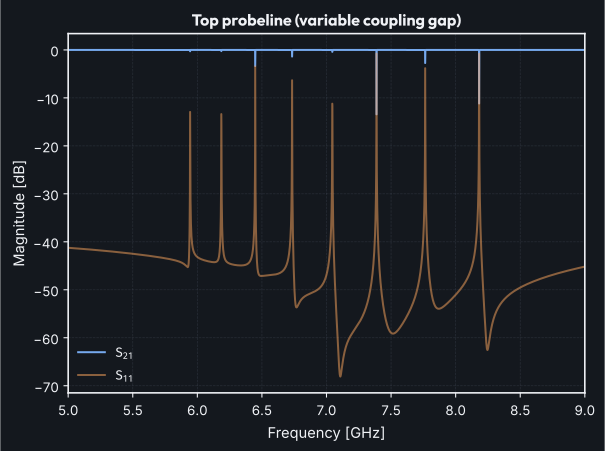
The top probeline has eight resonators with varying coupling gaps (12–26 µm) and the bottom probeline has eight resonators with a fixed coupling gap of 16 µm.
freq = jnp.linspace(5e9, 9e9, 5001)
s_params = circuit_fn(f=freq)

freq_ghz = freq / 1e9
Results#
Top probeline – variable coupling gap#
\(S_{21}\) (port o1 → o2) shows eight notches, one per resonator.
s21 = s_params["o1", "o2"]
s11 = s_params["o1", "o1"]

fig, ax = plt.subplots()
ax.plot(freq_ghz, 20 * jnp.log10(jnp.abs(s21)), label="$S_{21}$")
ax.plot(freq_ghz, 20 * jnp.log10(jnp.abs(s11)), label="$S_{11}$", alpha=0.5)
ax.set_xlabel("Frequency [GHz]")
ax.set_ylabel("Magnitude [dB]")
ax.set_title("Top probeline (variable coupling gap)")
ax.legend()
ax.grid(True)
plt.tight_layout()
plt.show(block=False)
Bottom probeline – fixed coupling gap#
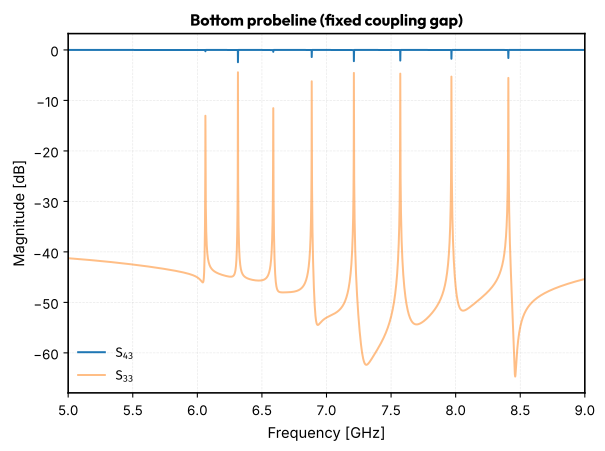
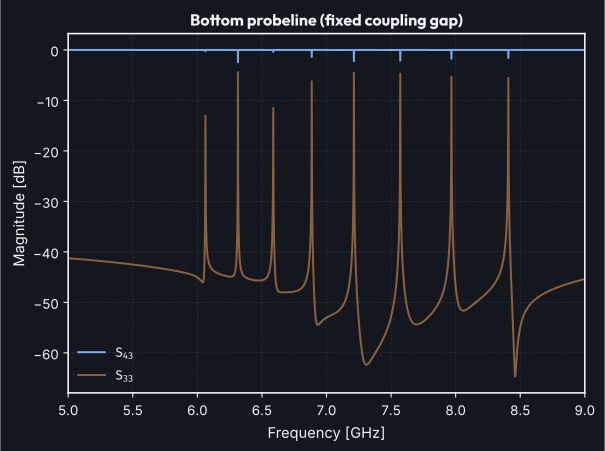
\(S_{43}\) (port o3 → o4) shows eight notches with uniform coupling depth because all resonators share the same 16 µm coupling gap.
s43 = s_params["o3", "o4"]
s33 = s_params["o3", "o3"]

fig, ax = plt.subplots()
ax.plot(freq_ghz, 20 * jnp.log10(jnp.abs(s43)), label="$S_{43}$")
ax.plot(freq_ghz, 20 * jnp.log10(jnp.abs(s33)), label="$S_{33}$", alpha=0.5)
ax.set_xlabel("Frequency [GHz]")
ax.set_ylabel("Magnitude [dB]")
ax.set_title("Bottom probeline (fixed coupling gap)")
ax.legend()
ax.grid(True)
plt.tight_layout()
plt.show(block=False)
Both probelines#
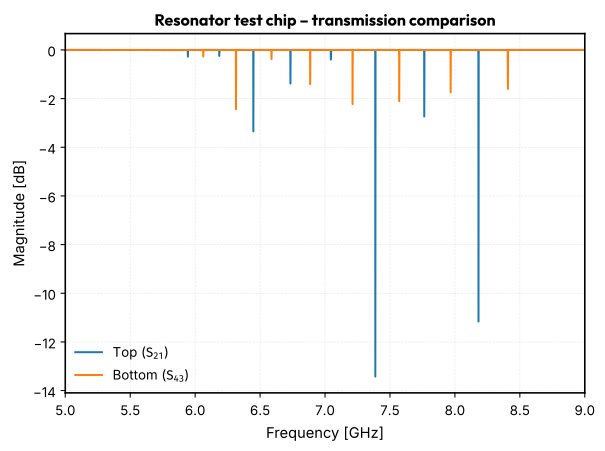
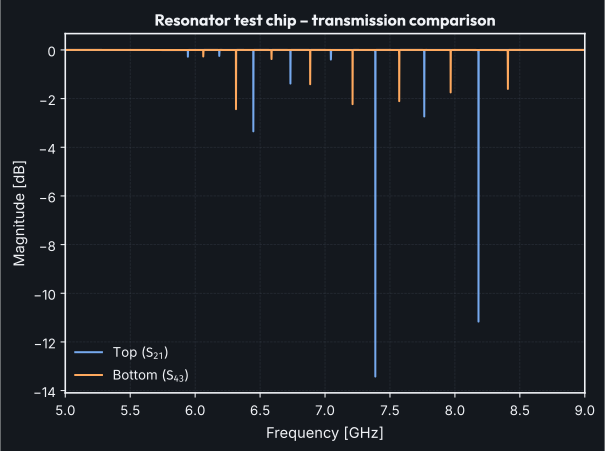
Overlay both transmission traces to compare the two probelines.
fig, ax = plt.subplots()
ax.plot(freq_ghz, 20 * jnp.log10(jnp.abs(s21)), label="Top ($S_{21}$)")
ax.plot(freq_ghz, 20 * jnp.log10(jnp.abs(s43)), label="Bottom ($S_{43}$)")
ax.set_xlabel("Frequency [GHz]")
ax.set_ylabel("Magnitude [dB]")
ax.set_title("Resonator test chip – transmission comparison")
ax.legend()
ax.grid(True)
plt.tight_layout()
plt.show(block=False)
Monte Carlo Fabrication Tolerance Analysis#
In superconducting quantum chip fabrication, the CPW centre-conductor width and gap to the ground plane are subject to process variations introduced during lithography and etching. Even sub-micrometre deviations from the nominal geometry change the characteristic impedance \(Z_0\), effective permittivity \(\varepsilon_{\text{eff}}\), and — most critically — the resonance frequencies of the on-chip resonators.
This section performs a Monte Carlo analysis inspired by the SAX layout-aware Monte Carlo example. The approach is:
Reuse the standard QPDK model functions (
straight,bend_euler,quarter_wave_resonator_coupled, etc.) which accept across_sectionparameter.Compile the SAX circuit once with these models.
For each Monte Carlo trial, create a
coplanar_waveguide(width=…, gap=…)cross-section with perturbed geometry and pass it as an override to every CPW instance in the circuit.Analyse the resulting spread in resonance frequencies and transmission.
CPW impedance sensitivity#
Before running the Monte Carlo simulation it is instructive to see how \(Z_0\) and \(\varepsilon_{\text{eff}}\) depend on the CPW dimensions.
.. note:: The characteristic impedance and effective permittivity have a small imaginary part due to the substrate loss tangent (\(\tan \delta \approx 2.7 \times 10^{-6}\) for high-resistivity silicon at mK temperatures [CFL+22]). In the sensitivity plots below, we only display the real part of these quantities.
widths_sweep = jnp.linspace(6, 16, 200)
gaps_sweep = [4.0, 5.0, 6.0, 7.0, 8.0]

fig, (ax1, ax2) = plt.subplots(1, 2, figsize=(12, 4.5))

for gap_val in gaps_sweep:
    ep_vals = []
    z0_vals = []
    for w in widths_sweep:
        ep, z0 = cpw_parameters(float(w), gap_val)
        ep_vals.append(float(jnp.real(ep)))
        z0_vals.append(float(jnp.real(z0)))
    ax1.plot(widths_sweep, z0_vals, label=f"gap = {gap_val:.0f} µm")
    ax2.plot(widths_sweep, ep_vals, label=f"gap = {gap_val:.0f} µm")

# Nominal point
ep_nom, z0_nom = cpw_parameters(10.0, 6.0)
ax1.axhline(float(jnp.real(z0_nom)), color="k", ls=":", lw=0.8)
ax1.axvline(10.0, color="k", ls=":", lw=0.8)
ax2.axhline(float(jnp.real(ep_nom)), color="k", ls=":", lw=0.8)
ax2.axvline(10.0, color="k", ls=":", lw=0.8)

ax1.set_xlabel("Centre-conductor width [µm]")
ax1.set_ylabel("$Z_0$ [Ω]")
ax1.set_title("Characteristic impedance")
ax1.legend(fontsize=8)
ax1.grid(True)

ax2.set_xlabel("Centre-conductor width [µm]")
ax2.set_ylabel(r"$\varepsilon_{\text{eff}}$")
ax2.set_title("Effective permittivity")
ax2.legend(fontsize=8)
ax2.grid(True)

fig.suptitle("CPW parameter sensitivity to geometry", fontsize=13, y=1.02)
plt.tight_layout()
plt.show(block=False)
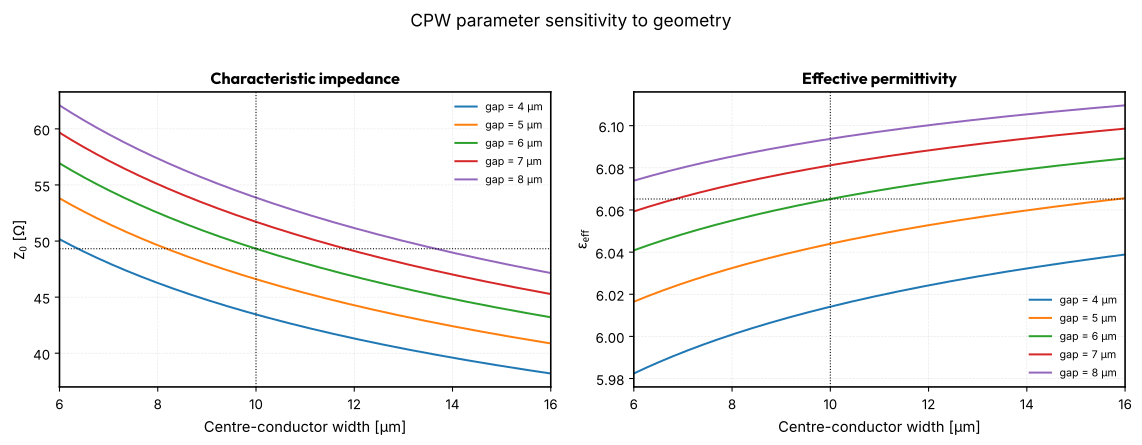
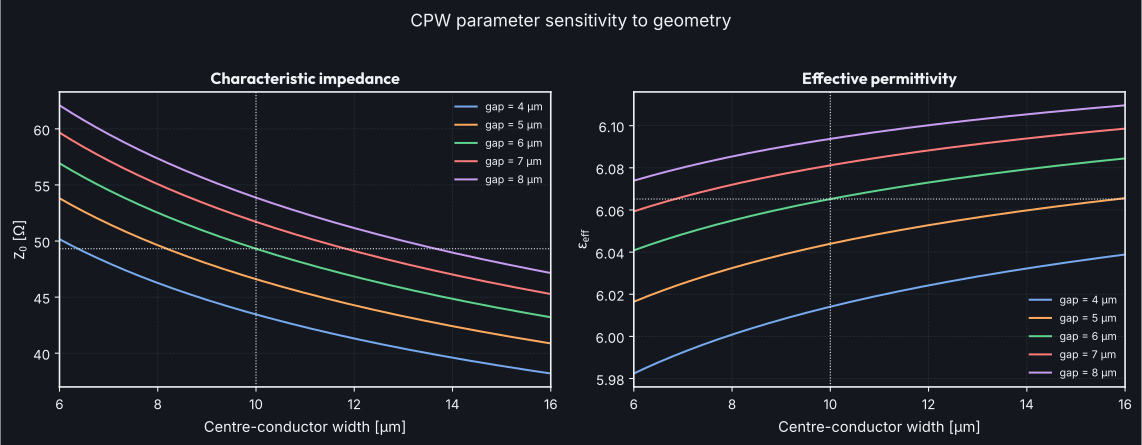
The plots show that \(Z_0\) and \(\varepsilon_{\text{eff}}\) are sensitive to both width and gap. A ±0.5 µm width shift at the nominal 10 µm / 6 µm geometry translates to a \(Z_0\) change of several ohms and a corresponding shift in resonance frequency.
Define fabrication tolerances#
Typical superconducting CPW fabrication tolerances are on the order of hundreds of nanometres to about 1 µm, depending on lithography technology [KKY+19]. We model these as independent Gaussian random variables.
NOMINAL_WIDTH = 10.0  # µm (centre-conductor width)
NOMINAL_GAP = 6.0  # µm (gap to ground plane)
WIDTH_SIGMA = 0.5  # µm (1σ tolerance on width)
GAP_SIGMA = 0.3  # µm (1σ tolerance on gap)

# For CI/documentation builds, reduce trials to speed up execution.
IS_CI = any((
    os.environ.get("GITHUB_ACTIONS") == "true",
    os.environ.get("CI") == "true",
))
# In a local development environment, use more trials for better statistics.
N_TRIALS = 10 if IS_CI else 25

rng = np.random.default_rng(42)
Initialize Ray for Parallel Execution#
We use Ray to parallelize the Monte Carlo trials across multiple CPU cores.
Warning
If you are running this notebook inside uv run and encounter a RuntimeError
related to pip or uv environments (e.g., “pip not found”), you may need to set
RAY_ENABLE_UV_RUN_RUNTIME_ENV=0 in your environment before starting the notebook.
See Ray issue #50961 for more context on this integration issue.
Resource Configuration Guide:#
Total Parallelism: By default, Ray uses all available CPU cores. To limit this, use
ray.init(num_cpus=8).Cores per Worker: In the
@ray.remote(num_cpus=1)decorators below, you can specifynum_cpus=1(default). If your simulation uses heavy internal multi-threading, increasing this (e.g.,num_cpus=2) will reduce the number of simultaneous workers to avoid over-subscribing the CPU.GPU Allocation: If using GPUs, you can specify
num_gpus=0.2to allow 5 workers to share a single GPU.Overall Workers: The number of concurrent workers is automatically calculated as
Total CPUs / Cores per Worker.
if not ray.is_initialized():
    # 1. Disable Ray's automatic uv-run matching which is causing setup errors.
    os.environ["RAY_ENABLE_UV_RUN_RUNTIME_ENV"] = "0"
    runtime_env = {
        "working_dir": str(PATH.repo),
        "excludes": [
            ".git",
            ".venv",
            "build",
            "__pycache__",
            ".ruff_cache",
            ".pytest_cache",
        ],
    }
    print(f"Initializing Ray with working_dir: {PATH.repo}")

    # Initialize Ray using 80% of available CPU cores.
    total_cpus = os.cpu_count() or 1
    num_cpus = max(1, int(total_cpus * 0.8))
    print(f"Initializing Ray with {num_cpus} CPUs (80% of {total_cpus})…")
    ray.init(num_cpus=num_cpus, runtime_env=runtime_env)

# To connect to a remote Ray cluster instead, use:
# ray.init("ray://<head_node_host>:10001", runtime_env=runtime_env)
Identify cross-section-tuneable instances#
We inspect the circuit settings to find all instances that expose
cross_section as a tuneable parameter. These are the straight sections,
bends, and resonators – i.e. every CPW element on the chip.
settings = sax.get_settings(circuit_fn)
cpw_instance_names = [name for name, s in settings.items() if "cross_section" in s]
# Exclude launcher instances — their large pad geometry (200 µm width)
# is insensitive to the small absolute variations we study here.
cpw_instance_names = [n for n in cpw_instance_names if "launcher" not in n]
print(f"{len(cpw_instance_names)} CPW instances found for MC perturbation.")
38 CPW instances found for MC perturbation.
Global (systematic) tolerance simulation#
In this scenario all CPW sections on the chip receive the same
width and gap perturbation in each trial, modelling a uniform fabrication
bias across the die. We loop over trials, creating a
coplanar_waveguide(width=…, gap=…) cross-section for each and
passing it as an override to every CPW instance.
The sketch shows why common and per-resonator geometry variation lead to different patterns of frequency shifts. Each tick represents one resonator.
def find_resonance_dips(
    freq_hz: ArrayLike,
    s21_db: np.ndarray,
    evaluate: Callable[[jnp.ndarray], jnp.ndarray],
    n_resonators: int = 8,
    prominence: float = 0.3,
    min_distance_idx: int = 30,
) -> np.ndarray:
    """Refine candidate notches before selecting the deepest resonances."""
    result = np.full(n_resonators, np.nan)
    peaks, _ = find_peaks(-np.asarray(s21_db), distance=min_distance_idx)
    if not len(peaks):
        return result
    frequencies = jnp.asarray(freq_hz)
    spacing = frequencies[1] - frequencies[0]
    refined = frequencies[peaks, None] + spacing * jnp.linspace(-1, 1, 257)
    values = jnp.asarray(evaluate(refined.ravel())).reshape(len(peaks), -1)
    minima = jnp.argmin(values, axis=1)
    depths = (
        jnp.maximum(values[:, 0], values[:, -1])
        - values[jnp.arange(len(peaks)), minima]
    )
    selected = jnp.argsort(depths)[::-1][:n_resonators]
    selected = selected[depths[selected] >= prominence]
    dips = jnp.sort(refined[selected, minima[selected]])
    result[: len(dips)] = np.asarray(dips)
    return result
@ray.remote(num_cpus=1)
def simulate_global_tolerance(
    dw: float,
    dg: float,
    freq: jnp.ndarray,
    netlist: dict[str, Any],
    models: dict[str, Any],
    instance_names: list[str],
) -> tuple[np.ndarray, np.ndarray]:
    """Return transmission and refined resonances for a global trial."""
    # ruff: disable[import-outside-top-level]
    import jax.numpy as jnp
    import numpy as np
    import sax

    from qpdk import PDK
    # ruff: enable[import-outside-top-level]

    PDK.activate()
    # Re-compiling the circuit on the worker is very fast in SAX
    circuit_fn, _ = sax.circuit(
        netlist=netlist, models=models, on_internal_port="ignore"
    )

    xs = coplanar_waveguide(width=10.0 + dw, gap=6.0 + dg)
    overrides = {name: {"cross_section": xs} for name in instance_names}

    def evaluate(frequencies):
        scattering = circuit_fn(f=frequencies, **overrides)
        return 20 * jnp.log10(jnp.abs(scattering["o1", "o2"]))

    transmission = np.asarray(evaluate(freq))
    dips = find_resonance_dips(freq, transmission, evaluate)
    return transmission, dips
dw_global = rng.normal(0, WIDTH_SIGMA, N_TRIALS)
dg_global = rng.normal(0, GAP_SIGMA, N_TRIALS)

# Nominal S₂₁ for reference
s21_nom_db = np.asarray(20 * jnp.log10(jnp.abs(s21)))

# Put large objects in the Ray Object Store to avoid serializing them repeatedly
netlist_ref = ray.put(netlist)
models_ref = ray.put(models)
freq_ref = ray.put(freq)

# Launch tasks in parallel
print(f"Launching {N_TRIALS} parallel global trials with Ray…")
futures = [
    simulate_global_tolerance.remote(
        dw_global[i],
        dg_global[i],
        freq_ref,
        netlist_ref,
        models_ref,
        cpw_instance_names,
    )
    for i in range(N_TRIALS)
]
print("Waiting for global trials to complete…")
results_global = ray_get_with_progress(futures, desc="Global trials", timeout=1200)
print("Global trials completed.")
s21_global_db = np.array([spectrum for spectrum, _ in results_global]).T
mc_dips = np.array([dips for _, dips in results_global])
Launching 10 parallel global trials with Ray…
Waiting for global trials to complete…
(raylet) warning: `VIRTUAL_ENV=/home/runner/work/quantum-rf-pdk/quantum-rf-pdk/.venv` does not match the project environment path `.venv` and will be ignored; use `--active` to target the active environment instead
(raylet) Using CPython 3.12.15 interpreter at: /opt/hostedtoolcache/Python/3.12.15/x64/bin/python3.12
(raylet) Creating virtual environment at: .venv
(raylet)    Building qpdk @ file:///tmp/ray/session_2026-10-22_13-30-58_551853_4243/runtime_resources/working_dir_files/_ray_pkg_80cca702cc3cbe6c
(raylet) warning: `build_system.requires = ["uv-build>=0.10.8,<0.12.0"]` does not contain the current uv version 0.13.5
(raylet) Installed 352 packages in 645ms
Global trials completed.
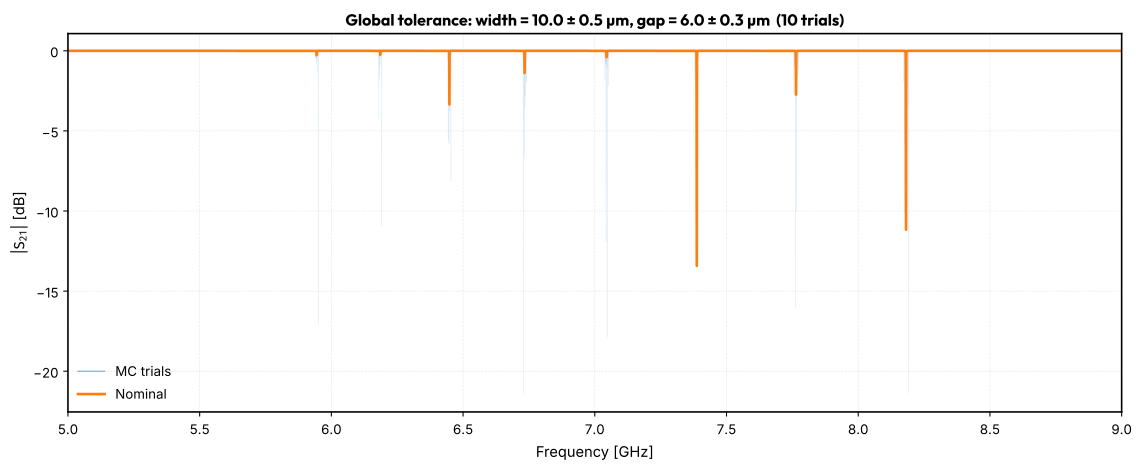
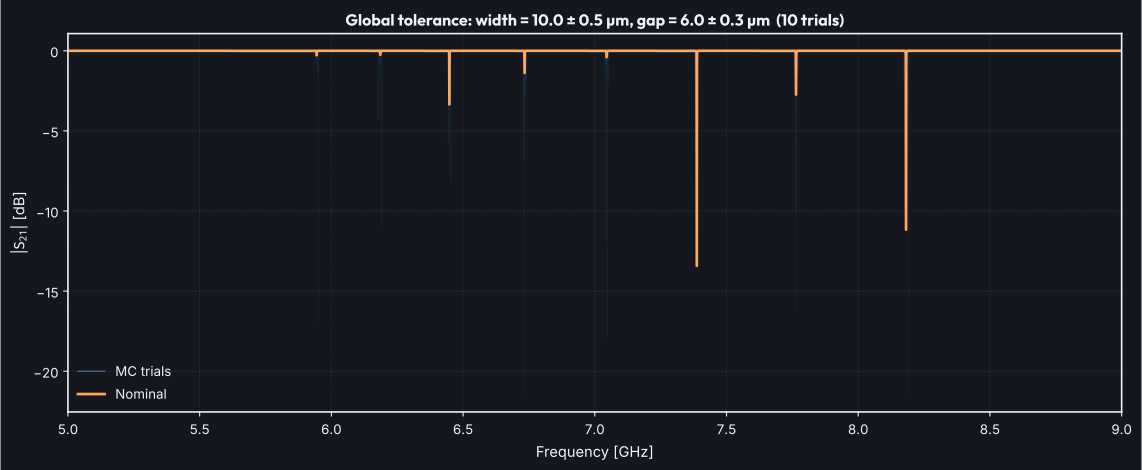
Transmission overlay – global tolerance#
Each pale blue trace is one MC trial; the orange curve is the nominal response.
fig, ax = plt.subplots(figsize=(12, 5))
ax.plot(freq_ghz, s21_global_db, color="C0", lw=0.4, alpha=0.15, rasterized=True)
ax.plot(freq_ghz, s21_nom_db, color="C1", lw=2, label="Nominal")

mc_line = Line2D([], [], color="C0", lw=1, alpha=0.5, label="MC trials")
ax.legend(handles=[mc_line, ax.get_lines()[-1]], fontsize=10)

ax.set_xlabel("Frequency [GHz]")
ax.set_ylabel("|$S_{21}$| [dB]")
ax.set_title(
    f"Global tolerance: width = {NOMINAL_WIDTH} ± {WIDTH_SIGMA} µm, "
    f"gap = {NOMINAL_GAP} ± {GAP_SIGMA} µm  ({N_TRIALS} trials)"
)
ax.grid(True)
plt.tight_layout()
plt.show(block=False)
Resonance frequency extraction#
We refine each candidate dip on a local frequency grid before applying the depth threshold. Ground shielding can make a resonance narrower than the coarse sweep spacing. The refined positions track frequency shifts across trials.
# Extract resonance frequencies for the nominal and all MC trials
freq_np = np.asarray(freq)

nominal_dips = find_resonance_dips(
    freq_np,
    s21_nom_db,
    lambda frequencies: 20 * jnp.log10(jnp.abs(circuit_fn(f=frequencies)["o1", "o2"])),
)
if not np.isfinite(nominal_dips).all():
    raise ValueError("The nominal sweep must resolve all eight resonators")
n_res = int(np.sum(~np.isnan(nominal_dips)))
print(f"Nominal resonance frequencies ({n_res} detected):")
for i, f_dip in enumerate(nominal_dips):
    if not np.isnan(f_dip):
        print(f"  Resonator {i + 1}: {f_dip / 1e9:.4f} GHz")
Nominal resonance frequencies (8 detected):
  Resonator 1: 5.9443 GHz
  Resonator 2: 6.1860 GHz
  Resonator 3: 6.4481 GHz
  Resonator 4: 6.7334 GHz
  Resonator 5: 7.0452 GHz
  Resonator 6: 7.3872 GHz
  Resonator 7: 7.7642 GHz
  Resonator 8: 8.1817 GHz
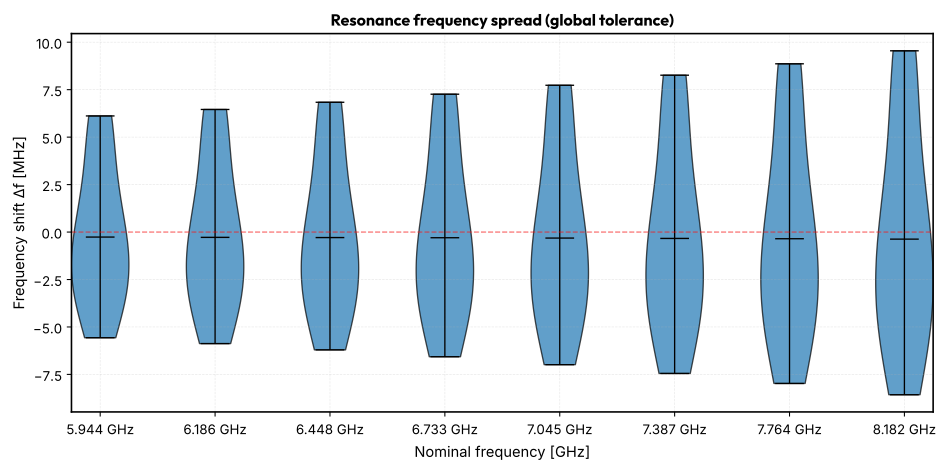
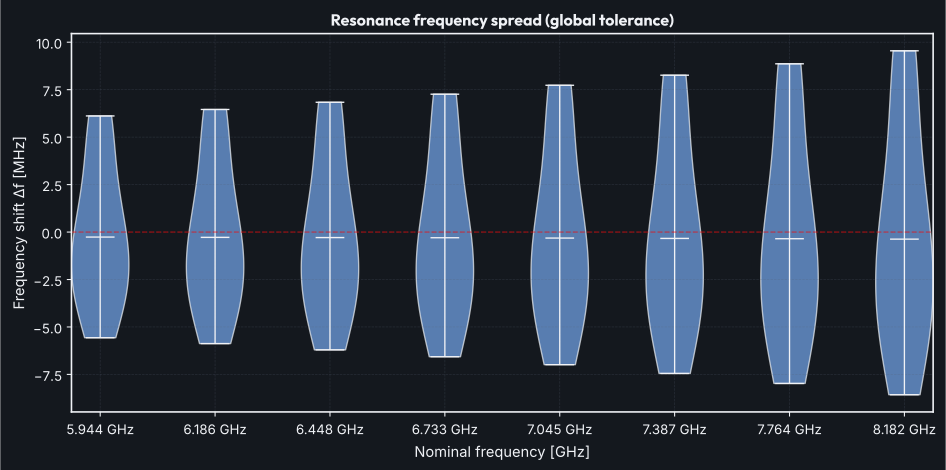
Resonance frequency distributions (global tolerance)#
This violin plot shows the distribution of frequency shifts for each resonator across all Monte Carlo trials. A shift of 0 MHz corresponds to the nominal resonance frequency.
shifts_mhz = (mc_dips - nominal_dips[None, :n_res]) / 1e6

fig, ax = plt.subplots(figsize=(10, 5))
data_to_plot = [shifts_mhz[~np.isnan(shifts_mhz[:, i]), i] for i in range(n_res)]
vparts = ax.violinplot(data_to_plot, showmeans=True, showmedians=False)

# Customise violin appearance
for pc in cast(list[PolyCollection], vparts["bodies"]):
    pc.set_facecolor("C0")
    pc.set_edgecolor("black")
    pc.set_alpha(0.7)

for partname in ("cbars", "cmins", "cmaxes", "cmeans"):
    vp = vparts[partname]
    vp.set_edgecolor("black")
    vp.set_linewidth(1)

ax.set_xticks(np.arange(1, n_res + 1))
ax.set_xticklabels([f"{nominal_dips[i] / 1e9:.3f} GHz" for i in range(n_res)])
ax.set_xlabel("Nominal frequency [GHz]")
ax.set_ylabel("Frequency shift Δf [MHz]")
ax.set_title("Resonance frequency spread (global tolerance)")
ax.axhline(0, color="r", ls="--", lw=1, alpha=0.5)
ax.grid(True, alpha=0.3)
plt.tight_layout()
plt.show(block=False)
Frequency shift statistics#
We summarise the absolute and relative frequency shifts.
mean_shift = np.nanmean(shifts_mhz, axis=0)
std_shift = np.nanstd(shifts_mhz, axis=0)
max_shift = np.nanmax(np.abs(shifts_mhz), axis=0)

df_stats = pl.DataFrame({
    "Resonator": [f"{i + 1}" for i in range(n_res)],
    "Nominal [GHz]": [float(f) / 1e9 for f in nominal_dips],
    "Mean shift [MHz]": mean_shift,
    "Std [MHz]": std_shift,
    "Max |shift| [MHz]": max_shift,
})
display_dataframe(df_stats)
| Resonator | Nominal [GHz] | Mean shift [MHz] | Std [MHz] | Max |shift| [MHz] |
|---|---|---|---|---|
| 1 | 5.944287 | -0.264375 | 3.566083 | 6.118750 |
| 2 | 6.185950 | -0.280000 | 3.762936 | 6.456250 |
| 3 | 6.448087 | -0.290625 | 3.980253 | 6.837500 |
| 4 | 6.733425 | -0.299375 | 4.222495 | 7.262500 |
| 5 | 7.045194 | -0.317500 | 4.493100 | 7.731250 |
| 6 | 7.387231 | -0.336250 | 4.797410 | 8.262500 |
| 7 | 7.764175 | -0.353125 | 5.141275 | 8.862500 |
| 8 | 8.181656 | -0.373125 | 5.534847 | 9.550000 |
Per-resonator (independent) tolerance simulation#
In practice, fabrication variations are not perfectly uniform across a die. Local effects such as proximity-dependent etching cause each resonator to experience a different random perturbation. We model this by assigning each resonator instance an independent cross-section perturbation. Routing sections (straights and bends connecting resonators) are kept at nominal dimensions to isolate the effect of per-resonator geometry variation.
@ray.remote(num_cpus=1)
def simulate_local_tolerance(
    trial_idx: int,
    dw_per_res: np.ndarray,
    dg_per_res: np.ndarray,
    freq: jnp.ndarray,
    netlist: dict[str, Any],
    models: dict[str, Any],
    res_names: list[str],
    non_res_names: list[str],
) -> tuple[np.ndarray, np.ndarray]:
    """Return transmission and refined resonances for a local trial."""
    # ruff: disable[import-outside-top-level]
    import numpy as np
    import sax

    from qpdk import PDK
    # ruff: enable[import-outside-top-level]

    PDK.activate()
    circuit_fn, _ = sax.circuit(
        netlist=netlist, models=models, on_internal_port="ignore"
    )

    overrides = {}
    for i, name in enumerate(res_names):
        xs_res = coplanar_waveguide(
            width=NOMINAL_WIDTH + dw_per_res[i, trial_idx],
            gap=NOMINAL_GAP + dg_per_res[i, trial_idx],
        )
        overrides[name] = {"cross_section": xs_res}

    xs_nominal = coplanar_waveguide(width=NOMINAL_WIDTH, gap=NOMINAL_GAP)
    for name in non_res_names:
        overrides[name] = {"cross_section": xs_nominal}

    def evaluate(frequencies):
        scattering = circuit_fn(f=frequencies, **overrides)
        return 20 * jnp.log10(jnp.abs(scattering["o1", "o2"]))

    transmission = np.asarray(evaluate(freq))
    dips = find_resonance_dips(freq, transmission, evaluate)
    return transmission, dips
# Resonator instance names get independent perturbations.
# Non-resonator CPW instances (routing) stay at nominal.

# Resonator instance names
res_names = sorted(
    [n for n in cpw_instance_names if n.startswith("resonator_")],
)
non_res_names = [n for n in cpw_instance_names if n not in res_names]
n_res_instances = len(res_names)

# Draw per-resonator perturbations: shape (n_resonator_instances, N_TRIALS)
dw_per_res = rng.normal(0, WIDTH_SIGMA, (n_res_instances, N_TRIALS))
dg_per_res = rng.normal(0, GAP_SIGMA, (n_res_instances, N_TRIALS))

# Put perturbations in object store
dw_per_res_ref = ray.put(dw_per_res)
dg_per_res_ref = ray.put(dg_per_res)

# Launch tasks in parallel
print(f"Launching {N_TRIALS} parallel per-resonator trials with Ray…")
futures_local = [
    simulate_local_tolerance.remote(
        i,
        dw_per_res_ref,
        dg_per_res_ref,
        freq_ref,
        netlist_ref,
        models_ref,
        res_names,
        non_res_names,
    )
    for i in range(N_TRIALS)
]
results_local = ray_get_with_progress(
    futures_local, desc="Per-resonator trials", timeout=1200
)
s21_local_db = np.array([spectrum for spectrum, _ in results_local]).T
mc_dips_local = np.array([dips for _, dips in results_local])
Launching 10 parallel per-resonator trials with Ray…
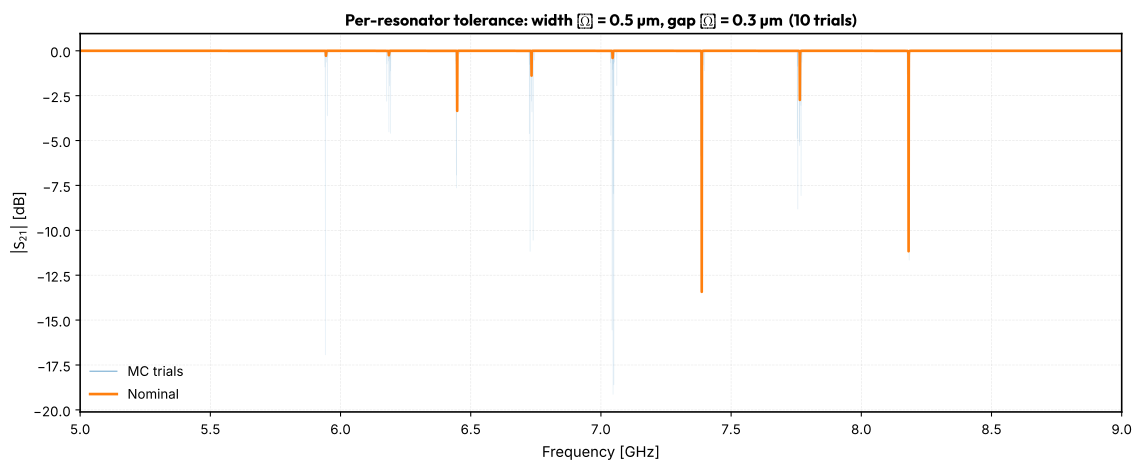
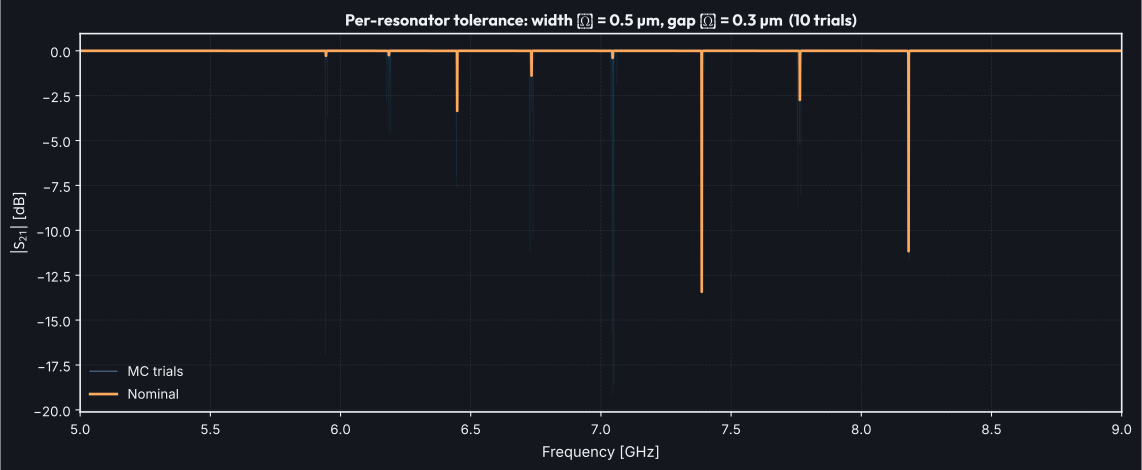
Transmission overlay – per-resonator tolerance#
fig, ax = plt.subplots(figsize=(12, 5))
ax.plot(freq_ghz, s21_local_db, color="C0", lw=0.4, alpha=0.15, rasterized=True)
ax.plot(freq_ghz, s21_nom_db, color="C1", lw=2, label="Nominal")

mc_line = Line2D([], [], color="C0", lw=1, alpha=0.5, label="MC trials")
ax.legend(handles=[mc_line, ax.get_lines()[-1]], fontsize=10)

ax.set_xlabel("Frequency [GHz]")
ax.set_ylabel("|$S_{21}$| [dB]")
ax.set_title(
    f"Per-resonator tolerance: width σ = {WIDTH_SIGMA} µm, "
    f"gap σ = {GAP_SIGMA} µm  ({N_TRIALS} trials)"
)
ax.grid(True)
plt.tight_layout()
plt.show(block=False)
/tmp/ipykernel_4243/2894363167.py:15: UserWarning: Glyph 963 (\N{GREEK SMALL LETTER SIGMA}) missing from font(s) Outfit.
  plt.tight_layout()
/home/runner/work/quantum-rf-pdk/quantum-rf-pdk/.venv/lib/python3.12/site-packages/IPython/core/pylabtools.py:170: UserWarning: Glyph 963 (\N{GREEK SMALL LETTER SIGMA}) missing from font(s) Outfit.
  fig.canvas.print_figure(bytes_io, **kw)
Compare global vs per-resonator spread#
shifts_local = (mc_dips_local - nominal_dips[None, :n_res]) / 1e6
std_local = np.nanstd(shifts_local, axis=0)

fig, ax = plt.subplots(figsize=(8, 4))
x = np.arange(1, n_res + 1)
width_bar = 0.35
ax.bar(x - width_bar / 2, std_shift, width_bar, label="Global", color="C0", alpha=0.8)
ax.bar(
    x + width_bar / 2,
    std_local,
    width_bar,
    label="Per-resonator",
    color="C3",
    alpha=0.8,
)
ax.set_xlabel("Nominal frequency [GHz]")
ax.set_ylabel("Frequency spread (1σ) [MHz]")
ax.set_title("Frequency uncertainty: global vs per-resonator tolerance")
ax.set_xticks(x)
ax.set_xticklabels([f"{nominal_dips[i - 1] / 1e9:.3f}" for i in x])
ax.legend()
ax.grid(True, alpha=0.3)
plt.tight_layout()
plt.show(block=False)
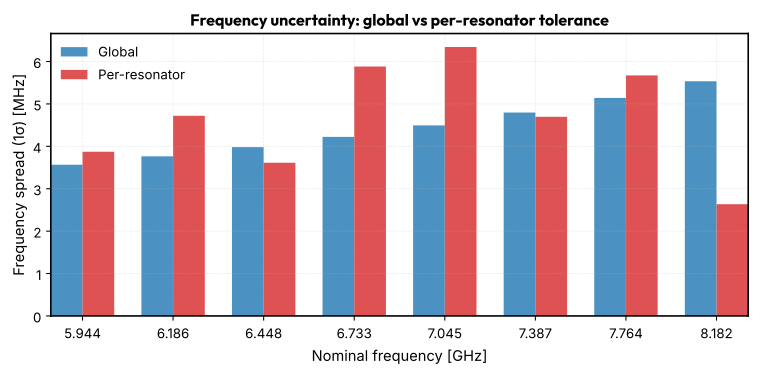
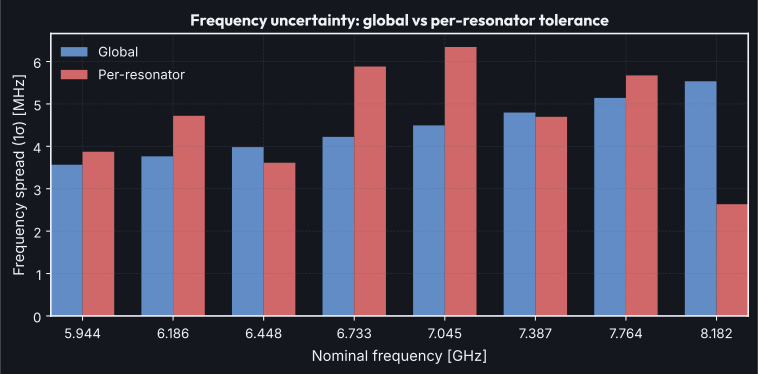
The global scenario produces correlated frequency shifts (all resonators move together), whereas the per-resonator scenario produces uncorrelated shifts that appear as a broadened distribution per resonator. In practice, both mechanisms coexist.
Sensitivity analysis – width vs gap#
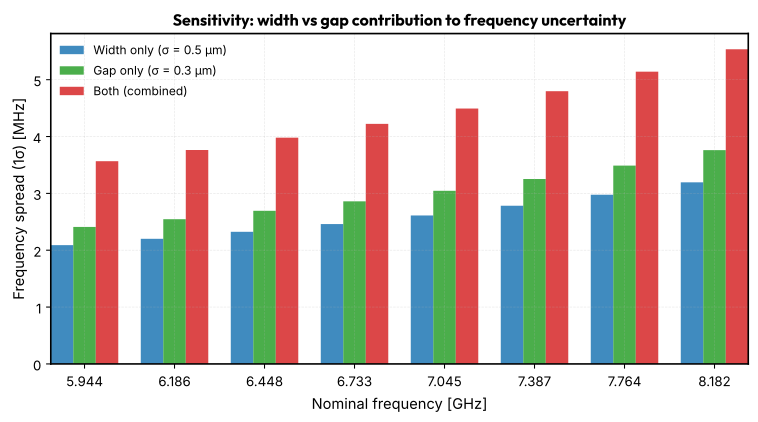
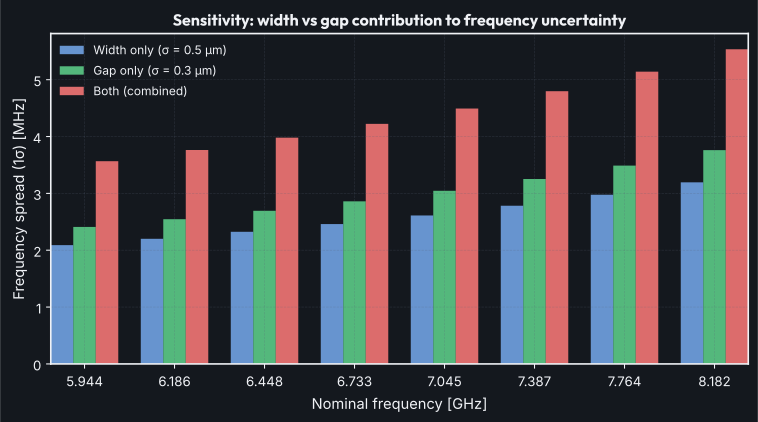
To understand which geometric parameter dominates the frequency uncertainty we run two additional sweeps: one varying only the width and one varying only the gap.
# Width-only variation
dw_only = rng.normal(0, WIDTH_SIGMA, N_TRIALS)
print(f"Launching {N_TRIALS} parallel width-only trials with Ray…")
futures_w = [
    simulate_global_tolerance.remote(
        dw_only[i], 0.0, freq_ref, netlist_ref, models_ref, cpw_instance_names
    )
    for i in range(N_TRIALS)
]
results_w = ray_get_with_progress(futures_w, desc="Width-only trials", timeout=1200)
mc_dips_w = np.array([dips for _, dips in results_w])

# Gap-only variation
dg_only = rng.normal(0, GAP_SIGMA, N_TRIALS)
print(f"Launching {N_TRIALS} parallel gap-only trials with Ray…")
futures_g = [
    simulate_global_tolerance.remote(
        0.0, dg_only[i], freq_ref, netlist_ref, models_ref, cpw_instance_names
    )
    for i in range(N_TRIALS)
]
results_g = ray_get_with_progress(futures_g, desc="Gap-only trials", timeout=1200)
mc_dips_g = np.array([dips for _, dips in results_g])
Launching 10 parallel width-only trials with Ray…
Launching 10 parallel gap-only trials with Ray…
std_w_only = np.nanstd((mc_dips_w - nominal_dips[None, :n_res]) / 1e6, axis=0)
std_g_only = np.nanstd((mc_dips_g - nominal_dips[None, :n_res]) / 1e6, axis=0)
Sensitivity comparison#
fig, ax = plt.subplots(figsize=(8, 4.5))
x = np.arange(1, n_res + 1)
w_bar = 0.25
ax.bar(
    x - w_bar,
    std_w_only,
    w_bar,
    label=f"Width only (σ = {WIDTH_SIGMA} µm)",
    color="C0",
    alpha=0.85,
)
ax.bar(
    x,
    std_g_only,
    w_bar,
    label=f"Gap only (σ = {GAP_SIGMA} µm)",
    color="C2",
    alpha=0.85,
)
ax.bar(
    x + w_bar,
    std_shift,
    w_bar,
    label="Both (combined)",
    color="C3",
    alpha=0.85,
)
ax.set_xlabel("Nominal frequency [GHz]")
ax.set_ylabel("Frequency spread (1σ) [MHz]")
ax.set_title("Sensitivity: width vs gap contribution to frequency uncertainty")
ax.set_xticks(x)
ax.set_xticklabels([f"{nominal_dips[i - 1] / 1e9:.3f}" for i in x])
ax.legend(fontsize=9)
ax.grid(True, alpha=0.3)
plt.tight_layout()
plt.show(block=False)
Scatter: width perturbation vs frequency shift#
fig, axes = plt.subplots(1, 2, figsize=(12, 4.5))

shifts_w = (mc_dips_w - nominal_dips[None, :n_res]) / 1e6
shifts_g = (mc_dips_g - nominal_dips[None, :n_res]) / 1e6

# Width perturbation scatter
ax = axes[0]
for i in range(n_res):
    valid = ~np.isnan(shifts_w[:, i])
    ax.scatter(
        dw_only[valid],
        shifts_w[valid, i],
        s=10,
        alpha=0.4,
        label=f"{nominal_dips[i] / 1e9:.3f} GHz",
    )
ax.set_xlabel("Width perturbation δw [µm]")
ax.set_ylabel("Frequency shift [MHz]")
ax.set_title("Width perturbation → frequency shift")
ax.axhline(0, color="k", ls=":", lw=0.8)
ax.axvline(0, color="k", ls=":", lw=0.8)
ax.grid(True, alpha=0.3)
ax.legend(fontsize=7, ncol=2)

# Gap perturbation scatter
ax = axes[1]
for i in range(n_res):
    valid = ~np.isnan(shifts_g[:, i])
    ax.scatter(
        dg_only[valid],
        shifts_g[valid, i],
        s=10,
        alpha=0.4,
        label=f"{nominal_dips[i] / 1e9:.3f} GHz",
    )
ax.set_xlabel("Gap perturbation δg [µm]")
ax.set_ylabel("Frequency shift [MHz]")
ax.set_title("Gap perturbation → frequency shift")
ax.axhline(0, color="k", ls=":", lw=0.8)
ax.axvline(0, color="k", ls=":", lw=0.8)
ax.grid(True, alpha=0.3)
ax.legend(fontsize=7, ncol=2)

plt.tight_layout()
plt.show(block=False)
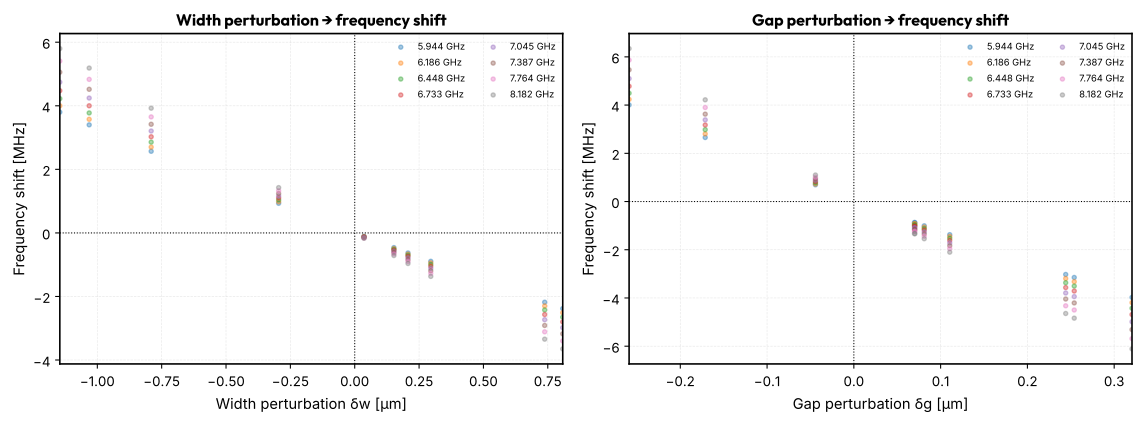
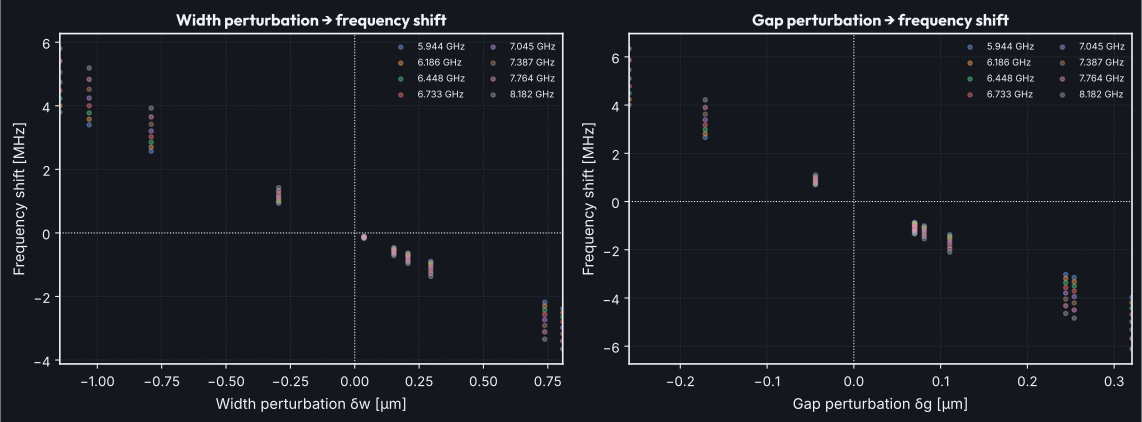
The scatter plots reveal a nearly linear relationship between the geometric perturbation and the resulting frequency shift, confirming that a first-order sensitivity model is appropriate for these tolerance levels. Width variations generally produce a larger frequency shift than gap variations of similar magnitude, making width control the dominant fabrication concern for frequency targeting.
Summary#
Scenario |
Width σ [µm] |
Gap σ [µm] |
Typical freq. spread (1σ) [MHz] |
|---|---|---|---|
Global (systematic bias) |
0.5 |
0.3 |
~tens of MHz (correlated) |
Per-resonator (local) |
0.5 |
0.3 |
~tens of MHz (uncorrelated) |
Width only |
0.5 |
0.0 |
dominant contribution |
Gap only |
0.0 |
0.3 |
secondary contribution |
Key takeaways:
Fabrication tolerances of ±0.5 µm on CPW width and ±0.3 µm on gap lead to resonance frequency spreads of tens of MHz — well above typical qubit–readout detuning budgets.
Width control is the single most important parameter for frequency targeting.
The Monte Carlo framework developed here can be extended to include spatial correlation across the die (wafer-map approach, as in the SAX layout-aware example) or additional sources of variation (substrate permittivity, metal thickness).
References#
M. Checchin, D. Frolov, A. Lunin, A. Grassellino, and A. Romanenko. Measurement of the Low-Temperature Loss Tangent of High-Resistivity Silicon Using a High- Q Superconducting Resonator. Physical Review Applied, 18(3):034013, September 2022. doi:10.1103/PhysRevApplied.18.034013.
P. Krantz, M. Kjaergaard, F. Yan, T. P. Orlando, S. Gustavsson, and W. D. Oliver. A quantum engineer's guide to superconducting qubits. Applied Physics Reviews, 6(2):021318, June 2019. doi:10.1063/1.5089550.