PCells
A PCell (short for parameterized
cell) is a reusable cell whose geometry is generated by a Python function.
In kfactory, any function decorated with @kf.cell becomes a PCell.
Key benefits:
- Automatic caching — calling the same function with the same arguments returns the identical cell object (no duplicate shapes or redundant computation).
- Auto-naming — the cell name encodes its parameters (e.g.
wg_straight_W0p5_L10), so GDS exports are always unambiguous. - Settings dict — each cached cell records its construction parameters in
cell.settings, enabling round-tripping and LVS annotation.
API quick-reference
| Decorator | Cell type returned | Unit hint |
|---|---|---|
@kf.cell |
KCell (DBU integers) |
DBU |
@kf.cell(output_type=kf.DKCell) |
DKCell (µm floats) |
µm |
@kf.vcell |
VKCell (virtual; geometry is materialised in the layout only when the cell is inserted into a KCell) |
any |
@pdk.cell |
KCell bound to a specific KCLayout |
DBU |
Setup
import kfactory as kf


class LAYER(kf.LayerInfos):
    WG: kf.kdb.LayerInfo = kf.kdb.LayerInfo(1, 0)
    WGCLAD: kf.kdb.LayerInfo = kf.kdb.LayerInfo(2, 0)


L = LAYER()
kf.kcl.infos = L
1 · Basic PCell — DBU API
Decorate a function that creates a KCell with @kf.cell. All arguments must
be hashable (integers, floats, strings, LayerInfo) so the cache key can be
computed.
@kf.cell
def wg_straight(width: int, length: int) -> kf.KCell:
    """Straight waveguide (DBU coordinates).

    Args:
        width: Waveguide core width in DBU.
        length: Waveguide length in DBU.
    """
    c = kf.KCell()
    layer = kf.kcl.find_layer(L.WG)
    c.shapes(layer).insert(kf.kdb.Box(0, -width // 2, length, width // 2))
    c.add_port(
        port=kf.Port(
            name="o1",
            trans=kf.kdb.Trans(2, False, 0, 0),
            width=width,
            layer_info=L.WG,
        )
    )
    c.add_port(
        port=kf.Port(
            name="o2",
            trans=kf.kdb.Trans(0, False, length, 0),
            width=width,
            layer_info=L.WG,
        )
    )
    return c


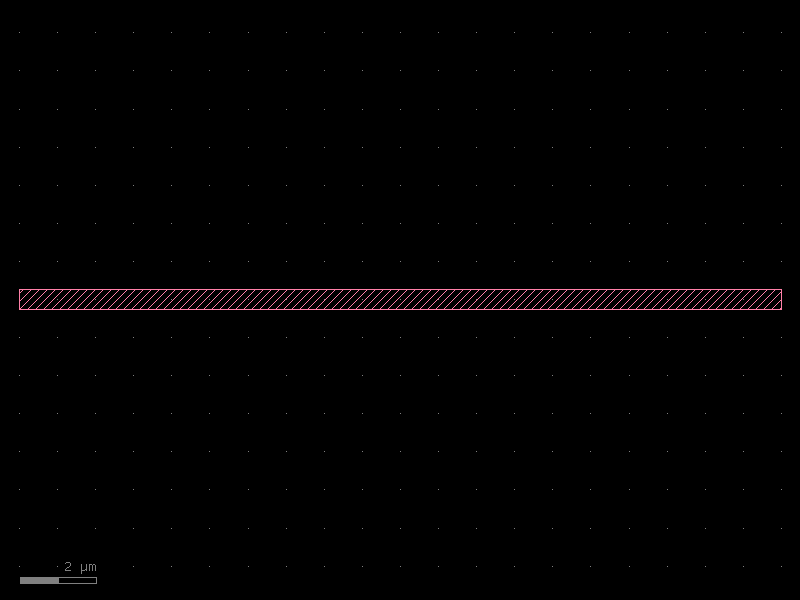
# Construct with DBU arguments (1 nm = 1 DBU at default dbu=0.001 µm/DBU)
WG_WIDTH = kf.kcl.to_dbu(0.5)  # 500 DBU  (0.5 µm)
WG_LEN = kf.kcl.to_dbu(20.0)  # 20000 DBU (20 µm)

s = wg_straight(WG_WIDTH, WG_LEN)
s
Automatic naming
The cell name is derived from the function name and its arguments. Floats are
formatted with p in place of . to keep the name GDS-legal.
print(s.name)  # → wg_straight_W500_L20000
print(s.settings)  # → KCellSettings(width=500, length=20000)
wg_straight_W500_L20000
KCellSettings(width=500, length=20000)
Caching
Calling wg_straight again with the same arguments returns the exact same
object — the body of the function is not executed a second time.
s2 = wg_straight(WG_WIDTH, WG_LEN)
s3 = wg_straight(WG_WIDTH, kf.kcl.to_dbu(30.0))  # different length → new cell

print("same args → same object:", s is s2)  # True
print("diff args → new object: ", s is s3)  # False
same args → same object: True
diff args → new object:  False
2 · µm API — output_type=kf.DKCell
For a µm-native interface, pass output_type=kf.DKCell to @kf.cell. The
decorator wraps the returned KCell in a DKCell automatically — you can still
build geometry in DBU inside the function.
@kf.cell(output_type=kf.DKCell)
def wg_straight_um(width: float, length: float) -> kf.KCell:
    """Straight waveguide (µm API, DBU internals).

    Args:
        width: Waveguide core width in µm.
        length: Waveguide length in µm.
    """
    c = kf.KCell()
    layer = kf.kcl.find_layer(L.WG)
    w = kf.kcl.to_dbu(width)
    l_ = kf.kcl.to_dbu(length)
    c.shapes(layer).insert(kf.kdb.Box(0, -w // 2, l_, w // 2))
    c.add_port(
        port=kf.Port(
            name="o1",
            trans=kf.kdb.Trans(2, False, 0, 0),
            width=w,
            layer_info=L.WG,
        )
    )
    c.add_port(
        port=kf.Port(
            name="o2",
            trans=kf.kdb.Trans(0, False, l_, 0),
            width=w,
            layer_info=L.WG,
        )
    )
    return c


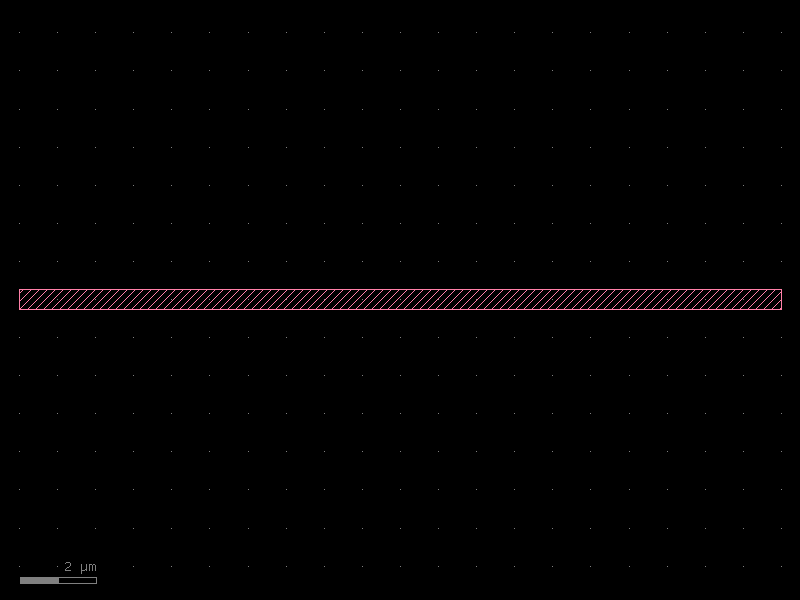
wg = wg_straight_um(0.5, 20.0)
print("type:", type(wg).__name__)  # DKCell
print("name:", wg.name)  # wg_straight_um_W0p5_L20
print("settings:", wg.settings)
wg
type: DKCell
name: wg_straight_um_W0p5_L20
settings: KCellSettings(width=0.5, length=20.0)
3 · Multi-layer PCell
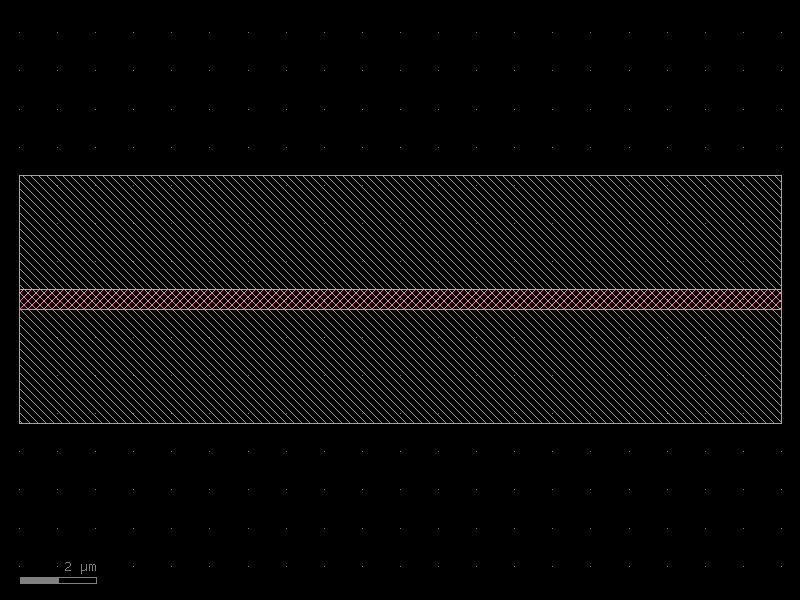
PCells can draw on multiple layers. Here a waveguide with a cladding layer (slab) demonstrates layered geometry.
@kf.cell
def wg_clad(width: int, length: int, clad_width: int) -> kf.KCell:
    """Waveguide with slab cladding.

    Args:
        width: Core width in DBU.
        length: Waveguide length in DBU.
        clad_width: Extra cladding on each side in DBU.
    """
    c = kf.KCell()
    wg_layer = kf.kcl.find_layer(L.WG)
    clad_layer = kf.kcl.find_layer(L.WGCLAD)

    half_w = width // 2
    half_c = half_w + clad_width

    c.shapes(wg_layer).insert(kf.kdb.Box(0, -half_w, length, half_w))
    c.shapes(clad_layer).insert(kf.kdb.Box(0, -half_c, length, half_c))

    c.add_port(
        port=kf.Port(
            name="o1",
            trans=kf.kdb.Trans(2, False, 0, 0),
            width=width,
            layer_info=L.WG,
        )
    )
    c.add_port(
        port=kf.Port(
            name="o2",
            trans=kf.kdb.Trans(0, False, length, 0),
            width=width,
            layer_info=L.WG,
        )
    )
    return c


wg_c = wg_clad(
    width=kf.kcl.to_dbu(0.5),
    length=kf.kcl.to_dbu(20.0),
    clad_width=kf.kcl.to_dbu(3.0),
)
wg_c
4 · Composing PCells
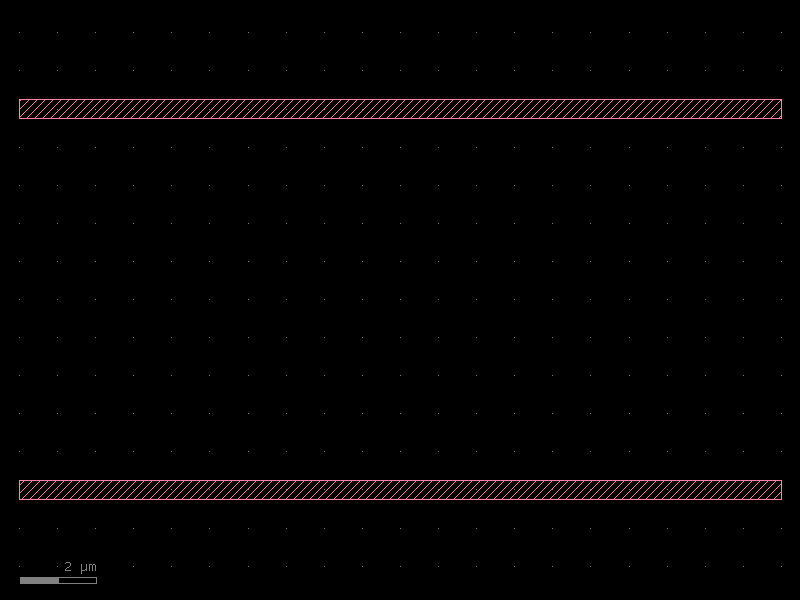
PCells can reference other PCells via cell.create_inst(other_cell). The inner
cell is fetched from the cache (or created once and cached), so there is no
duplication even when many parent cells share the same child.
@kf.cell
def y_branch(width: int, length: int, arm_sep: int) -> kf.KCell:
    """Simplified Y-branch: one input, two parallel outputs.

    Args:
        width: Waveguide width in DBU.
        length: Arm length in DBU.
        arm_sep: Centre-to-centre separation of the two output arms in DBU.
    """
    c = kf.KCell()
    arm = wg_straight(width, length)  # fetched from cache

    inst_top = c.create_inst(arm)
    inst_bot = c.create_inst(arm)

    inst_top.transform(kf.kdb.Trans(0, False, 0, arm_sep // 2))
    inst_bot.transform(kf.kdb.Trans(0, False, 0, -(arm_sep // 2)))

    c.add_port(port=inst_top.ports["o2"], name="o_top")
    c.add_port(port=inst_bot.ports["o2"], name="o_bot")
    return c


yb = y_branch(WG_WIDTH, kf.kcl.to_dbu(20.0), kf.kcl.to_dbu(10.0))
yb
5 · Virtual cells — @kf.vcell
A VKCell (virtual cell) is built like a PCell but is not registered in the
KLayout cell database. It is useful for intermediate helper geometry that never
needs to appear as a standalone cell in the GDS.
@kf.vcell
def marker_cross(size: int) -> kf.VKCell:
    """Alignment cross marker (virtual — not stored in the layout DB).

    Args:
        size: Half-width of each arm in DBU.
    """
    v = kf.VKCell()
    layer = kf.kcl.find_layer(L.WG)
    v.shapes(layer).insert(kf.kdb.Box(-size // 4, -size, size // 4, size))
    v.shapes(layer).insert(kf.kdb.Box(-size, -size // 4, size, size // 4))
    return v


m = marker_cross(kf.kcl.to_dbu(5.0))
print("VKCell type:", type(m).__name__)  # VKCell
VKCell type: VKCell
6 · Per-PDK cells — @pdk.cell
When building a PDK, each component should be created inside that PDK's
KCLayout instance rather than the global kf.kcl. Use @pdk.cell instead
of @kf.cell so that layer indices are looked up from the correct layout.
class PDK_LAYERS(kf.LayerInfos):
    WG: kf.kdb.LayerInfo = kf.kdb.LayerInfo(1, 0)
    SLAB: kf.kdb.LayerInfo = kf.kdb.LayerInfo(3, 0)


pdk = kf.KCLayout("DEMO_PDK", infos=PDK_LAYERS)


@pdk.cell
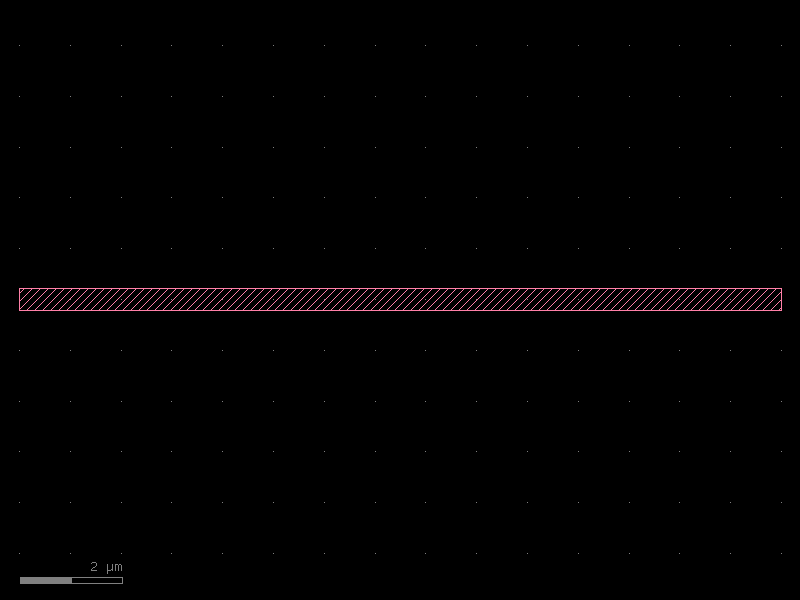
def pdk_straight(width: float, length: float) -> kf.KCell:
    """Straight waveguide inside DEMO_PDK layout.

    Args:
        width: Core width in µm.
        length: Waveguide length in µm.
    """
    c = pdk.kcell()
    layer = pdk.find_layer(PDK_LAYERS().WG)
    w = pdk.to_dbu(width)
    l_ = pdk.to_dbu(length)
    c.shapes(layer).insert(kf.kdb.Box(0, -w // 2, l_, w // 2))
    c.add_port(
        port=kf.Port(
            name="o1",
            trans=kf.kdb.Trans(2, False, 0, 0),
            width=w,
            layer_info=PDK_LAYERS().WG,
            kcl=pdk,
        )
    )
    c.add_port(
        port=kf.Port(
            name="o2",
            trans=kf.kdb.Trans(0, False, l_, 0),
            width=w,
            layer_info=PDK_LAYERS().WG,
            kcl=pdk,
        )
    )
    return c


ps = pdk_straight(0.45, 15.0)
print("name:", ps.name)  # pdk_straight_W0p45_L15
print("kcl: ", ps.kcl.name)  # DEMO_PDK
ps
name: pdk_straight_W0p45_L15
kcl:  DEMO_PDK
7 · Decorator options
The @kf.cell decorator accepts several keyword arguments to control naming,
caching, and validation.
| Option | Default | Effect |
|---|---|---|
output_type |
None (→ KCell) |
Wrap result in DKCell or a subclass |
basename |
function name | Override the name prefix |
set_name |
True |
Auto-set cell name from params |
set_settings |
True |
Populate cell.settings |
check_ports |
True |
Warn on duplicate/unnamed ports |
snap_ports |
True |
Snap port positions to grid |
cache |
shared per-layout dict | Custom cache (e.g. {} to disable) |
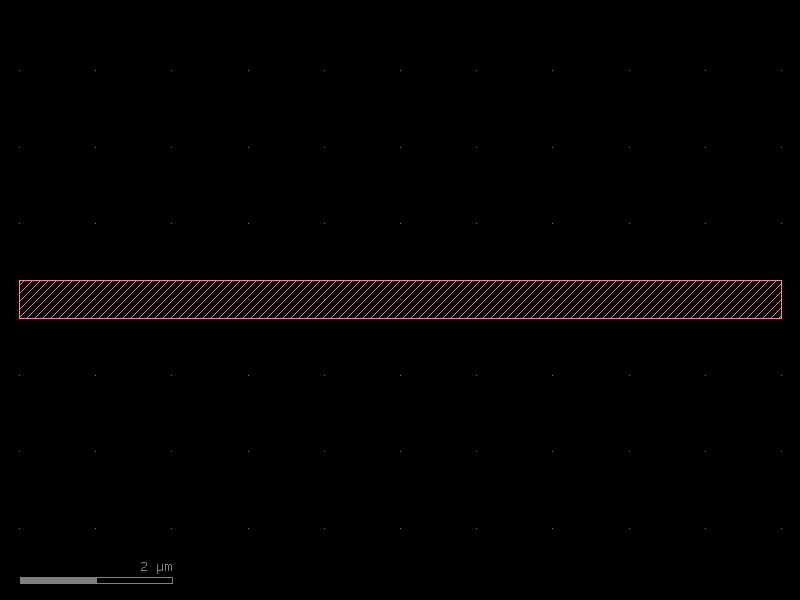
@kf.cell(basename="WG_STRIP", set_settings=True)
def strip_waveguide(width: float, length: float) -> kf.KCell:
    """Strip waveguide with custom basename."""
    c = kf.KCell()
    layer = kf.kcl.find_layer(L.WG)
    w = kf.kcl.to_dbu(width)
    l_ = kf.kcl.to_dbu(length)
    c.shapes(layer).insert(kf.kdb.Box(0, -w // 2, l_, w // 2))
    c.add_port(
        port=kf.Port(
            name="o1",
            trans=kf.kdb.Trans(2, False, 0, 0),
            width=w,
            layer_info=L.WG,
        )
    )
    c.add_port(
        port=kf.Port(
            name="o2",
            trans=kf.kdb.Trans(0, False, l_, 0),
            width=w,
            layer_info=L.WG,
        )
    )
    return c


sw = strip_waveguide(0.5, 10.0)
print("name:    ", sw.name)  # WG_STRIP_W0p5_L10
print("settings:", sw.settings)
sw
name:     WG_STRIP_W0p5_L10
settings: KCellSettings(width=0.5, length=10.0)
Summary
| Task | API |
|---|---|
| DBU PCell | @kf.cell on a function returning KCell |
| µm PCell | @kf.cell(output_type=kf.DKCell) |
| Virtual cell | @kf.vcell on a function returning VKCell |
| PDK-scoped cell | @pdk.cell where pdk is a KCLayout |
| Custom name prefix | @kf.cell(basename="MY_CELL") |
| Disable name/settings | set_name=False, set_settings=False |
Caching rules: Two calls with equal arguments produce the same object — a is b
is True. Arguments must be hashable (int, float, str, LayerInfo, frozen
containers). Pass mutable state (like a LayerEnclosure) by name, not by value,
to avoid hash errors.
See Also
| Topic | Where |
|---|---|
| Factory functions reference | Components: Factories |
| Virtual (non-physical) cells | Components: Virtual Cells |
| KCell / DKCell / VKCell basics | Core Concepts: KCell |
| DBU vs µm coordinate systems | Core Concepts: DBU vs µm |
| Creating a full PDK | PDK: Creating a PDK |