Electrical Routing — Deep Dive
This page covers electrical (metal-wire) routing in kfactory. For a quick intro see Routing Overview.
Electrical routes are plain Manhattan wires — no bend cells, no radii. The router places a filled rectangular path along the backbone and supports all the same waypoint / stub / obstacle-avoidance features as optical routing.
| Topic | API |
|---|---|
| Basic wire bundle | kf.routing.electrical.route_bundle(c, starts, ends, sep, place_layer=...) |
| Per-route wire width | route_bundle(..., route_width=...) |
| Entry / exit stubs | route_bundle(..., starts=..., ends=...) |
| Waypoints | route_bundle(..., waypoints=...) |
| Obstacle avoidance | route_bundle(..., bboxes=[...]) |
| Coplanar / dual-rail | kf.routing.electrical.route_bundle_dual_rails(...) |
Setup
All coordinates in KCell-based APIs are in DBU (database units).
With the default dbu = 0.001 µm/DBU, 1 µm = 1 000 DBU.
Use kf.kcl.to_dbu(x_µm) to convert.
import kfactory as kf


class LAYER(kf.LayerInfos):
    METAL1: kf.kdb.LayerInfo = kf.kdb.LayerInfo(10, 0)
    METAL2: kf.kdb.LayerInfo = kf.kdb.LayerInfo(11, 0)
    FLOORPLAN: kf.kdb.LayerInfo = kf.kdb.LayerInfo(99, 0)


L = LAYER()
kf.kcl.infos = L

# Typical metal wire: 2 µm wide, 2 µm separation between adjacent routes
WIRE_WIDTH = kf.kcl.to_dbu(2)  # 2_000 DBU
SEPARATION = kf.kcl.to_dbu(2)  # 2_000 DBU
1 · Basic wire bundle
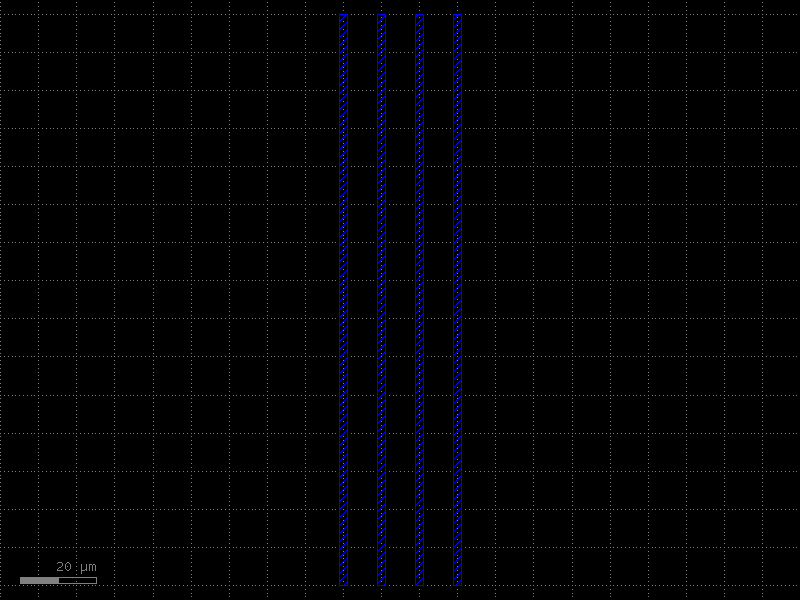
route_bundle connects N start ports to N end ports with straight-corner wires.
Supply place_layer to draw all wires on a specific layer.
Port angles follow the KLayout integer convention:
0 = East, 1 = North, 2 = West, 3 = South.
The most common pattern is start facing North (angle=1) and end facing South
(angle=3) with end ports above start ports, producing S-shaped wires.
c_basic = kf.KCell("elec_basic_bundle")

n = 4
starts_basic = [
    kf.Port(
        name=f"in_{i}",
        trans=kf.kdb.Trans(1, False, kf.kcl.to_dbu(i * 10), 0),
        width=WIRE_WIDTH,
        layer_info=L.METAL1,
    )
    for i in range(n)
]
ends_basic = [
    kf.Port(
        name=f"out_{i}",
        trans=kf.kdb.Trans(3, False, kf.kcl.to_dbu(i * 10), kf.kcl.to_dbu(150)),
        width=WIRE_WIDTH,
        layer_info=L.METAL1,
    )
    for i in range(n)
]

kf.routing.electrical.route_bundle(
    c_basic,
    starts_basic,
    ends_basic,
    separation=SEPARATION,
    place_layer=L.METAL1,
)
c_basic
2 · Overriding wire width with route_width
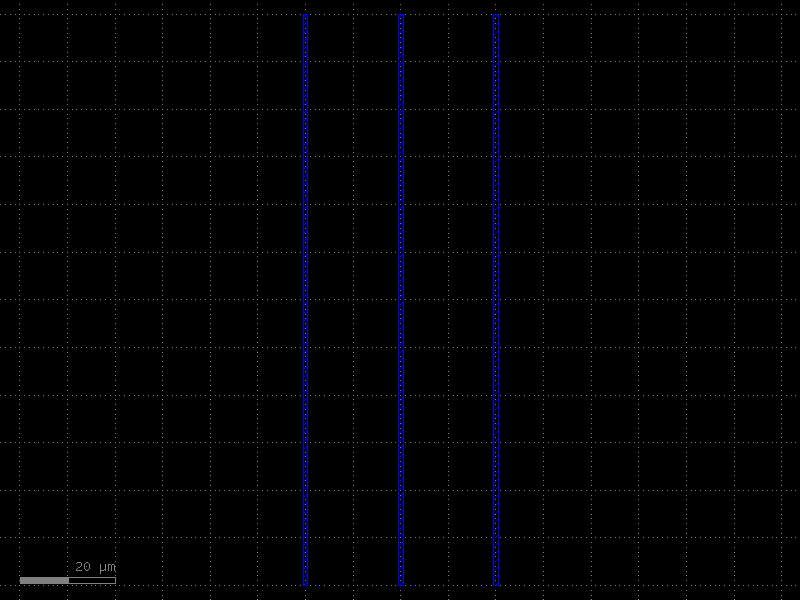
By default each route inherits the width of its start port. Pass route_width (in
DBU) to draw all wires at a uniform width, or pass a list to set per-route widths.
This is useful when routing between ports of different widths or when the route must
be narrower than the pad.
c_rw = kf.KCell("elec_route_width")

starts_rw = [
    kf.Port(
        name=f"pad_{i}",
        # Wide pads: 10 µm
        trans=kf.kdb.Trans(1, False, kf.kcl.to_dbu(i * 20), 0),
        width=kf.kcl.to_dbu(10),
        layer_info=L.METAL1,
    )
    for i in range(3)
]
ends_rw = [
    kf.Port(
        name=f"wire_{i}",
        # Narrow landing pads: 2 µm
        trans=kf.kdb.Trans(3, False, kf.kcl.to_dbu(i * 20), kf.kcl.to_dbu(120)),
        width=WIRE_WIDTH,
        layer_info=L.METAL1,
    )
    for i in range(3)
]

# Route the wire at 1 µm regardless of the port widths.
kf.routing.electrical.route_bundle(
    c_rw,
    starts_rw,
    ends_rw,
    separation=SEPARATION,
    place_layer=L.METAL1,
    route_width=kf.kcl.to_dbu(1),
)
c_rw
3 · Entry and exit stubs — starts and ends
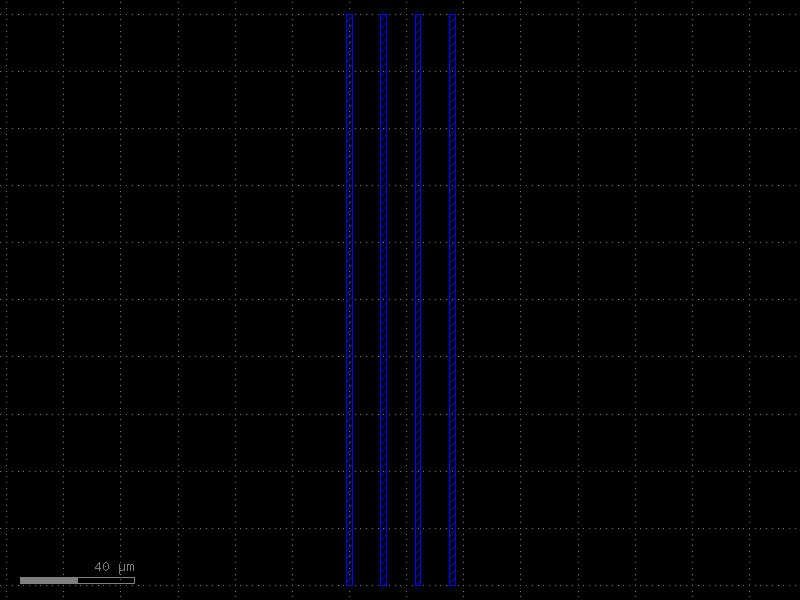
starts / ends force each route to travel straight for a given distance before the
router takes over. A scalar applies the same stub to all routes; a list provides
per-route control (all values in DBU).
Stubs are useful for: - maintaining clearance from a dense pad array before the wires fan out, or - ensuring a minimum straight segment from a component port before turning.
c_stubs = kf.KCell("elec_stubs")

starts_stub = [
    kf.Port(
        name=f"in_{i}",
        trans=kf.kdb.Trans(1, False, kf.kcl.to_dbu(i * 12), 0),
        width=WIRE_WIDTH,
        layer_info=L.METAL1,
    )
    for i in range(4)
]
ends_stub = [
    kf.Port(
        name=f"out_{i}",
        trans=kf.kdb.Trans(3, False, kf.kcl.to_dbu(i * 12), kf.kcl.to_dbu(200)),
        width=WIRE_WIDTH,
        layer_info=L.METAL1,
    )
    for i in range(4)
]

kf.routing.electrical.route_bundle(
    c_stubs,
    starts_stub,
    ends_stub,
    separation=SEPARATION,
    place_layer=L.METAL1,
    starts=kf.kcl.to_dbu(20),  # 20 µm straight after each start port
    ends=kf.kcl.to_dbu(10),  # 10 µm straight before each end port
)
c_stubs
4 · Waypoints — routing through a fixed corridor
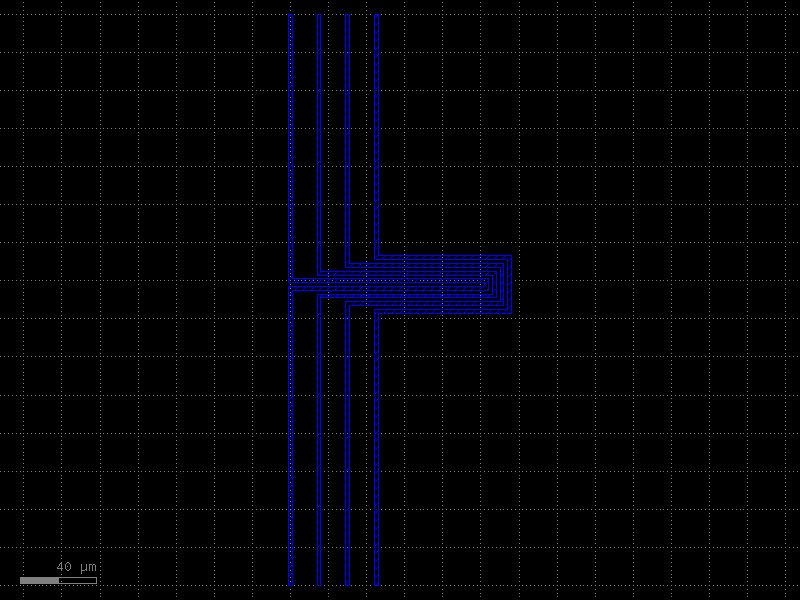
Waypoints force all routes to converge at a specific position and direction before continuing to their end ports.
- Pass a
kdb.Transto specify a single convergence point with a direction (angle encoded as0=East,1=North,2=West,3=South). - Pass a
list[kdb.Point]to define a multi-point corridor (direction inferred from the first two points).
The example below routes 4 wires North from their start pads, forces them through a narrow East-facing corridor in the middle of the layout, then continues up to the end ports.
c_wp = kf.KCell("elec_waypoints")

starts_wp = [
    kf.Port(
        name=f"in_{i}",
        trans=kf.kdb.Trans(1, False, kf.kcl.to_dbu(i * 15), 0),
        width=WIRE_WIDTH,
        layer_info=L.METAL1,
    )
    for i in range(4)
]
ends_wp = [
    kf.Port(
        name=f"out_{i}",
        trans=kf.kdb.Trans(3, False, kf.kcl.to_dbu(i * 15), kf.kcl.to_dbu(300)),
        width=WIRE_WIDTH,
        layer_info=L.METAL1,
    )
    for i in range(4)
]

# All 4 wires must pass through (x=100 µm, y=150 µm) heading East.
kf.routing.electrical.route_bundle(
    c_wp,
    starts_wp,
    ends_wp,
    separation=SEPARATION,
    place_layer=L.METAL1,
    waypoints=kf.kdb.Trans(0, False, kf.kcl.to_dbu(100), kf.kcl.to_dbu(150)),
)
c_wp
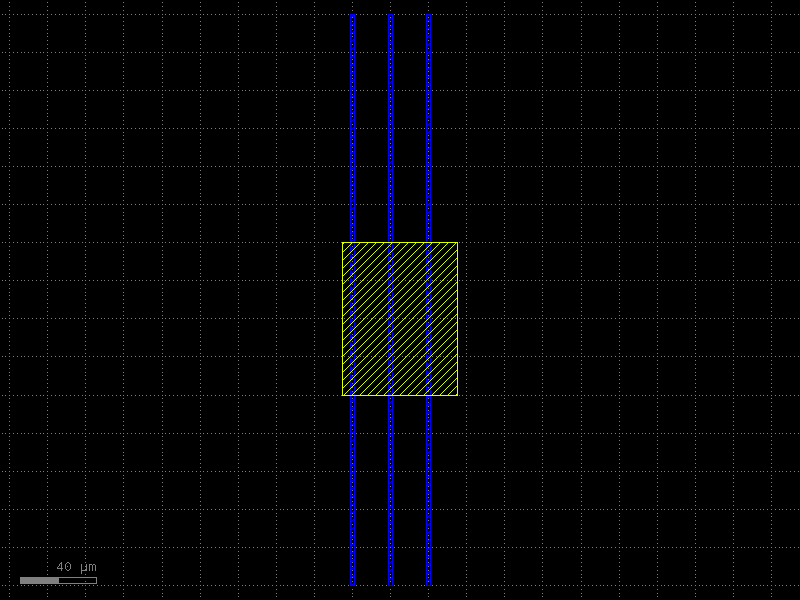
5 · Obstacle avoidance
Pass a list of kdb.Box objects as bboxes to mark keep-out regions.
The router automatically routes around them.
Obstacle boxes are in DBU and are defined as kdb.Box(left, bottom, right, top).
c_obs = kf.KCell("elec_obstacle")

starts_obs = [
    kf.Port(
        name=f"in_{i}",
        trans=kf.kdb.Trans(1, False, kf.kcl.to_dbu(i * 20), 0),
        width=WIRE_WIDTH,
        layer_info=L.METAL1,
    )
    for i in range(3)
]
ends_obs = [
    kf.Port(
        name=f"out_{i}",
        trans=kf.kdb.Trans(3, False, kf.kcl.to_dbu(i * 20), kf.kcl.to_dbu(300)),
        width=WIRE_WIDTH,
        layer_info=L.METAL1,
    )
    for i in range(3)
]

# A keep-out box blocking the centre of the routing area.
obstacle = kf.kdb.Box(
    kf.kcl.to_dbu(-5),
    kf.kcl.to_dbu(100),
    kf.kcl.to_dbu(55),
    kf.kcl.to_dbu(180),
)
# Draw the obstacle on the floorplan layer for visibility.
c_obs.shapes(kf.kcl.find_layer(L.FLOORPLAN)).insert(obstacle)

kf.routing.electrical.route_bundle(
    c_obs,
    starts_obs,
    ends_obs,
    separation=SEPARATION,
    place_layer=L.METAL1,
    bboxes=[obstacle],
)
c_obs
6 · Dual-rail routing
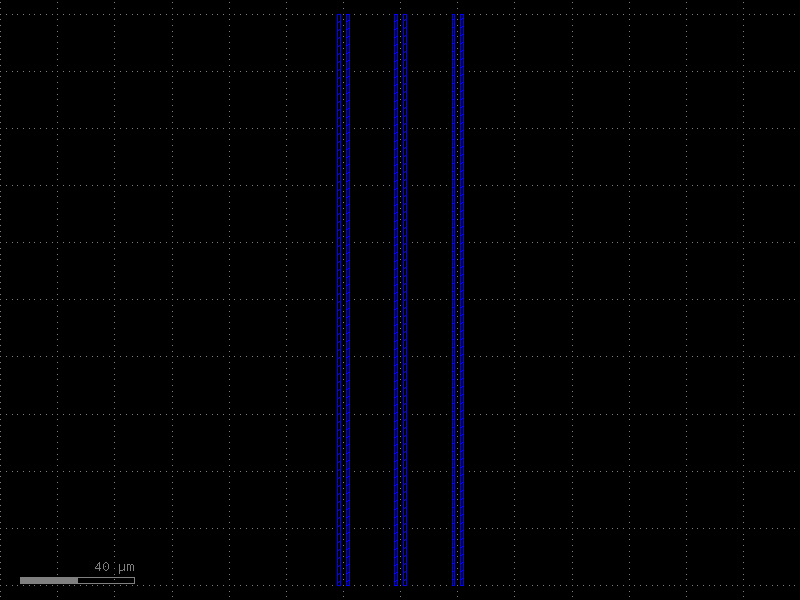
route_bundle_dual_rails draws each wire as two parallel rails with a gap in between
— a common pattern for coplanar waveguide (CPW) transmission lines or differential
signal pairs.
Key parameters (all in DBU):
| Parameter | Meaning |
|---|---|
separation |
Minimum edge-to-edge spacing between adjacent routes |
width_rails |
Total outer width of the hollow path (rail + gap + rail) |
separation_rails |
Width of the inner gap cutout (must be < width_rails) |
For two 1 µm rails separated by a 2 µm gap, set
width_rails = 4 µm (total = rail + gap + rail) and separation_rails = 2 µm.
c_dr = kf.KCell("elec_dual_rails")

# Total outer width: rail(1µm) + gap(2µm) + rail(1µm) = 4µm
DR_TOTAL = kf.kcl.to_dbu(4)  # outer path width
DR_GAP = kf.kcl.to_dbu(2)  # inner hollow width (the gap between rails)

starts_dr = [
    kf.Port(
        name=f"in_{i}",
        trans=kf.kdb.Trans(1, False, kf.kcl.to_dbu(i * 20), 0),
        width=DR_TOTAL,
        layer_info=L.METAL1,
    )
    for i in range(3)
]
ends_dr = [
    kf.Port(
        name=f"out_{i}",
        trans=kf.kdb.Trans(3, False, kf.kcl.to_dbu(i * 20), kf.kcl.to_dbu(200)),
        width=DR_TOTAL,
        layer_info=L.METAL1,
    )
    for i in range(3)
]

kf.routing.electrical.route_bundle_dual_rails(
    c_dr,
    starts_dr,
    ends_dr,
    separation=kf.kcl.to_dbu(5),
    place_layer=L.METAL1,
    width_rails=DR_TOTAL,
    separation_rails=DR_GAP,
    on_collision=None,
)
c_dr
Summary
| Need | Parameter |
|---|---|
| Basic wire bundle | route_bundle(c, starts, ends, sep, place_layer=L.METAL1) |
| Uniform wire width | route_width=kf.kcl.to_dbu(w_µm) |
| Per-route widths | route_width=[w1_dbu, w2_dbu, ...] |
| Minimum straight before turn | starts=dbu_length (scalar or list) |
| Route through fixed corridor | waypoints=kdb.Trans(angle, flip, x, y) |
| Avoid keep-out regions | bboxes=[kdb.Box(l, b, r, t)] |
| Coplanar / differential pair | route_bundle_dual_rails(..., width_rails=..., separation_rails=...) |
All coordinates in KCell-based APIs are in DBU (1 nm = 1 DBU with default
dbu=0.001). Convert with kf.kcl.to_dbu(x_µm).
See Also
| Topic | Where |
|---|---|
| Routing overview (optical + electrical entry point) | Routing: Overview |
| Bundle routing details: sort, sbend, bbox modes | Routing: Bundle |
| Optical waveguide routing | Routing: Optical |
| Layer definitions and metal layers | Core Concepts: Layers |
| Cross-sections for wire geometry | Cross-Sections |
| Port construction and connection | Core Concepts: Ports |