Routing Overview
kfactory provides routing utilities for connecting component ports with wires or
waveguides. All routers live under kf.routing:
| Sub-module | Purpose |
|---|---|
kf.routing.optical |
Photonic/optical waveguides — uses bends (euler, circular) |
kf.routing.electrical |
Metal wires — right-angle corners only |
kf.routing.aa.optical |
All-angle optical routing (non-Manhattan) |
The primary entry point in each module is route_bundle, which routes N start
ports to N end ports while avoiding obstacles.
Port angle convention
A port's angle is the outward direction — the direction a wire exits the device at
that port. route_bundle connects:
- Start ports: wire exits in the direction of the port's angle.
- End ports: wire arrives going in the direction of the port's angle.
The most common pairing is start facing North (angle=1) and end facing South (angle=3) with end ports above start ports, which produces S-shaped routes. Alternatively, start and end can face the same direction when one port sits directly "in front" of the other (e.g., two East-facing ports on a horizontal axis).
KLayout angle integers: 0 = East (0°), 1 = North (90°), 2 = West (180°),
3 = South (270°).
from functools import partial

import kfactory as kf


# ── Layers ────────────────────────────────────────────────────────────────
# Use kf.kcl (the global layout) and register all layers on it.
# Ports, cells, and factories all need to share the same KCLayout instance.
class LAYER(kf.LayerInfos):
    WG: kf.kdb.LayerInfo = kf.kdb.LayerInfo(1, 0)
    WGCLAD: kf.kdb.LayerInfo = kf.kdb.LayerInfo(2, 0)
    METAL: kf.kdb.LayerInfo = kf.kdb.LayerInfo(20, 0)
    METALEX: kf.kdb.LayerInfo = kf.kdb.LayerInfo(20, 1)
    FLOORPLAN: kf.kdb.LayerInfo = kf.kdb.LayerInfo(10, 0)


L = LAYER()
kf.kcl.infos = L

# ── Optical waveguide setup ───────────────────────────────────────────────
wg_enc = kf.kcl.get_enclosure(
    kf.LayerEnclosure(name="WGSTD", sections=[(L.WGCLAD, 0, 2_000)])
)

# Euler bend cell (angle=90, radius=10 µm).
# bend_euler_factory takes width and radius in µm.
bend90 = kf.factories.euler.bend_euler_factory(kcl=kf.kcl)(
    width=0.5,  # µm
    radius=10,  # µm
    layer=L.WG,
    enclosure=wg_enc,
    angle=90,
)

# Straight factory: call with width= and length= in DBU
straight_factory = partial(
    kf.factories.straight.straight_dbu_factory(kcl=kf.kcl),
    layer=L.WG,
    enclosure=wg_enc,
)

# Convenience: 0.5 µm port width in DBU
WG_WIDTH = kf.kcl.to_dbu(0.5)  # 500 DBU at 1 nm/DBU
1 · Straight (degenerate) route
When two East-facing ports sit on the same horizontal axis, route_bundle places
a single straight waveguide with no bends.
c_straight = kf.KCell("route_straight")

p1 = kf.Port(
    name="o1",
    trans=kf.kdb.Trans(0, False, 0, 0),
    width=WG_WIDTH,
    layer_info=L.WG,
)
p2 = kf.Port(
    name="o2",
    trans=kf.kdb.Trans(0, False, kf.kcl.to_dbu(80), 0),
    width=WG_WIDTH,
    layer_info=L.WG,
)

kf.routing.optical.route_bundle(
    c_straight,
    [p1],
    [p2],
    separation=kf.kcl.to_dbu(5),
    straight_factory=straight_factory,
    bend90_cell=bend90,
)
c_straight
2 · Single route with bends
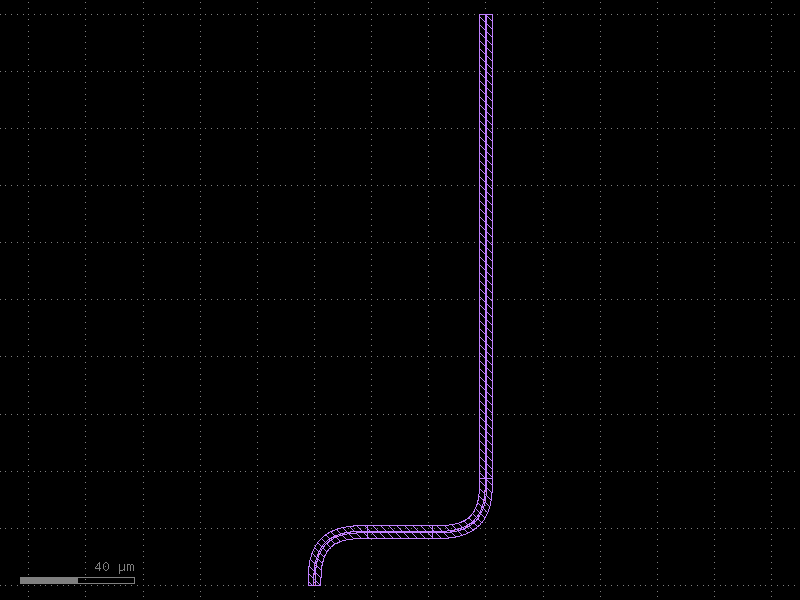
Start facing North (angle=1), end facing South (angle=3), end above start. The router inserts euler bends to produce an S-shaped path.
c1 = kf.KCell("single_route_bend")

p_start = kf.Port(
    name="o1",
    trans=kf.kdb.Trans(1, False, 0, 0),
    width=WG_WIDTH,
    layer_info=L.WG,
)
p_end = kf.Port(
    name="o2",
    trans=kf.kdb.Trans(3, False, kf.kcl.to_dbu(60), kf.kcl.to_dbu(200)),
    width=WG_WIDTH,
    layer_info=L.WG,
)

kf.routing.optical.route_bundle(
    c1,
    [p_start],
    [p_end],
    separation=kf.kcl.to_dbu(5),
    straight_factory=straight_factory,
    bend90_cell=bend90,
)
c1
3 · Bundle routing
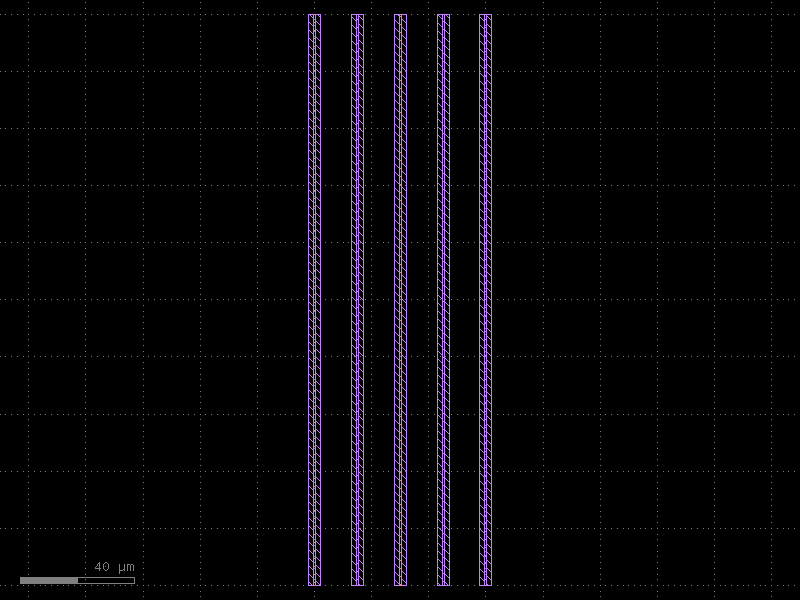
Route multiple waveguides in parallel. kfactory fans the routes apart to maintain
at least separation between adjacent route edges.
c2 = kf.KCell("bundle_route")

n = 5
start_ports = [
    kf.Port(
        name=f"in_{i}",
        trans=kf.kdb.Trans(1, False, kf.kcl.to_dbu(i * 15), 0),
        width=WG_WIDTH,
        layer_info=L.WG,
    )
    for i in range(n)
]
end_ports = [
    kf.Port(
        name=f"out_{i}",
        trans=kf.kdb.Trans(3, False, kf.kcl.to_dbu(i * 15), kf.kcl.to_dbu(200)),
        width=WG_WIDTH,
        layer_info=L.WG,
    )
    for i in range(n)
]

kf.routing.optical.route_bundle(
    c2,
    start_ports,
    end_ports,
    separation=kf.kcl.to_dbu(5),
    straight_factory=straight_factory,
    bend90_cell=bend90,
)
c2
4 · Obstacle avoidance
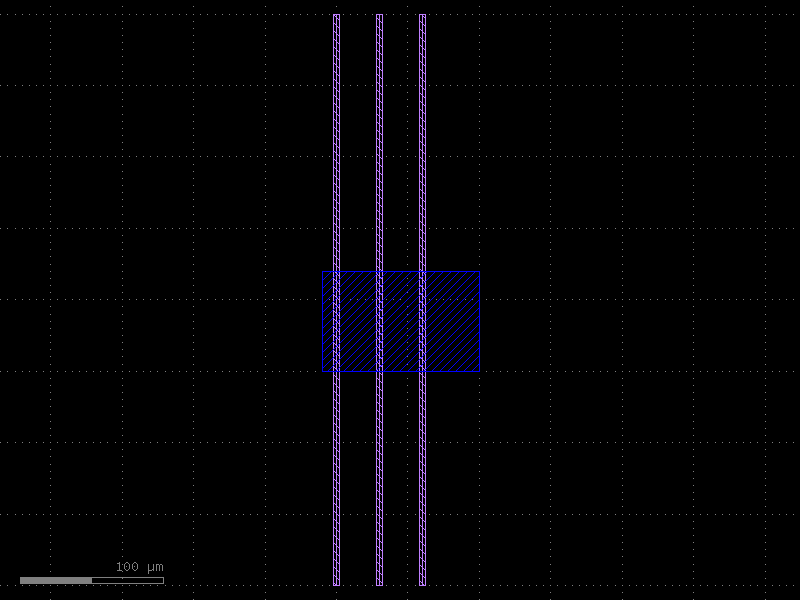
Pass bboxes to mark keep-out zones. The router automatically detours around them.
c3 = kf.KCell("obstacle_avoidance")

start_ports3 = [
    kf.Port(
        name=f"in_{i}",
        trans=kf.kdb.Trans(1, False, kf.kcl.to_dbu(i * 30), 0),
        width=WG_WIDTH,
        layer_info=L.WG,
    )
    for i in range(3)
]
end_ports3 = [
    kf.Port(
        name=f"out_{i}",
        trans=kf.kdb.Trans(3, False, kf.kcl.to_dbu(i * 30), kf.kcl.to_dbu(400)),
        width=WG_WIDTH,
        layer_info=L.WG,
    )
    for i in range(3)
]

obstacle = kf.kdb.Box(
    kf.kcl.to_dbu(-10),
    kf.kcl.to_dbu(150),
    kf.kcl.to_dbu(100),
    kf.kcl.to_dbu(220),
)
c3.shapes(kf.kcl.find_layer(L.FLOORPLAN)).insert(obstacle)

kf.routing.optical.route_bundle(
    c3,
    start_ports3,
    end_ports3,
    separation=kf.kcl.to_dbu(5),
    straight_factory=straight_factory,
    bend90_cell=bend90,
    bboxes=[obstacle],
)
c3
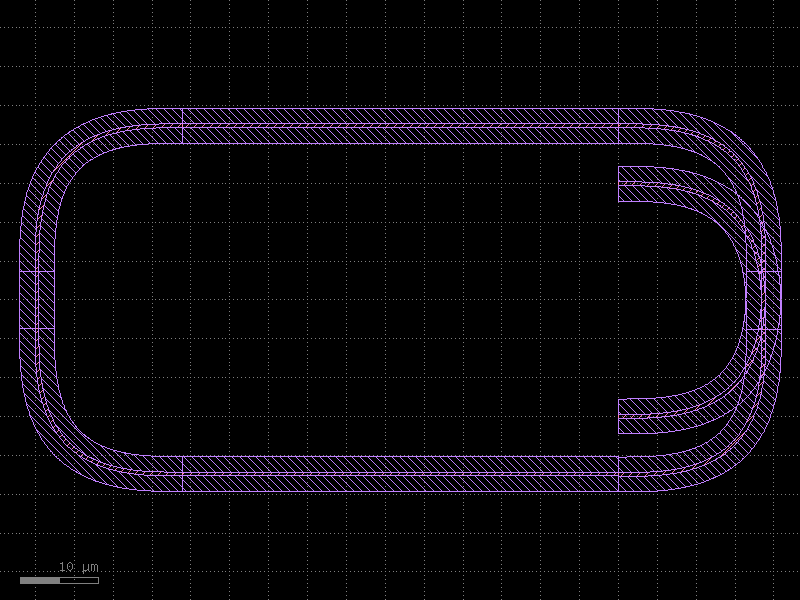
5 · Loopback (U-turn between parallel ports)
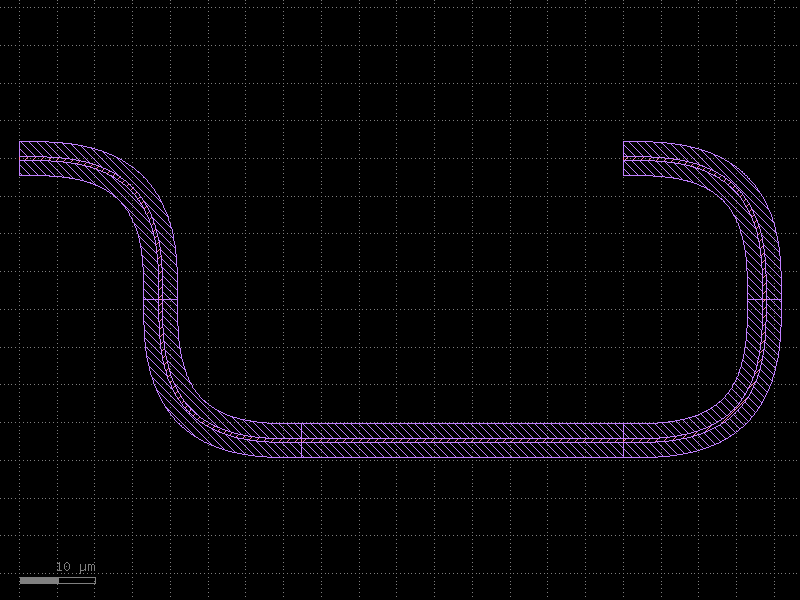
route_loopback computes backbone waypoints for a U-shaped path between two
co-directional parallel ports. Pass the result to place_manhattan to materialise
the route geometry.
c4 = kf.KCell("loopback_demo")

lb_p1 = kf.Port(
    name="p1",
    trans=kf.kdb.Trans(0, False, 0, 0),
    width=WG_WIDTH,
    layer_info=L.WG,
)
lb_p2 = kf.Port(
    name="p2",
    trans=kf.kdb.Trans(0, False, 0, kf.kcl.to_dbu(30)),
    width=WG_WIDTH,
    layer_info=L.WG,
)

# get_radius returns the effective routing radius for this bend cell (euler bends are
# larger than their nominal radius — use get_radius rather than a hard-coded value).
bend_radius = kf.routing.optical.get_radius(bend90)

backbone = kf.routing.optical.route_loopback(
    lb_p1,
    lb_p2,
    bend90_radius=bend_radius,
    d_loop=bend_radius * 4,
)

kf.routing.optical.place_manhattan(
    c4,
    lb_p1,
    lb_p2,
    backbone,
    straight_factory=straight_factory,
    bend90_cell=bend90,
)
c4
6 · Electrical routing
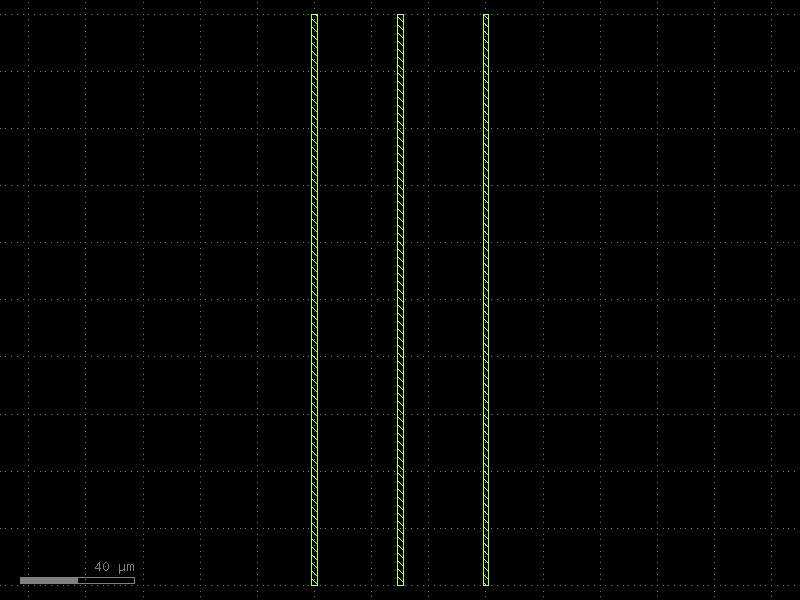
Electrical routes are plain Manhattan wires — no bend cells needed. Use
kf.routing.electrical.route_bundle with place_layer and route_width (in DBU).
METAL_WIDTH = 2_000  # 2 µm in DBU

ce = kf.KCell("electrical_bundle")

e_start = [
    kf.Port(
        name=f"e_in_{i}",
        trans=kf.kdb.Trans(1, False, i * 30_000, 0),
        width=METAL_WIDTH,
        layer_info=L.METAL,
    )
    for i in range(3)
]
e_end = [
    kf.Port(
        name=f"e_out_{i}",
        trans=kf.kdb.Trans(3, False, i * 30_000, 200_000),
        width=METAL_WIDTH,
        layer_info=L.METAL,
    )
    for i in range(3)
]

kf.routing.electrical.route_bundle(
    ce,
    e_start,
    e_end,
    separation=5_000,
    place_layer=L.METAL,
)
ce
Summary
| Task | API |
|---|---|
| Route N optical waveguides | kf.routing.optical.route_bundle(c, starts, ends, sep, straight_factory=..., bend90_cell=...) |
| Route N metal wires | kf.routing.electrical.route_bundle(c, starts, ends, sep, place_layer=...) |
| U-turn loopback | kf.routing.optical.route_loopback(p1, p2, bend90_radius=...) → pts, then place_manhattan(c, p1, p2, pts, ...) |
| Avoid obstacles | add bboxes=[kdb.Box(...)] to route_bundle |
All coordinates in KCell-based APIs are in DBU (1 nm = 1 DBU with default dbu = 0.001).
Use kf.kcl.to_dbu(x_um) to convert from µm. For a purely µm-native workflow use
DKCell / DPort variants instead.
See Also
| Topic | Where |
|---|---|
| Optical route options: waypoints, path-length matching, loopbacks | Routing: Optical |
| Electrical (metal wire) routing | Routing: Electrical |
| Manhattan backbone algorithm and Steps API | Routing: Manhattan |
| All-angle (diagonal) routing | Routing: All-Angle |
| Bundle routing: sort, separation, sbend, bbox modes | Routing: Bundle |
| Equal path-length routing | Routing: Path Length |
| Euler bend cells and effective radius | Components: Euler Bends |
| DBU vs µm coordinate systems | Core Concepts: DBU vs µm |