Directional coupler: four FDTD solvers
Broadband photonic simulation in just over a minute. GDSFactory FDTD solved this 37-million-cell directional coupler on cloud CPUs in 75 seconds. See how its optical response, throughput and cost compare with commercial CPU, commercial GPU and Meep solvers.
The problem
A directional coupler controls how much light passes straight through and how much transfers to a neighboring waveguide. Getting that split right is central to designing splitters, interferometers and photonic circuits.
This benchmark uses two 500 × 220 nm silicon waveguides, a 236 nm gap and a 20 µm coupling section, with SiO₂ cladding. Light enters at o1; the cross port o3 measures |S31|² and the through port o4 measures |S41|².
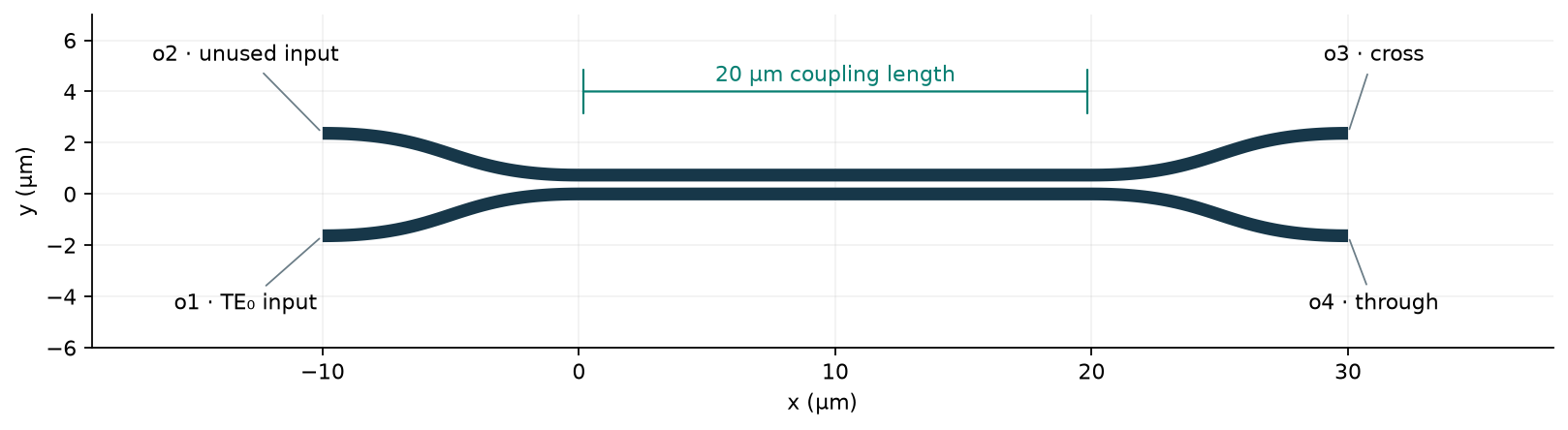
Based on a published photonic device
Z. Liu and J. K. S. Poon (2025), Comparison of Lumerical FDTD and Tidy3D for three-dimensional FDTD simulations of passive silicon photonic components.
Read the original paper
The device geometry comes from this study. The four-solver comparison below is a separate benchmark.
Cross and through transmission
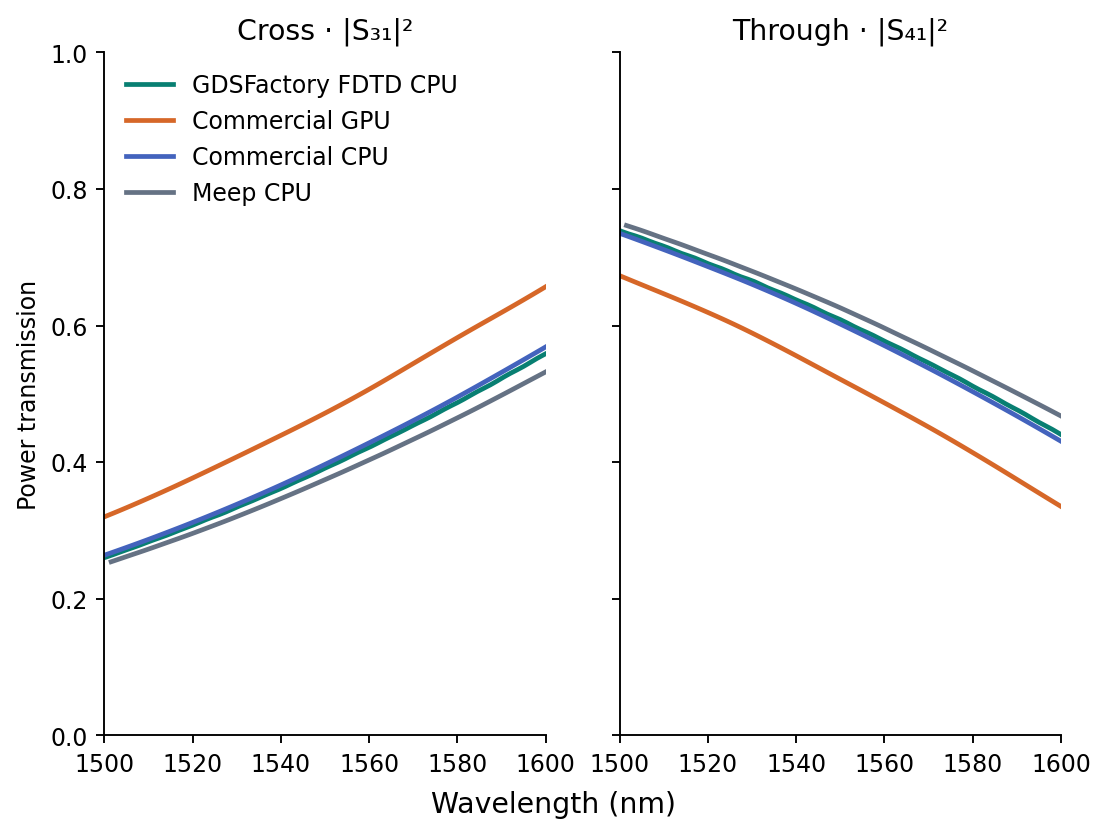
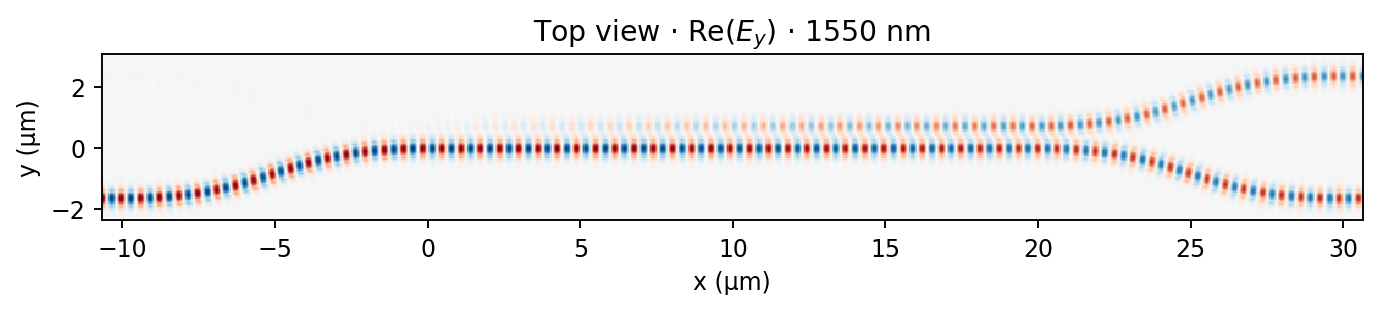
Close agreement with the commercial CPU result. At 1550 nm, GDSFactory predicts 39.1% cross transmission and 60.9% through transmission, each within 0.7 percentage points of the commercial CPU result. The plots show the full 1500–1600 nm response for all four solvers at 40 nm nominal cell size.
Throughput
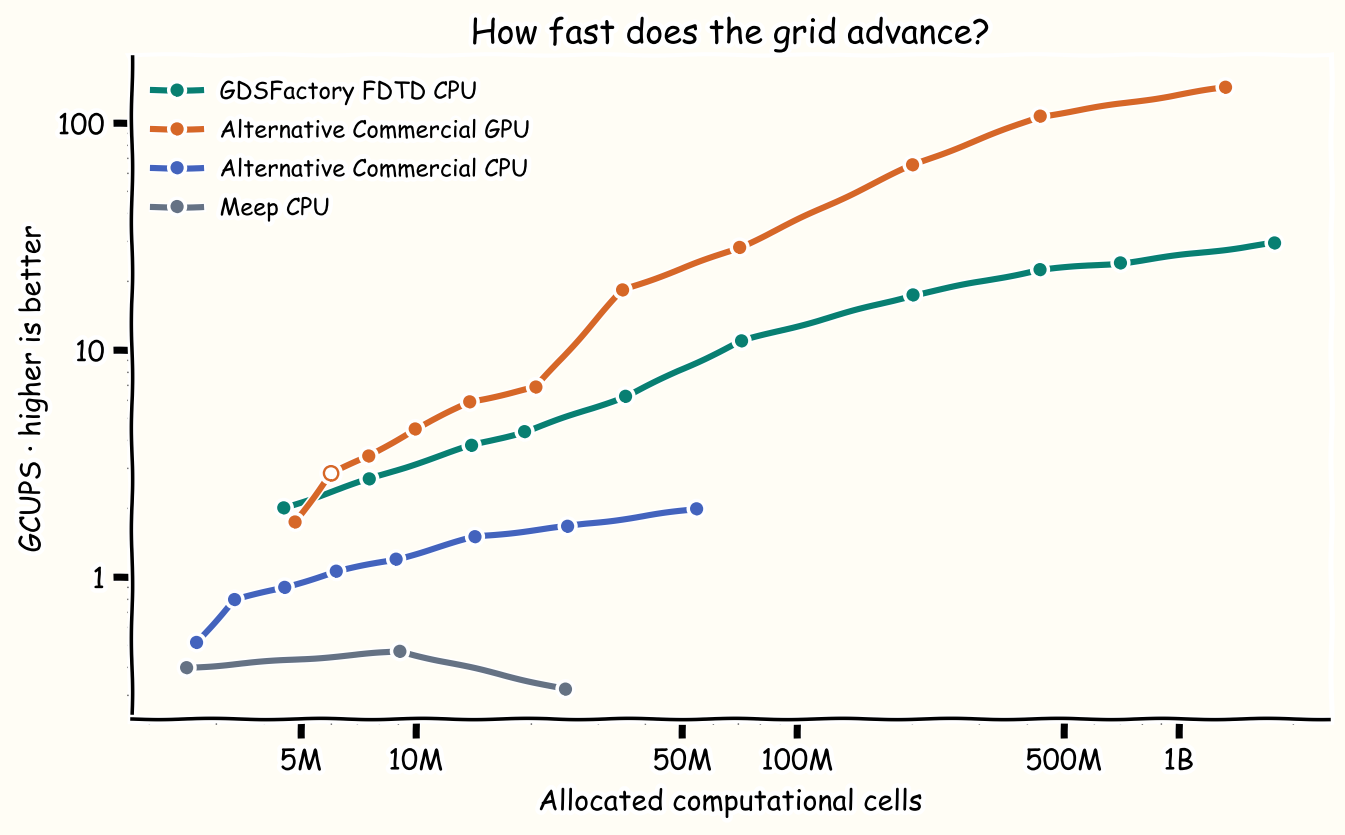
High throughput on CPUs. GDSFactory FDTD reaches 29.5 GCUPS on the largest measured grid. Compare how throughput changes as the simulation grows from millions to billions of cells.
What is GCUPS?
GCUPS means giga cell updates per second: billions of simulation cells advanced by one timestep, every second.
GCUPS = cells × timesteps / (seconds × 10⁹)
Higher throughput means more grid updates per second. One GCUPS-hour is 3.6 trillion cell updates.
CPU scalability
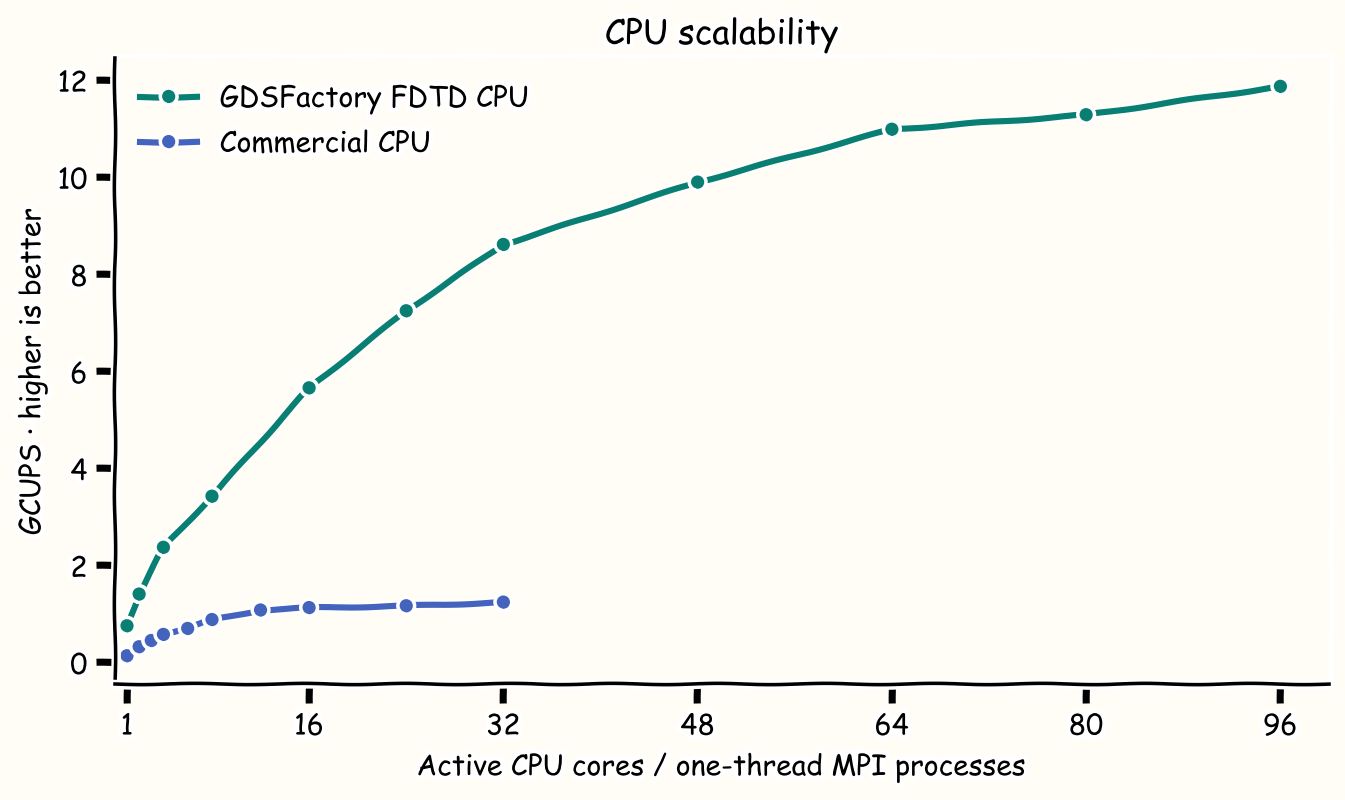
Put more CPU cores to work. See how each solver's throughput changes as more CPU cores are used.
How much does it cost?
$1.95 per run for this directional coupler, including the allocated annual subscription and usage charges. The table compares the cost of a run; the chart below shows the cost per GCUPS-hour as simulation size increases.
Cost of the directional-coupler run
| Solver | Recorded runtime | Customer cost / run |
|---|---|---|
| GDSFactory FDTD CPU | 75 s | $1.95 |
| Commercial GPU | 31.2 s | $4.90 |
| Commercial CPU | 221.4 s | $4.36 |
| Meep CPU · self-managed | 1,239.3 s | $0.67 |
Meep uses self-managed compute without a solver license fee.
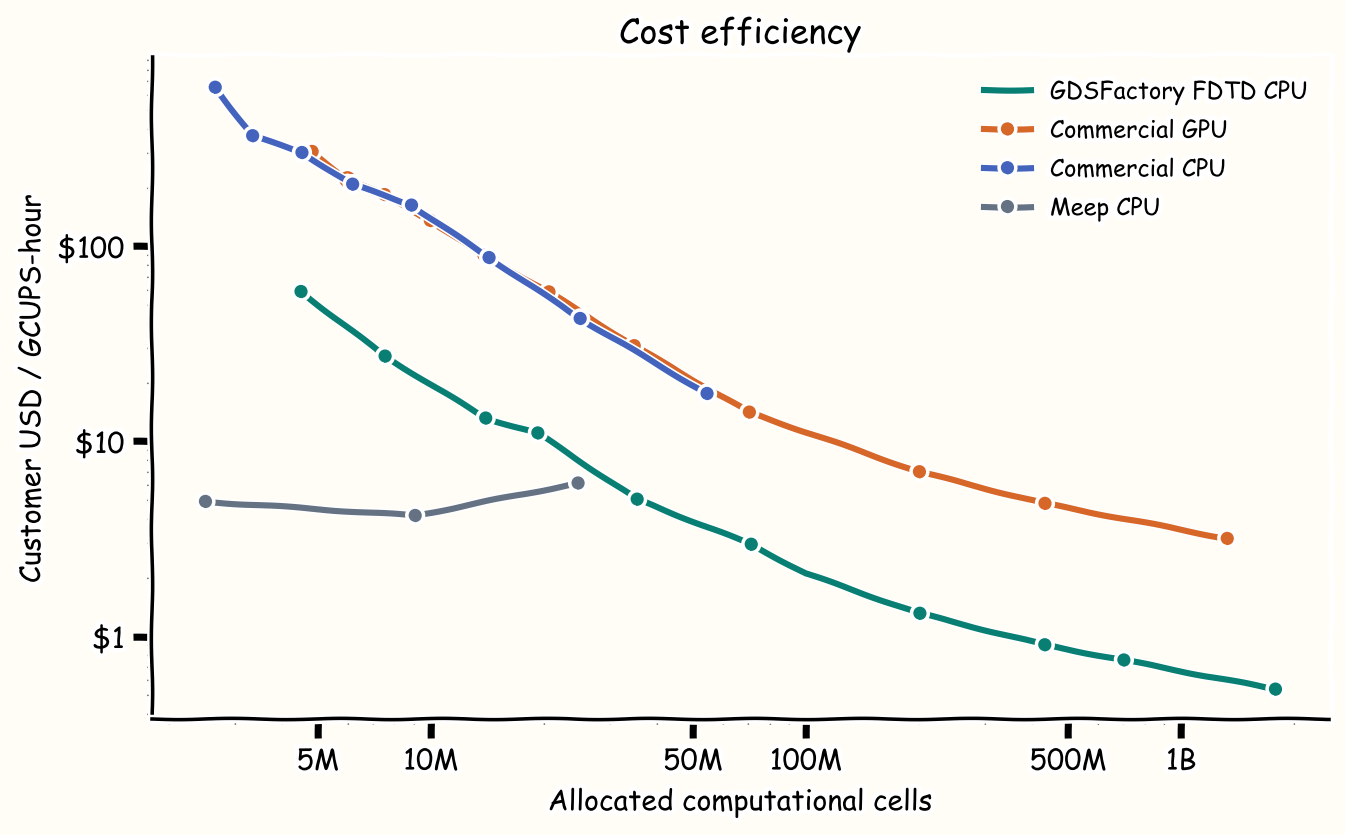
Lower dollars per GCUPS-hour means more grid updates for the same budget. Above 100M cells, the GDSFactory curve illustrates a hypothetical cost scenario following the commercial GPU trend. Values through 100M cells use the benchmark's customer rates.
Alternative commercial offerings combine annual subscriptions with pay-as-you-go usage rates, similarly to GDSFactory+.
Try it on your next design
Use these notebooks as a starting point for your own photonic layouts.